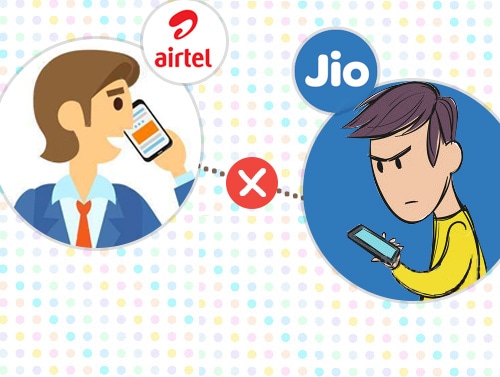
Reliance Jio Infocomm has informed that over 1.6 crore calls are still failing every day between Bharti Airtel and Jio.
The company also said that there are no call failures in Jio-to-Jio calls and the reason for call failure is insufficient point of interconnect (PoI).
Reliance Jio denies that there has been any delay at its end in operationalising the E1s from Bharti Airtel. On the contrary, RJIL has been consistently following-up with Airtel and the other incumbent operators over the last several months for augmentation of interconnection capacity.
These requests had been denied by Airtel and the other incumbent operators as part of their anti-competitive strategy and in complete breach of their license conditions. This has resulted in unprecedented call failures between Airtel and RJIL in complete disregard of the quality of service (QoS) norms stipulated by TRAI and has caused severe hardships to Indian customers.
RJIL has been completely ready to accept any augmentation of PoIs from Airtel and other incumbent operators. As against allegation of under-preparedness and insufficient testing teams and efforts, reality is that work has not been held up at RJIL’s end even briefly. Transmission media of RJIL has been ready and operational for several months now.
Airtel has itself said that inspite of the several QoS and congestion issues, it has provisioned capacity in 10 days against their entitlement of 90 days. It may be noted that 10 days is too long given the current QoS parameters. Furthermore, there is no entitlement of timing when it comes to such severe breach of QoS as against the 90 days sought by Airtel.
Airtel's contention that the congestion has been caused by large-scale subscriber acquisition by RJIL is not only unreasonable but also anti-competitive.
With regard to the traffic asymmetry issue, the current traffic pattern is completely in line with what is expected in a new network. It would tend to move towards balanced traffic as the network matures and has sufficient scale.