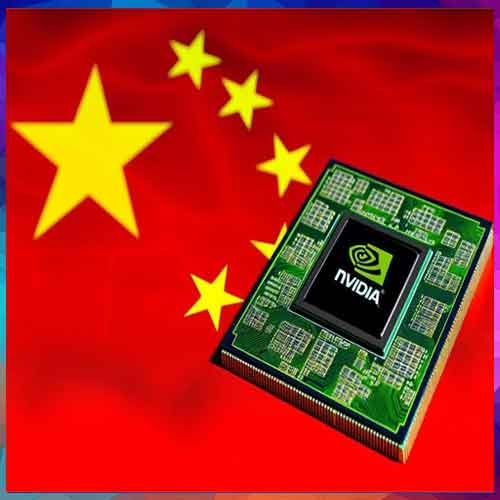
Chinese companies are reportedly building a massive data center in Xinjiang’s Yiwu County, planning to deploy 115,000 AI chips to train large language models, leveraging abundant energy resources from the Gobi Desert region
Nvidia may see renewed investor interest amid reports that Chinese companies are planning to deploy tens of thousands of its artificial intelligence (AI) chips across a vast data center complex in western China. According to a Bloomberg report citing investment approvals, tenders, and company filings, data center operators in Xinjiang are planning to install approximately 115,000 high-performance computing (HPC) chips in a single compound currently under construction.
Located in Yiwu County on the edge of the Gobi Desert, the site offers strategic energy advantages, with access to both renewable sources and coal. The project reportedly aims to build the computational infrastructure required to train large language models (LLMs), similar to those developed by Chinese AI startup DeepSeek. The company’s first reasoning models, introduced in January, sparked notable volatility in U.S. AI stocks.
Geopolitics, chips, and opportunity
While the scale of the proposed data center is unprecedented within China, it remains smaller compared to similar infrastructure in the United States. Still, the initiative could represent a significant opportunity for Nvidia, whose stock is trading just below its all-time high of $160.98. Nvidia is currently the most valuable publicly traded company in the world.
However, the reported plans could trigger geopolitical concerns. The U.S. government has imposed strict export controls aimed at limiting China’s access to advanced AI chips, including Nvidia’s top-tier processors. To comply, U.S. chipmakers have been offering downgraded versions specifically designed to meet regulatory thresholds.
Bloomberg’s findings suggest that the scale of the Xinjiang project has largely flown under Washington’s radar, raising questions about potential gaps in monitoring and enforcement. The report did not find evidence that China has already secured or stockpiled the full volume of restricted Nvidia chips. However, it highlighted the existence of complex procurement networks that may be facilitating access to limited quantities.
The development aligns with China’s broader goal of technological self-sufficiency. Backed by the Xi Jinping administration, domestic firms are accelerating efforts to build homegrown AI capabilities, even as global tensions around semiconductors and strategic technologies continue to intensify.