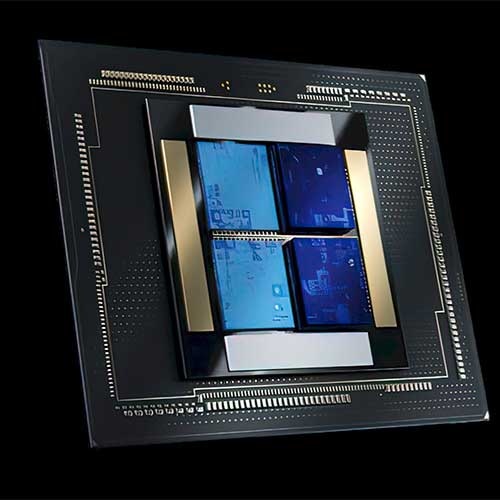
Intel has officially canceled its Falcon Shores AI GPU project, marking a strategic shift in its approach to AI acceleration. Initially planned as a next-generation hybrid AI accelerator, Falcon Shores was set to replace Intel’s Gaudi 3 AI accelerator. However, the company has now shelved the project, opting to use it only as an internal test chip, with no plans for commercial release. This move reshapes Intel’s AI roadmap, raising questions about its competitive positioning against industry giants NVIDIA and AMD.
Intel has decided to discontinue the commercial release of its Falcon Shores AI processor, which was developed using technology from Israeli AI chip company Habana Labs. Instead, the processor will be repurposed for internal testing, marking a strategic shift as Intel struggles to keep pace in the rapidly evolving AI hardware market.
Announced in 2022, Falcon Shores was designed to merge CPU and GPU architectures, delivering high-performance AI processing for data centers, machine learning, and high-performance computing (HPC). It was expected to compete with NVIDIA’s H100 and AMD’s MI300 series, boasting superior compute density, energy efficiency, and memory bandwidth. The cancellation of Falcon Shores signals a strategic reallocation of Intel’s AI development focus.
One major factor is the fierce competition in the AI chip market. NVIDIA dominates with its H100 and upcoming B100 GPUs, while AMD’s MI300X is gaining traction. Instead of developing a completely new GPU architecture, Intel appears to be doubling down on Gaudi 3, a more immediate competitor to existing AI accelerators.
Additionally, resource allocation played a role in this decision. Developing cutting-edge AI GPUs requires substantial R&D investment. Rather than diverting resources to a hybrid XPU, Intel is focusing on optimizing Gaudi 3 and enhancing Xeon processors with AI acceleration capabilities. This approach allows for faster market adaptation with a more defined AI strategy.
Despite canceling Falcon Shores, Intel remains committed to AI innovation. It is prioritizing the Gaudi 3 AI accelerator, which is expected to compete directly with NVIDIA’s AI GPUs in deep learning applications. Additionally, Intel is integrating AI-focused enhancements into its Xeon processors, leveraging Advanced Matrix Extensions (AMX) to improve enterprise AI performance.
Beyond hardware, Intel is investing in AI software ecosystems. The company is focusing on open-source AI development, aiming to create a competitive alternative to NVIDIA’s CUDA and AMD’s ROCm frameworks. Establishing a robust AI software infrastructure is crucial for Intel’s long-term AI ambitions.
Intel’s decision underscores a broader trend in AI computing—the growing preference for specialized AI accelerators over hybrid solutions. With NVIDIA and AMD leading AI chip advancements, Intel’s revised AI focus reflects its strategy to stay relevant in the rapidly evolving AI landscape. By prioritizing Gaudi 3 and enhancing its AI software ecosystem, Intel aims to solidify its position in the AI sector while reassessing its future AI innovations.
While the cancellation of Falcon Shores signals a setback for Intel’s next-gen AI ambitions, it also marks a pragmatic shift toward more competitive AI offerings. The success of Gaudi AI accelerators, Xeon AI integrations, and Intel’s software advancements will ultimately determine its standing in the AI-driven computing era.