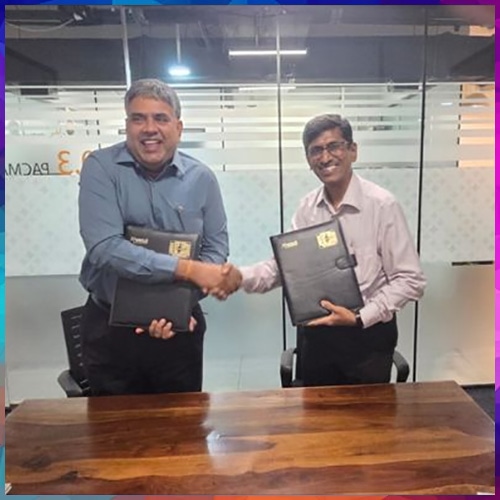
Aheesa Digital Innovations, a DLI-scheme backed fabless semiconductor has signed a Memorandum of Understanding (MoU) with Optilink Networks Pvt. Ltd., onboarding the company as its packaging partner for VIHAAN-I, Aheesa’s indigenous RISC-V broadband networking System-on-Chip (SoC). The partnership marks another step towards commercializing VIHAAN-I, strengthening the pathway from indigenous chip design and silicon validation to packaging, distribution and market deployment.
The partnership brings together two complementary parts of the broadband technology ecosystem. Optilink has supported the VIHAAN-I journey through testing, validation and engineering support, with its in-house capabilities across product design, firmware development and hardware integration. Under the MoU, Optilink will support end-to-end product development from prototyping to packaging, while the companies work towards developing, qualifying and commercialising ONT/CPE products based on the VIHAAN-I chipset. The collaboration is aimed at delivering solutions that are cost-efficient and comply with Indian and global standards, while accelerating commercialisation through Optilink’s engineering and manufacturing expertise.
This further advances Aheesa’s ambition to establish itself as a semiconductor design house with a portfolio of Indian-designed chips serving both domestic and global markets. With design, silicon validation, packaging and distribution capabilities progressively coming together, Aheesa is now leaping towards commercial deployment in early 2027.
The partnership comes in a landmark year for Aheesa. VIHAAN-I achieved tape-out on Republic Day 2026, followed by Aheesa securing investment from the Tamil Nadu Infrastructure Fund Management Corporation (TNIFMC) through the Tamil Nadu Emerging Sector Seed Fund. On this Independence Day, the chip achieved first-pass silicon success on its very first attempt.
Commenting on the partnership, Sridharan Mani, Founder and CEO, Aheesa Digital Innovations, said, “Building a chip is only half the journey as the real test is turning that silicon into a product people can use. No semiconductor ecosystem thrives on the strength of one player alone; it takes multiple partners, each doing their part, to carry a design to the consumer and make this sector succeed. With Optilink joining us for packaging, VIHAAN-I takes a step closer to that reality. We have spent years estabilishing that world-class semiconductor design can happen in India. Now with Optilink, we're building the pathway to take it from systems to scale.”
Devchand Haria, Managing Director, Optilink Networks Pvt. Ltd said, “At Optilink, we've spent close to two decades building the networking hardware that connects Indian homes from fiber access to broadband CPE. Partnering with Aheesa for VIHAAN-I lets us bring that same experience to an Indian-designed chip, taking it from silicon to the products that will actually sit in Indian households. This is exactly the kind of collaboration our sector needs, that is Indian design and Indian manufacturing expertise working together to put homegrown silicon inside the devices people use every day.”
Founded in 2005 and headquartered in Mumbai, Optilink Networks Pvt. Ltd. is an Indian Original Equipment Manufacturer (OEM) that designs, manufactures and distributes IP-based networking hardware, Fiber-to-the-Home (FTTH) solutions and IP Television (IPTV) technologies. Serving ISPs, telecom operators, cable and MSO networks, enterprises and government customers, Optilink has built a strong B2B presence through its channel partners, distributors and system integrators across India.
Aheesa's work spans indigenous semiconductor and networking technologies across telecom, broadband, cybersecurity and edge computing. This partnership now reflects the wider momentum in India's semiconductor design ecosystem, now scaling under Semicon 2.0 — the ₹1,27,500 crore programme approved in July 2026 to build a globally competitive supply chain across chip design, manufacturing, packaging and materials. As indigenous designs move from validation towards commercial adoption, it is partnerships like this, pairing Indian chip design with the reach to deploy it, that will help define how homegrown silicon scales.