
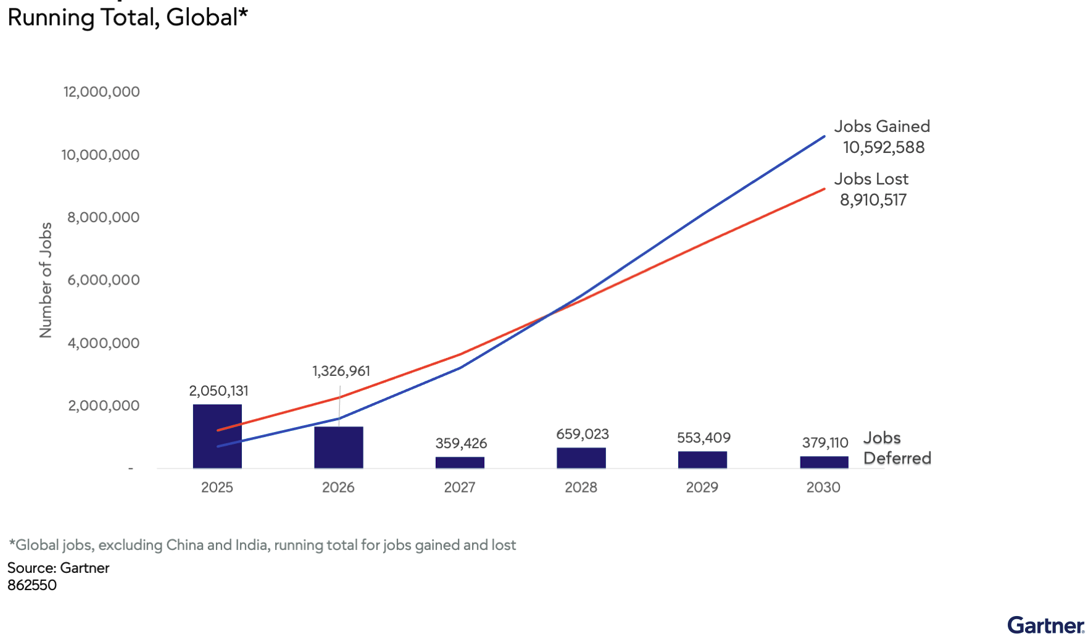
Gartner projects AI will create 10.6 million jobs and eliminate 8.9 million worldwide by 2030, while reshaping work for 435.5 million employees and prompting employers to defer hiring across industries as workforce needs continue evolving.
Artificial intelligence is expected to generate more jobs than it eliminates worldwide by 2030, resulting in a net increase of 1.7 million positions, according to Gartner. The research firm forecasts that AI will create 10.6 million jobs while removing 8.9 million over the period.
The findings, released in Barcelona on November 12, also point to changes within existing roles. Gartner expects just over 20% of workers, representing 435.5 million employees worldwide, to adapt to changes in their tasks, working methods and responsibilities through 2030.
Helen Poitevin, Distinguished VP Analyst at Gartner, said: “Organizations most advanced in AI execution view AI not as a replacement for labor, but as a catalyst to reinvent operations and rebalance workforce and technology capabilities to compete in changing markets. They ensure AI's economic value goes beyond replacing labor.”
Deferred hiring adds to workforce changes
Gartner identified deferred hiring as a significant effect of AI on the labour market in 2026. Business executives postponed the creation and hiring of 1.3 million positions during the year, alongside 2.2 million jobs lost and 1.6 million jobs gained.
By 2030, Gartner expects a total of five million people to have experienced delayed hiring as business and IT executives postpone creating new positions.
“Deferred jobs are not the same as lost jobs. They simply aren’t created,” said John Lovelock, Distinguished VP Analyst, Chief of Research at Gartner.
Impact varies across industries and roles
Gartner projects that between 0.4% and 1.8% of workers will experience job losses directly attributable to AI by 2030. However, it cautioned that the effects will differ across industries, functions and geographies.
“AI job impacts are unevenly distributed across geographies, job functions and industries. The worst mistake that a business and IT executive can make is to apply lessons from one industry or role to another which can lead to poor errors in judgment and missed targets,” said Poitevin. “Each industry faces unique challenges and risks that executive leaders must understand and address.”
Technology sector expected to record job growth
In asset-intensive industries, which involve physical products or services delivered through capital-intensive infrastructure, Gartner forecasts 6.4 million jobs created and six million lost by 2030.
The public sector is expected to record 400,000 job gains and 900,000 job losses. Gartner said AI investment in the sector is unlikely to be sufficient to offset severe future skills shortages driven by other factors.
The technology sector, where nearly 70% of the workforce has high exposure to AI, is forecast to generate 1.9 million jobs and lose 400,000 positions by 2030.
The findings are detailed in Gartner’s report, AI Won’t Cause a Jobs Apocalypse, but Will Unleash Job Chaos Through 2030.