
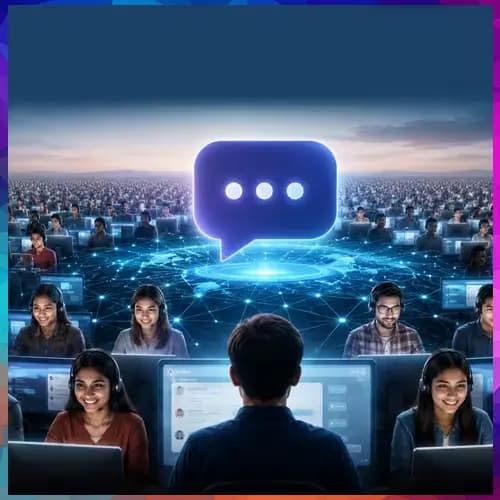
Created as an art experiment, the human-powered chatbot is challenging conventional AI interactions by replacing automated responses with personal replies, sparking conversations about technology, independent thinking and the value of human connection.
The chatbot boom has produced another unusual entrant, but this one does not rely on an artificial intelligence model. ChatTJB, an experimental service created by San Francisco artist and former Google employee Tucker Bryant, resembles a conventional AI chatbot while putting an actual person behind every response. Bryant personally reads incoming questions and replies to them, turning the familiar chatbot format into a deliberately human experience.
The project’s name is part of the joke. Promotional material describes ChatTJB as being powered by “AI”, but the acronym refers to “average individual”, rather than artificial intelligence. The service was launched in April as an art project examining the increasingly routine role AI tools play in answering everyday questions. Its interface and presentation intentionally resemble those of sophisticated AI products, while the response process is considerably slower because every query depends on one person being available to answer it.
One person behind thousands of questions
Users can ask ChatTJB ordinary questions about cooking, clothing, meals or other everyday decisions, with Bryant providing the responses himself. Even creative requests can involve manual work. For example, a request for an image may result in Bryant drawing something himself instead of generating it through an AI image model.
The website humorously describes the service as “artisanal intelligence” created by one human, presenting itself as a “single-operator large language experience”. The concept plays on the terminology surrounding AI while deliberately stripping away the automation that normally powers modern chatbots.
For several months, ChatTJB remained relatively obscure. That changed after Bryant spent around $6,000 on a billboard in San Francisco on July 27 to advertise the project. Images of the billboard circulated widely online, driving a sharp increase in visitors and questions. Bryant has reportedly received more than 30,000 queries, while demand at one point reached roughly 5,000 requests an hour.
The unexpected attention created a problem that no conventional chatbot would face: its sole operator could not physically answer questions fast enough. The website also came under pressure from the sudden increase in traffic.
Viral experiment questions AI dependence
The popularity has since prompted Bryant to broaden the experiment. About 10 volunteers have reportedly joined the project to help manage incoming questions, while Bryant is considering developing ChatTJB into a larger, community-supported initiative.
Despite its humorous premise, Bryant says the project is not intended simply as an attack on AI. Instead, it is designed to make users reconsider how quickly they have begun turning to automated systems for decisions and advice that they once handled independently.
The experiment also appears to highlight a different quality of human interaction. Bryant observed that once users understood that an actual person was reading their questions, conversations often became more open and personal.
What began as a temporary artistic experiment has therefore evolved into a broader commentary on the relationship between people and AI. By deliberately replacing instant machine-generated answers with delayed human responses, ChatTJB is prompting users to consider not only what AI can do, but also what may be lost when human judgment and interaction are routinely replaced by automation.