

As cyberattacks become increasingly sophisticated, organisations must understand the fundamental difference between cyber threats and cyber vulnerabilities. While threats represent potential sources of harm, vulnerabilities are exploitable weaknesses within systems, applications, networks, and security architectures.
Cyber threats originate from multiple sources, including criminal organisations, state-sponsored attackers, and malicious insiders. Their tactics range from social engineering and credential abuse to complex exploit chains designed to compromise sensitive information and disrupt business operations.
Threat intelligence plays a crucial role in identifying emerging attack patterns. Indicators of Compromise (IOCs), adversary Tactics, Techniques and Procedures (TTPs), campaign intelligence, and target-specific signals help security teams anticipate potential attacks before they escalate.
Meanwhile, cyber vulnerabilities arise from coding defects, configuration errors, and architectural weaknesses. Their severity depends not only on technical flaws but also on internet exposure, privileged access pathways, and the business criticality of affected assets.
Modern vulnerability management increasingly relies on CVSS severity scores, Known Exploited Vulnerabilities (KEV) intelligence, and Exploit Prediction Scoring System (EPSS) to prioritise remediation. This risk-based approach helps organisations address the most exploitable and business-critical weaknesses first.
Today's threat landscape is further complicated by ransomware, identity abuse, and software supply-chain attacks. Artificial intelligence is also enabling attackers to automate reconnaissance, generate convincing phishing messages, and develop sophisticated impersonation techniques, increasing pressure on traditional security controls.
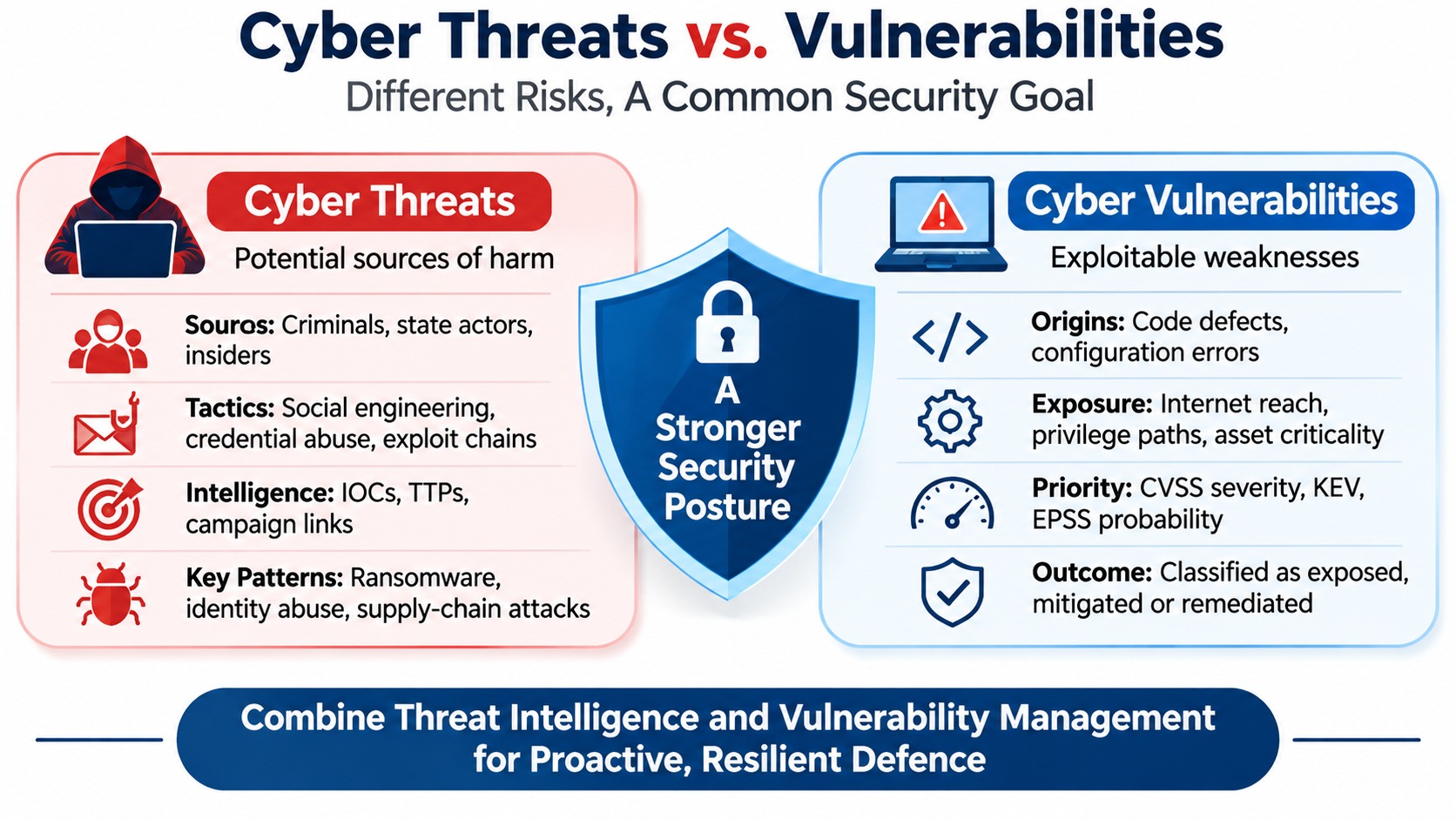
Threat-informed defence and vulnerability assurance must work together. Intelligence fusion, detection engineering, and incident-response exercises strengthen threat preparedness, while comprehensive asset visibility, risk-based triage, and remediation validation reduce exploitable weaknesses. Vulnerabilities must be continuously classified as exposed, mitigated, or remediated.
Ultimately, cybersecurity must shift from reactive protection to intelligence-driven resilience. Organisations need continuous monitoring, AI-powered threat detection, proactive vulnerability management, and validated response capabilities. The future belongs to enterprises that can connect threat intelligence with real-world exposure, minimise attack surfaces, and build measurable digital trust.