CrowdStrike’s reported $43.9 billion acquisition of Zscaler signals a significant transformation in the global cybersecurity landscape, as vendors consolidate capabilities across traditionally fragmented security environments.
Leading cybersecurity companies, including Palo Alto Networks, Cisco, Okta and Check Point, are increasingly expanding their capabilities through strategic acquisitions and platform integration.
Major cyber security acquisitions announced or closed between Nov 2025 and Nov 2026
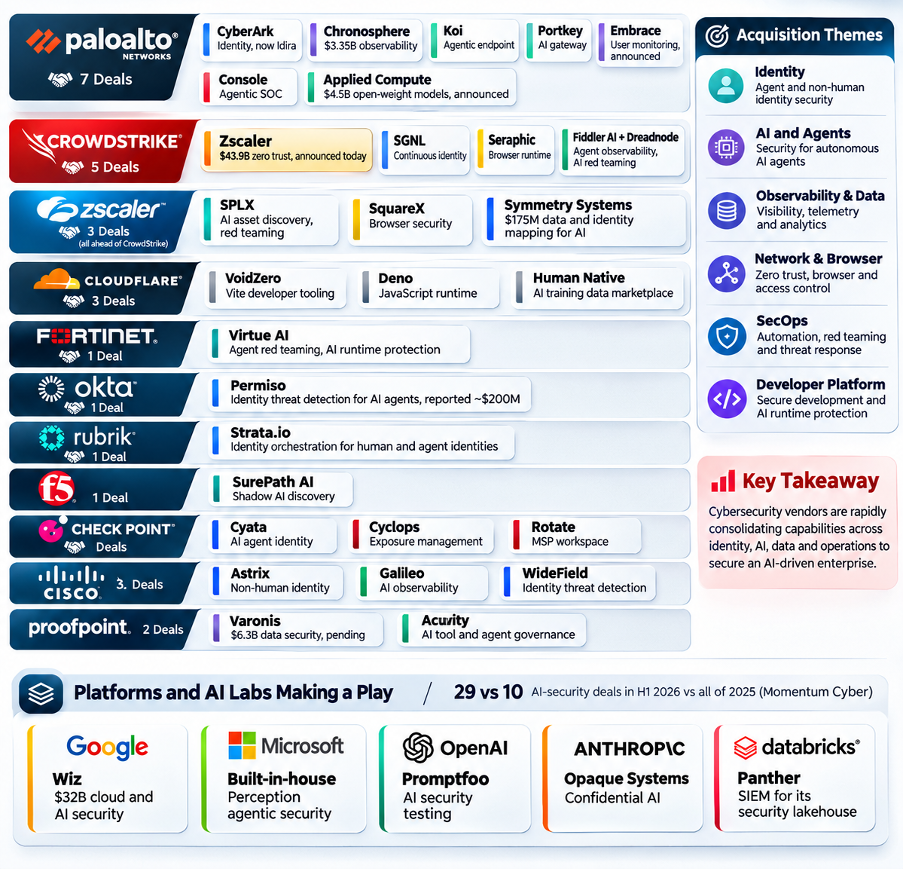
These acquisitions reflect a broader industry shift towards identity security, observability, AI discovery, red-teaming and intelligent security controls across enterprise infrastructure.
The emerging challenge is securing an increasingly autonomous digital ecosystem where AI agents can access sensitive information, execute transactions and modify enterprise systems.
While integrated cybersecurity platforms can provide greater visibility into these activities, visibility alone cannot establish whether an autonomous action was legitimately authorized.
Enterprises must therefore establish clear governance frameworks defining what AI agents can access, execute, modify and communicate on behalf of the organization.
Identity security is becoming increasingly critical as organizations must discover, authenticate and manage both human and non-human identities operating across interconnected systems.
Observability represents another essential capability, enabling security teams to trace agent activities, reconstruct decisions and establish accountability across complex enterprise environments.
AI discovery and security testing are equally important for identifying unauthorized agents, evaluating vulnerabilities and validating security boundaries before enterprise deployment.
According to AI Security Lab, an analysis of more than 30 cybersecurity acquisitions over twelve months suggests these transactions primarily address three of twelve identified AI security capabilities.
This assessment highlights the potential gaps between expanding cybersecurity platforms and comprehensive enterprise AI governance requirements.
Organizations must complement conventional cybersecurity with continuous authentication, behavioral intelligence, agent authorization, data privacy controls and real-time risk assessment.
Ultimately, cybersecurity vendors can provide technological capabilities, but enterprises remain responsible for establishing authorization, accountability and risk ownership. The future of cybersecurity is not merely about securing autonomous intelligence, but governing its authority, verifying its actions and establishing digital trust.