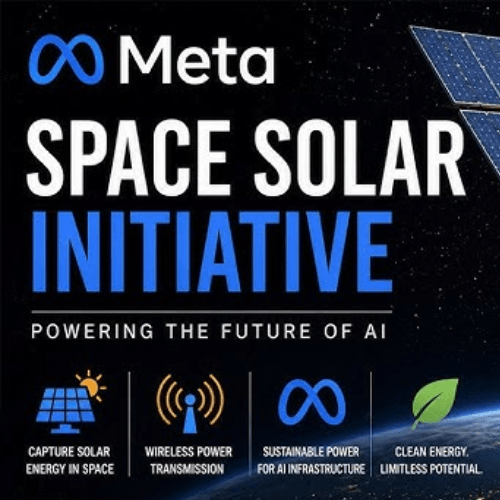
Meta has announced a ground-breaking plan to power its AI data centers using solar energy beamed from space.
By placing satellites in geo-synchronous orbit 22,000 miles above Earth, the Meta aims to harvest near-constant sunlight.
This "orbit-to-grid" system would beam energy to Earth-based collectors using infrared light, bypassing the limitations of night time and weather.
To support this ambitious vision, Meta reserved 1 Gigawatt of capacity from the startup Overview Energy.
The technology effectively turns existing solar farms into 24/7 power plants.
While space-based solar has been a theoretical concept for decades, Meta’s commitment marks a significant move towards commercial deployment to meet exploding AI energy demands.
Addressing the challenge of intermittency, Meta also partnered with Noon Energy for 100 Gigawatt-hours of ultra-long-duration storage.
Using carbon-based storage systems, this technology provides over 100 hours of sustained power.
This ensures that the continuous and massive energy requirements of AI infrastructure are met even during prolonged periods of low renewable generation.
The strategy highlights the immense strain AI is placing on global electrical grids.
Meta, alongside other tech giants, is aggressively diversifying into geo-thermal and nuclear power.
However, space solar offers a unique solution to the 24/7 clean energy puzzle, with initial orbital demonstrations scheduled for 2028 and commercial delivery targeted for 2030.
This initiative follows Meta's broader energy expansion, which includes supporting seven new natural gas plants and contracting over 30 GW of renewable energy.
By combining orbital harvesting with advanced long-duration storage, Meta is attempting to build a resilient, futuristic energy backbone that can sustain the next generation of autonomous intelligence and high-scale computing.