
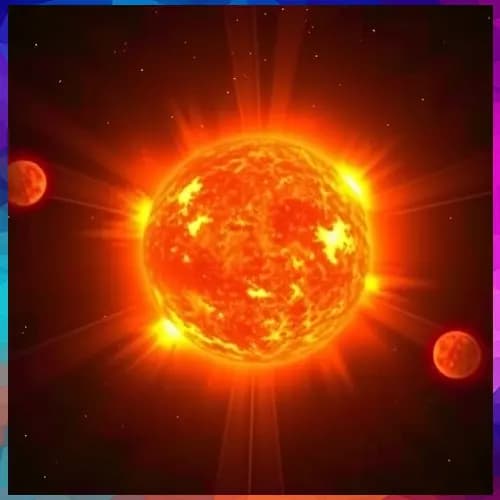
NASA scientists are using artificial intelligence to detect subtle signals beneath the Sun’s surface. This will help potentially give space weather forecasters an earlier warning of regions that can trigger powerful solar flares. The Sun may look relatively calm from Earth, but beneath its surface, enormous magnetic structures are constantly developing. Researchers working with NASA’s COFFIES (Consequence of Fields and Flows in the Interior and Exterior of the Sun) have developed a machine-learning model that can predict the emergence of these active regions up to 12 hours.
The research could offer a new way to improve space weather forecasting, an increasingly important task as astronauts travel farther from Earth and modern technology remains vulnerable to solar activity.
While Scientists cannot directly observe a magnetic structure while it is still moving through the Sun's interior, they instead look for subtle changes that may reveal what is happening below the surface.
The COFFIES team analysed observations from NASA's Solar Dynamics Observatory and used supercomputing resources at NASA's Ames Research Center. The researchers focused on tiny changes in acoustic waves and magnetic activity associated with active regions developing beneath the visible surface. (NASA Science)
The AI system uses a specialized sliding-window transformer architecture. Rather than examining solar activity as one enormous dataset, the model studies sections of a long sequence while retaining information about broader patterns. This allows it to identify small changes that may otherwise be difficult to distinguish from the Sun's constant background activity.
Alexander Kosovichev, a COFFIES co-investigator at the New Jersey Institute of Technology, described the signal as similar to a subtle change in rhythm within a very noisy orchestra.