On finding the information searched on the Internet, there are three possible ways of recording it. The first is you save the link go back to that every now and then; the second is you start writing (copying) it word by word on a notebook; and the third is "right-click" and choose the option "print". These days, we see people preferring the third option more. With the digitization of content, opportunities for printer vendors have increased.
Evolved Printing needs in Offices
Printers are routinely classified by the printer technology they employ. The choice of engine has a substantial effect on what job that printer is suitable for, as different technologies are capable of different levels of image or text quality, print speed, cost, and noise. Some printer technologies are even media specific. The popular printing technologies found in modern printers are toner-based printers that include Laser and LED printers and Liquid inkjet printers that comprise of Inkjet printers. There are other categories of printers too, but we would not be discussing them here as they are not so commonly seen in any corporate or office environment. And, the focus of my story is printers and trends like MPS suiting various business sizes.
The days when printers were devices that merely copied other pages and printed electronic documents are long gone. With the coming of networked PCs, printer vendors are seen offering increasingly sophisticated management software to go with their machines. Not only this, with the BYOD (Bring Your own Device) fashion in office culture creeping in, printer vendors are answering demand and providing connections from mobile devices to their printers.
K. Bhaskar, Sr. Director, Office Imaging Solutions, Canon India, says, "Ongoing advancement in the field of technology has resulted in the evolution of state-of-the art multifunction devices which are capable of facilitating several tasks and it is this device which is gaining a significant momentum in the market. An array of factors including high content generation, enterprise mobility and the huge PC base in India basically propels the market forward. An ongoing tendency to adopt multifunction devices, cloud printing, green printing and managed printing services is on the rise in India. Currently, standalone A3 MFDs contribute to almost 75% of outright sales, and MPS contributes to around 25% which is expected to grow with more organizations becoming aware about the benefits of managed print services."
MPS
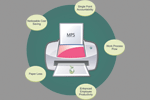
Managed Print Services (MPS) is the active management and optimization of document output devices and related business processes. What is important to note is the nature of MPS which is essentially the accurate monitoring of print resources, and without clearly defined reporting and analysis, these values cannot be instilled. The concept of MPS is evolving every day since more and more companies are becoming aware of their contribution towards a better environment. Organization must undertake MPS as part of their strategy to lower costs, manage complexity and reduce the risks associated with unmanaged multi-vendor environments. Unmanaged print environments represent a huge cost drain and are characterized by fragmented ownership, device sprawl and a mix of old and new technology. This results in poor visibility and control over what is printed, leading to excessive consumption of paper, toner and ink. MPS rationalizes the print environment by minimizing device proliferation through reducing user-to-device ratios. This simplifies management tasks, provides economies of scale in respect to managing supplies and maximizes business uptime through proactive monitoring.
MPS has gained momentum in the last one-two years in India as enterprises have started transitioning from Capex to Opex business mode of printing. Enterprises in India have been using MPS to identify waste and reduce costs related to printing and the expertise is now available to businesses of all sizes The overall market estimation of MPS in India estimated to be around 250 million dollars in 2009 which is expected to grow to US$300 billion by 2015 (source BCG), this is when Canon entered the market.
Worldwide Ricoh has been in MPS/MDS for nearly a decade in various forms. Since then, it has changed its definition, form, and offerings and is still evolving. "MPS is a services model, based on a strong and fast emerging concept, to address the needs of complex business environments. The need for MPS is really dependant on the organisation's needs to change," shares Rajiv Bhatia, COO - Core Business Group, Ricoh India.
MPS is witnessing huge demand from the enterprise customers and the traction is expected to multiply manifold in the years to come. According to the Photizo Group, India is the fastest-growing market for MPS in APAC with a CAGR of 20 per cent from 2009 till 2014. Yet another interesting study by AMI Partners states that about 18 per cent of the total printing business from SMBs in India comes from MPS. By 2015, almost 60 per cent of the printing business will transform into MPS.
Kyocera group manufactures and markets a comprehensive range of monochrome and colour network printers and digital copiers/MFPs, as well as a range of wide-format imaging systems has recently entered the MPS line of Business. Dilip Kanth, Sr. Vice-President – Sales & Marketing, Kyocera Document Solutions India Pvt. Ltd., informs, "The contribution of MPS in the total turnover currently would be only 1%, but we see a comprehensive expansion in this fiscal year."
A recent report on MPS by Forrester warns that enterprises still are purchasing devices from multiple sources and under different budgets, and as a result, will struggle to meet emerging print reduction and sustainability goals if they do not adopt a pan-enterprise MPS strategy.
Relevance of MPS
With the changing technology, MPS not only caters to specific segments but also to a group of small and large enterprises. There is increasing awareness about the MPS market in India as outsourcing as a service model matures and early adopters demonstrate benefits. The momentum is currently evident in the large enterprises, but the vibrancy in the market with the entry of more players offering MPS is slowly but surely permeating to other segments, including the medium and small enterprises. MPS is bound to witness impressive growth in the next 18 months as its compelling business benefits along with enhanced service standards attract enterprises of all sizes.
"SMBs spend up to 2% of revenues on running printers, copiers, scanners and fax machines & devices which are often energy inefficient. A document process optimization strategy can reduce this expenditure by as much as 15-25% while also decreasing energy consumed and waste generated," informs Vishal Awal, Executive Director, Services, Xerox South Asia.
With imaging and printing environment becoming critical in every organization, MPS is no longer restricted to a select few customers. "HP offers end-to-end services to the enterprise customers through our MPS model for the enterprise and has sensed the need of MPS even for the mid- market and SMB customers. They are fast evolving and are demanding the same sophisticated products, services and solutions which were until now only limited to the enterprise customers. Through our Partner-led MPS offering for SMBs, we are promoting MPS adoption in the SMBs," shares Nitin Hiranandani, Director -Printing Systems, PPS, HP India.
Today, organizations feel that high-paid staff spend precious time on simple printer issues and endless hours are lost dealing with different suppliers and vendors. To this, Vishal Awal adds, "Additionally, the employee productivity can be enhanced due to efficient management of print operations and via innovative features like mobile/ cloud printing."
 |  |  | ||
| K.Bhaskar Sr.Director,Office Imaging Solutions Canon India | Nitin Hiranandani Director-Printing Systems,PPS HP India | Vishal Awal Executive Director-Services,Xerox South Asia | ||
 |  | |||
| Dilip Kanth Sr. VP-Sales & Marketing Kyocera Document Solutions India | Rajiv Bhatia COO - Core Business Group Ricoh India |
Retailing Vs Leasing
Almost all vendors agree that both retailing and leasing are different concepts altogether. Hence, they both can't be compared per se. Whether it is selling a printer to the home consumer or MPS offering which includes the end-to-end outsourcing of the workflow including hardware, solutions, services, supplies and consumables, each model means customer satisfaction. To give an example, Laserjet series of HP moves up to the enterprise series which are printers and MFDs with higher capabilities including fascinating soft wares and solutions supported by the series. The enterprise printers are primarily deployed in enterprises and mid-market segment, which is also available through MPS offerings too.
"Technology & Managing technology are different things. MPS is essentially a competitive services model and thus, MPS has a bright future, in spite of availability of many affordable printing technologies,"adds Rajiv.
Manufacturers will continue to develop and enhance MPS tools and support for resellers. In a highly commoditised market, where margins are thin, resellers cannot afford to ignore the potential for additional revenue that MPS offers along with the potential for longer-term customer relationships. The challenge that remains for all vendors trying to deliver MPS through channel partners is training resellers to move to a solutions and services-led model.
Canon's presence in the channel is, of course, through distribution which contributes 50% of the business. "But we also have System integration and Enterprise sales that contribute to the remaining 50% of our total sales," shared K Bhaskar.
Players like HP who had been in the market offering MPS solutions for the past five years have identified partners from their existing HP IT VARs and new ones. "Our focus is to have partners with a robust service and sales infrastructure, preferably with presence in multiple cities with the mindset to invest in managed print services as a business model. We are supporting them with customer assessment services of their print infrastructure, Financial and Procurement Services through HPFS, helping them with management and Support Services (includes traditional break-fix and ink/toner supplies replenishment and management of devices) and offering document and Workflow Solutions, wherever required," added Nitin Hiranandani.
There are two models for partners to choose from based on their competency or suitability. They might want to adopt a model to provide supplies, while the customer owns the hardware. They also have the option to buy the hardware on behalf of the customer and offer it on lease. Though Kyocera in the first phase has decided to push the MPS business through their direct sales team as its sales require a decent level of technical knowledge and need investment which would be recovered during a given period of time. "But, going forward, we would also start pushing MPS through our channel partners," added Dilip Kanth.
Good days for everyone!
Even with affordable printing technologies hitting the market, still vendors believe managed print services still hold a very bright future. According to a report by Springboard Research, the MPS market in the Asia-Pacific (excluding Japan) region is estimated to grow to $1 billion by 2012. The report also shows that the Indian market is expected to be the fastest-growing market in the region, with a CAGR of 22.6%. Though, at the organizations level, a good share of this is getting converted to Managed Print Services (MPS), still potential of home segment and SoHo can't be ruled out.