Data sovereignty, regulatory accountability and technological independence are becoming strategic priorities for Indian enterprises.
Under India's Digital Personal Data Protection (DPDP) Act, 2023, organizations remain accountable for protecting personal data, even when they outsource processing to third-party technology providers, cloud platforms or AI solution vendors.
The fundamental principle is clear: outsourcing technology does not mean outsourcing accountability. A company deploying an AI model or privacy platform must ensure that appropriate safeguards protect the personal data processed through that technology.
This makes the selection of technology partners a critical boardroom decision. For Indian enterprises, adopting Make in India, India-hosted privacy and AI solutions can offer significant advantages in regulatory oversight, data governance, security assurance and operational control.
An indigenous solution provider can offer local technical support, Indian-language consent management, faster incident coordination and greater visibility into where sensitive data is stored, processed and accessed.
More importantly, locally developed technology can reduce dependence on foreign jurisdictions, overseas infrastructure and external technology ecosystems, particularly for banks, financial institutions, government departments and critical infrastructure operators.
Why Indian Enterprises Should Prioritize Make in India Solutions
Section 8(1) of the DPDP Act establishes that a Data Fiduciary remains responsible for compliance even when personal data is processed by an external technology provider. Consequently, choosing a foreign vendor does not transfer the organization's statutory responsibilities.
Make in India providers can offer several strategic advantages:
-
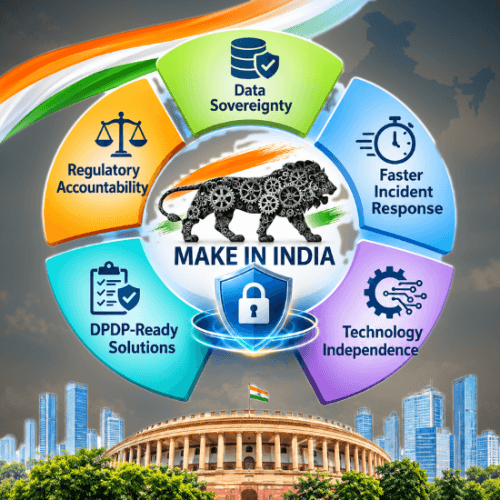
Data sovereignty: Greater control over where personal data, backups, logs and encryption keys are maintained.
-
Regulatory accountability: Indian contractual jurisdiction, local audits and easier coordination with regulators.
-
Faster incident response: Domestic technical teams can facilitate timely breach investigations and reporting.
-
DPDP-focused capabilities: Consent management, data discovery, masking, erasure, grievance handling and audit evidence tailored to Indian requirements.
-
Technology independence: Reduced dependence on foreign platforms and improved control over software supply chains.
The DPDP Rules also emphasize encryption or equivalent safeguards, access controls, monitoring, backups and contractual protections for data processed by vendors. These requirements must be verified regardless of the vendor's nationality.
Importantly, the DPDP Act does not universally prohibit overseas processing or require enterprises to purchase Indian software. An Indian company is not automatically more secure or compliant merely because it is indigenous. Section 16 permits cross-border transfers subject to government restrictions and other applicable laws.
Nevertheless, a genuinely indigenous, independently audited, India-hosted solution can provide a compelling combination of regulatory alignment, operational transparency and technological control.
For India's BFSI sector, government institutions and enterprises managing sensitive personal information, this is more than a procurement preference. It is an opportunity to strengthen national digital resilience while supporting India's indigenous technology ecosystem.
Moving ahead, when the accountability remains with your organization, choose technology that gives you demonstrable control over your data, security and compliance. Make in India should stand for measurable trust, not merely a label.