VENDORS SEE A GREAT POTENTIAL IN PARTNERS TO DRIVE THE INDUSTRY
The 10th Canalys APAC Forum 2022 was a hybrid event organised at its headquarters in Singapore, that witnessed the opportunity for the partners and corporates to understand how the evolving technology and information is critical for creating effective digital transformation. With more than a thousand people attending the event, the summit saw participation from 100+ distributors along with 500+ partners and 200+ OEMs/vendors. Over 100 people from the Indian tech industry were also present at the forum.
The summit discussed how channel partners can be involved in supporting and adding value as the industry transforms through this period of uncertainty. The Canalys Forums provide a platform to network, share, listen, learn and add value to one another. The common challenges faced by the channel in APAC have been supply chain issues and a lack of talent. Talent shortages were ubiquitous in the APAC region and companies in other regions offered strong compensation packages and remote working to hire the top people. It has become a matter of concern as we enter an era of inflation and profit pressures rise for companies.
 Talking about the growing concerns in the APAC, Steve Brazier, President and CEO, Canalys was quoted as saying “The world is not in a great state. There was a war in Ukraine, the trade wars between China and the US political instability in many different countries, interest rates are going up, currencies are turbulent, the price of energy is a problem everywhere, inflation is devastating for many ordinary people and the zero COVID policy in China continues to reduce the capacity of the economy, which is important in driving the world. WiFi is one of the fastest growing categories of technology in the world right now. Internet of Things and edge computing are here along with cybersecurity and cloud. E-vehicles are a major new growth opportunity. E-vehicles are technology on wheels. Gaming continues to strive, education has started to transform during the pandemic and still has a long way to go. The mega trends have not changed. Everything will be digital but also sustainable and needs to be secured. We are in a turbulent time and those opportunities continue to thrive.”
He also addressed the political and trade issues that have affected the industry. He said, “The world is nervous because of these political and trade issues. On the investment front, everybody is expecting a black swan. A black swan is an unpredictable event. That’s why stock markets are gyrating. We can predict through October that the global channel partners will grow over 10% this year. In some countries, for example in India 10% growth is modest, 30-40% growth is more common. This is the first time ever that China, Europe and the US have all gone into recession at the same time.”
Talking about the channel and its partners, he added, “Channel partners are growing. You need to plan for uncertainty but also recognize the opportunities. The channel is bigger and important now than it has ever been. Vendors have to plead for partners to work with them. The balance of power is shifting. We are a thriving industry on our own. We are still up and over 100% from early 2020 in terms of share price performance. In terms of megatrends, cloud continues to be the biggest of them all. For the first time, half of all servers will ship to hyper scalers this year. 50% of the market is enterprise and 50% is going to hyper scalers. This is an enormous industry with disturbing trends going through the industry.”
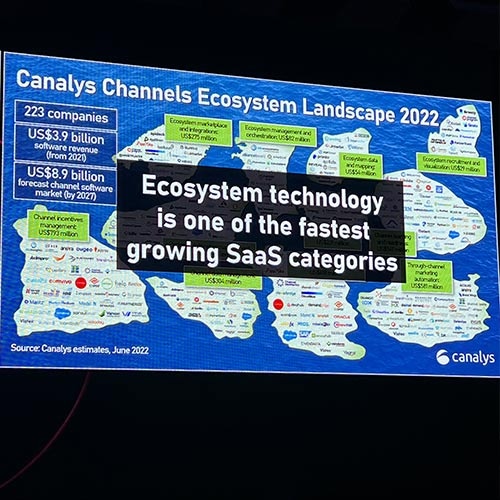
 On the other hand, Alex Smith, VP-Channels, Canalys, talked about the growth prospects the industry will witness in the coming years. He said, “Despite the challenges that we see in the market, SaaS will grow 25% this year, which is five times faster than the growth of the overall industry. These SaaS companies span a wide array of sectors and industries and cater sales executives, marketing executives, developers and everyday working professionals. Many of these companies have prioritized a product led growth strategy which is kind of like a grandchild of the freemium model. They focus on getting end users to start using their tech and leverage this community as their sales champions. When they talk about partner ecosystems, they’re focused on integrations with other software companies or marketplaces so that they can mind each other’s installed base for growth. These software companies prioritize a go-to market model that bypasses traditional IT decision makers, as well as traditional transactional channels. The attitude amongst this community is shifting. The big tech SaaS companies collectively will grow 27% this year and represent about $50 billion in end users spent. For the vast majority of these companies, indirect is actually the fastest growing segment because the direct product led growth strategy has a natural ceiling as business needs are complex and choices in the market are getting vast.” He emphasised on people preferring relationships with other people, but not with products. At a time where tech companies need to cut their costs, they need a partner ecosystem to drive that profitable growth, he said.
He also urged organisations to position themselves in a way so that they can capture this south growth opportunity. He further said, “The timing in the industry is right, but not all partners will be able to take advantage. There are two things needed to do. First, be prepared to live with your own services. The mantra of this industry is multipliers, not margins. SaaS companies describe their partners as advisors, trainers, thought leaders, etc. They have consulting partner programs and service partner programs and resell eventually becomes part of that overall opportunity. In order to have a real seat at the table, you need to bring your own services capabilities. Second, you can’t offer a lot of SaaS related services without software engineers. Whether you engage in CRM, data analytics, or cybersecurity, you need to have front end engineers, Q&A engineers to unlock the services opportunities.”
Megatrends in India
 India is moving towards digitisation at a rapid pace. Talking about various new emerging technologies that are disrupting the Indian Tech Industry at the Canalys Forum, Vishal Goyal, Head- Sales and Distribution, Redington Ltd thinks that the demand will remain high, both from mobility and IT perspective. He said, “While the hybrid model will continue for a longer time, the demand will remain high for all the products which are required, largely from a terminal point of view. With 5G coming in, there is a spurt in demand for high-end handsets, not only for the features, but on what benefits a device brings across the table. Cloud is also growing leaps and bounds for having seamless connectivity.” On the other hand, Amit Luthra, MD- ISG India, Lenovo Global Technology (India), stated 5G, edge and sustainability as the top three megatrends. Whereas Sundaresan Kanappan, VP & Country GM, Tech Data said that the Indian government trends on digitisation and corporate investing, which is insulated by recession, the coming digitisation, cloud and security momentum, AI and ML. Munish Bhasin, Director- Alliances & Channels, F5 said that cloud and digital, serverless computing, AI, IOT will be the top trends in India.
 Manish Alshi, Senior Director, Channels & Growth Tech, Checkpoint India, mainly focused on cybersecurity as a mega trend. He said, “The industry should be specific to cyber security. There should be a consolidation of cyber security solutions across customer environments, educating customers, creating single platform solutions for security.” Secondly, he stated that cyber security needs have increased due to increased cyberattacks and growth in cyber security solutions. Lastly, cloud security is also seen as a top trend due to adoption of cloud native services.
IT sector shaping the future of India
Vishal Goyal said, “With technology coming in, smart classes, smartboards, etc have replaced the traditional teaching method. The emphasis has changed from teaching to learning. For all these things, we need to have devices around applications, content and other things around it.”
According to Amit Luthra, everything has changed from what it was a decade ago, from the way people live, do business and the way they relax and play, as digitisation has taken a big leap forward in India. He said, “It couldn’t be real if the IT industry wouldn’t have contributed and will continue to contribute towards Digital India and making the economy stronger.”
 Stating skills as unparalleled in IT way par than world, Sundaresan Kanappan said India is reaping the benefits of the IT industry which it outsourced earlier, resulting in faster momentum in the economy. Munish Bhasin said that IT will come out from a cost centre to a profit center and will focus on co-innovations in shaping the country’s future.
On the other hand, Manish Alshi said foreign investments and company setups, IT automation, data center infra is impacting every sphere of our services like fintech, pharma, auto, etc. and these will also help in shaping the country’s future.
Key Priorities for 2023
Amit Luthra said the company will keep a watch on 5G and edge as these will do a lot more different than what social media, mobility, analytics and cloud computing did 4-5 years back. He added, “It is important that most of the channel community should focus on building their strength on 5G and edge. Partners should think about hybrid cloud competencies because there are customers who want to go into hybrid cloud and a lot of services get associated with it. Device modernisation should also be looked upon.”
Munish Bhasin said the organisation will focus on BFSI and IT/ITES as they are the major adopters of cloud. India is much more developed in many IT services than the other developed economies. He said the organisation will also focus on multi-cloud transformation (AWS, Azure, GCP, etc.), cybersecurity including API security, application security, multi-cloud security, etc.
Manish Alshi stated that the company will focus on serving its existing customer base, helping them with latest products and technologies and giving holistic solutions. Secondly, the company is expanding with its new customer base in the Indian market. Apart from these, the company will continue its robust partner ecosystem via training, extensive onboardings, etc. and will jointly work with them on go-to market strategy to gather more customers.
Strategies for new challenges
 Vishal Goyal talked about the ongoing recession the world is going through, however, it hasn’t grown that much big in India because of the GDP. He said, “The multinationals are going a bit slow on procurement of goods. The world is moving from CapEx to OpEx, from fixed costs to recurring costs, from one-time payment to pay-as-you-use. One has to create an environment or infrastructure around it so that a solution can be provided to the end customer. There is more demand for system integrators or solution as a service, wherein the customer is looking at brand-agnostic solutions.”
Whereas, Sundaresan Kanappan stated that the company will have a mix tier strategy for existing challenges but will stick to the long-term plan of staying invested in the country. Also, bring in the new technologies at a faster pace and serve channel partners. The company will also look into cloud security, IoT, data, ML, etc.
On the cybersecurity front, Manish Alshi stated that the biggest challenge for the cybersecurity landscape will be serving the customers with the growing cloud security needs. According to him, cloud security will face more challenges due to more customer migration, both inside and outside, and due to multiple stakeholder interaction with applications. He also focused on the data center security that will be of utmost concern to mitigate risk. Due to remote work, end-to-end access needs to be secure on all applications.
Partner Transformation Strategies
According to Amit Luthra, technology is getting adopted at an ever-increasing pace. He also said digital transformation has accelerated in the last few years, and is at its peak now. He further added, “It is important that the community working with customers’ needs to transform as well and help them in their journey. In this process, enablement is the biggest pillar because a lot of these technologies are relatively new.” Lenovo has changed its coverage model by introducing Lenovo 360 for its partners. Explaining this, he said, “A partner will have a Partner Account Manager who covers our multiple logs of business like the PC business, workstation business, ISG business, etc. as transformation today is happening by-directional, from pocket to core, core to edge, edge to cloud.”
 Talking about his organisation’s strategies, Munish Bhasin stated that partners are a mix bag of old and new. The market is shifting now and more digital transformation is happening in both cloud and on-prem. He added that the organisation is focusing on the polishing of evolved partners and for others, they will provide bootcamp opportunities for fast transitions. In bootcamp, they will try to build additional resources, making new partners learn basic things.
Meanwhile, Checkpoint India solely depends on partners to extend its reach in the market. Manish Alshi said, “We will do transformation by aligning our goals with partners and expanding our customer base, primarily new customer acquisition. Secondly, revisiting our existing customers and serving them better, product expansion in cloud and end-point security, along with certifications and hands-on training for partners.”
Impact of recession in India
While addressing the recession happening globally, Sundaresan Kanappan said India will not hit the recession as it has a large stable economy. Although, there will be some cascading effects due to 3 larger economies going down, dollars going up and shortage of resources. There is a need for good forex reserves to not lose customers, making the partners confident. Also, a conscious cash flow will be needed and constantly keeping a check on debt-equity ratio will be required.
On the other hand, Munish Bhasin was dubious, as he said recession is happening more with social media companies, advertising centric companies, but not cloud companies (AWS, etc.). At last, he said that India might not hit the recession, as the government has taken the right steps. The economy is slow but steady and India will resist recession. Manish Alshi was confident that the Indian economy will be better than many economies and that we will cope up with challenges and lead the world, especially in the IT sector to boost the country’s economy.
New IT challenges in hybrid work
Talking about the new IT challenges in today’s hybrid work culture, Vishal Goyal said, “Whether you are working from office or home, first and foremost, you need to have an infrastructure which includes a terminal, a device and high-speed broadband that remains connected to the device all the time because you need to be reachable and approachable. Connectivity will help in terms of addressing the needs.”
Meanwhile, accepting the fact that hybrid is the new norm, Sundaresan Kanappan said his organisation is comfortable with any work culture. Whether it is hybrid or physical, contribution and delivery are more important, according to him. He urged the organisations to take care of the partners first.
Munish Bhasin emphasised on always favouring hybrid. He further said, “We can support cloud native as well as on-premise applications with the same agility.”