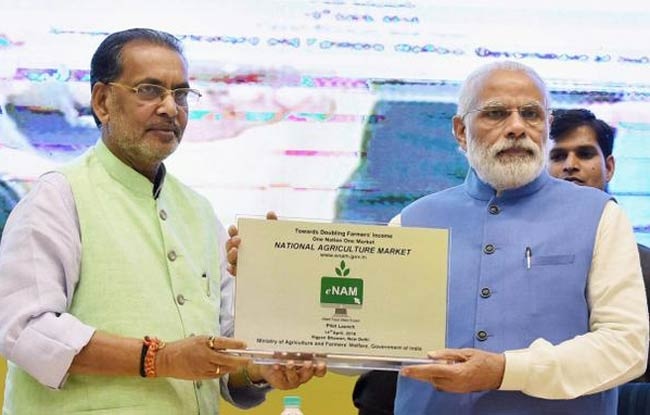
 National Agriculture Market (NAM), a pan-India electronic trading portal which networks existing APMC mantis has now connected 250 markets to the portal.
The e-NAM portal provides a single window service for all APMC related information and services such as: commodity arrivals and prices, buy and sell trade offers, provision to respond to trade offers, among other services. While material flow (agriculture produce) continue to happen through mandis, an online market reduces transaction costs and information asymmetry.
Union minister of agriculture & farmers welfare, Radha Mohan Singh has successfully announced the completion of e-NAM first phase and launched e-NAM Mobile App in New Delhi.
Speaking on the occasion, Radha Mohan Singh announced that most of the implementation issues faced in pilot phase have been addressed and e-NAM platform is connected to 250 markets across 10 states: (Andhra Pradesh (12), Chhattisgarh (5), Gujarat (40), Haryana (36), Himachal Pradesh (7), Jharkhand (8), Madhya Pradesh (20), Rajasthan (11), Telangana (44), and Uttar Pradesh (67).

Radha Mohan Singh also said that Detailed Project Reports (DPRs) for integrating 399 mandis with e-NAM has been received from 14 states and all of them have been approved.
Radha Mohan Singh is sure that e-NAM will significantly contribute towards enhancing the farmer’s income. Agriculture minister informed that so far, 1,53,992.7 MT of agriculture produce worth Rs 421 crore has been transacted on e-NAM platform and 160,229 farmers, 46,688 traders and 25,970 commission agents have registered on the e-NAM platform.
Union Minister said that quality parameters for 69 agricultural and horticultural commodities including cereals, pulses, oil seeds, spices, fruits and vegetables have been notified for trading on e-NAM platform. States have been asked to set up the quality assaying facilities to ensure quality assessment of the farmer’s produce in a scientific and professional manner.
A total number of 585 markets are targeted to be integrated with e-NAM by March 2018, out of which 400 markets will be integrated by March 2017.
Agriculture Minister said that the issues in hardware and software during implementation of the project have been resolved and a new version of software has been released whereby trading is going on in a stable manner.