LameHug hides in ZIP files and uses AI to automate information theft, marking a dangerous shift in how large language models (LLMs) can be weaponized for cyberattacks.
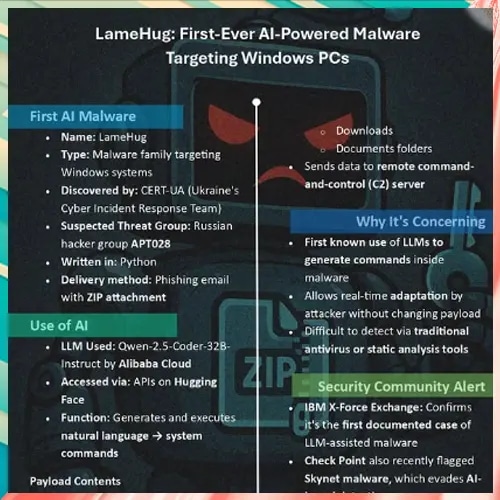
A new and alarming threat has surfaced in the cybersecurity landscape — LameHug, the world’s first known AI-powered malware, has been identified by Ukraine's Computer Emergency Response Team (CERT-UA). This malware signifies a chilling evolution in cyberattacks, using artificial intelligence not just for automation but also for malicious execution.
LameHug utilizes Alibaba's Qwen-2.5-Coder-32B-Instruct, a sophisticated large language model (LLM), to generate and execute malicious commands directly on Windows-based systems. The malware is written in Python and leverages APIs from Hugging Face, a leading open-source AI platform. It typically hides within ZIP files, making it difficult to detect during initial scans.
Linked to the Russian hacking group APT028, also known as Fancy Bear, LameHug marks a turning point in cyber warfare. The AI capabilities embedded within the malware allow it to automate data theft, evade traditional detection mechanisms, and even adapt its behavior dynamically based on system responses — all without human intervention.
This signals a broader concern in cybersecurity, where LLMs like Qwen, OpenAI’s GPT, and Google's Gemini could be weaponized by threat actors. The line between ethical AI development and AI misuse is rapidly thinning, raising the need for stricter AI governance, cyber defense mechanisms, and data protection frameworks.
LameHug’s emergence highlights how AI in cybercrime is no longer theoretical. With AI now capable of producing malicious scripts, bypassing defenses, and analyzing system vulnerabilities in real-time, traditional antivirus software, firewalls, and endpoint detection tools may no longer suffice.
The threat also emphasizes the need for greater vigilance in the AI research community, secure coding practices, and international cybersecurity collaborations. Businesses, especially those in critical infrastructure, must reassess their cyber hygiene and implement AI-aware defense strategies.
As the AI-powered malware era begins, LameHug stands as a wake-up call to rethink how we secure digital ecosystems in the age of artificial intelligence.