
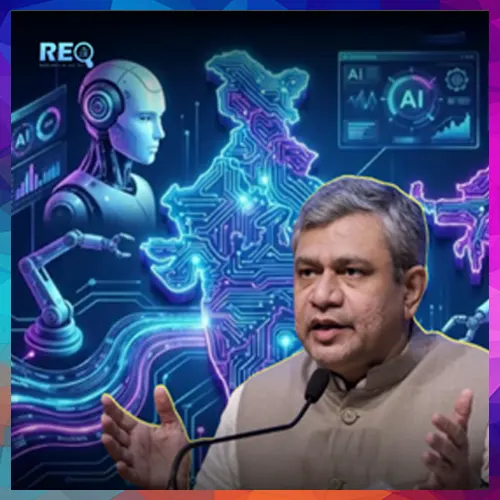
Union IT Minister Ashwini Vaishnaw said India’s sovereign AI strategy is delivering results, citing growing global recognition for Sarvam’s homegrown models, even as early sceptics acknowledge major technological gains and real-world relevance.
India’s push to build sovereign artificial intelligence capabilities has gained fresh momentum, with Union Minister for Electronics and Information Technology Ashwini Vaishnaw publicly defending the country’s approach after early criticism from Indian-origin Silicon Valley commentator Deedy Das.
In a post on social media, Vaishnaw said India’s AI mission is beginning to show tangible outcomes, pointing to the rising global appreciation for models developed domestically. He noted that even some of the most critical voices are now recognising the technological strength of AI tools created under the national mission, including those developed by Bengaluru-based start-up Sarvam.
“Our sovereign model strategy is delivering results,” the minister said, adding that young Indian engineers are also working on innovations in areas such as materials science, healthcare and cybersecurity that could draw international attention as breakthrough technologies.
Sarvam’s AI models gain traction
Sarvam, which is building foundational AI models entirely in India, has recently attracted attention for two of its tools—Sarvam Vision and Bulbul. Both are part of the company’s broader effort to develop AI systems tailored for Indian languages and use cases.
Sarvam Vision, an optical character recognition model, has reportedly outperformed several well-known global AI systems on select benchmarks. According to data shared by the company, the model achieved an accuracy score of 84.3 percent on the olmOCR-Bench, surpassing results posted by newer OCR systems and some flagship multimodal models.
Sarvam AI co-founder Pratyush Kumar highlighted the performance in a series of posts, saying the results reflect years of focused work on Indian-language data and real-world deployment needs. Users and industry observers have also praised the model for its consistency and applicability in high-volume document processing.
Critic turns supporter
The developments appear to have prompted a shift in tone from Deedy Das, who had earlier questioned India’s approach to training language models. In a recent post, Das acknowledged Sarvam’s progress, praising its text-to-speech, speech-to-text and OCR capabilities for Indian languages, along with its pricing and ease of use.
He said the company is addressing gaps that large global labs are unlikely to prioritise in the near term, calling its technological progress noteworthy and rare among Indian software products.
For the government, the episode has become a validation point. Vaishnaw reiterated that India’s focus on sovereign, application-driven AI is aimed not just at scale, but at building globally competitive technologies rooted in local needs.

See What’s Next in Tech With the Fast Forward Newsletter








Tweets From @varindiamag
Nothing to see here - yet
When they Tweet, their Tweets will show up here.