Serial entrepreneur Amalendu Mukherjee warns that the U.S. government's landmark directive restricting frontier AI access is not a temporary disruption — it is a permanent geopolitical restructuring that India cannot afford to ignore.
The announcement arrived without warning. On the morning of 13 June 2026, Anthropic confirmed receipt of a U.S. Government directive mandating the immediate suspension of its frontier AI models — Fable 5 and Mythos 5 — for all foreign nationals worldwide. In a single stroke, two of the world's most powerful artificial intelligence systems became, effectively, instruments of national security rather than commercial products.
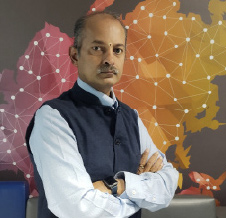
VARIndia sat down exclusively with Amalendu Mukherjee, serial entrepreneur and technology strategist — to understand what this means for Indian enterprises, the IT channel, and the nation's AI ambitions. With decades of experience spanning IT, ITS, and emerging technology ecosystems, Mukherjee offers a perspective that is equal parts strategic, technical, and urgently practical.
“This is not a trade dispute. This is the moment AI became a strategic weapon of state. India must decide — right now — whether it leads or follows.”
Q. Mr. Mukherjee, you have been tracking this development closely. When the U.S. Government directive restricting access to Anthropic's Fable 5 and Mythos 5 came through, what was your immediate reaction?
My first reaction was: this was inevitable. The surprise was not that it happened — the surprise was how quickly it happened. We have watched the United States treat semiconductors, cryptographic systems, and satellite technologies as export-controlled assets for decades. AI was always going to arrive at the same destination. What changes everything now is that the intelligence layer itself — not just the hardware — is being treated as a sovereign asset. That is a fundamentally different world than the one Indian enterprises were planning for even twelve months ago.
Q For the IT channel and enterprise technology sector in India, what are the immediate, ground-level consequences?
The impact is layered. At the surface level, any Indian IT integrator, system integrator, or enterprise that has built workflows, products, or client deliverables on top of Fable 5 or Mythos 5 APIs now has a contingency problem. Contracts need to be reviewed. Roadmaps need to be revised. Customer commitments need to be reassessed. That is the immediate fire to put out. But beneath that, there is a deeper reckoning: Indian organisations have been building on foreign AI infrastructure as if it were a utility — like electricity or the internet. This directive is the reminder that it is not. It is a geopolitically controlled resource.
“Indian organisations have been building on foreign AI as if it were a utility. This directive is the reminder that it is not — it is a geopolitically controlled resource.”
Q. You have been deeply involved in digital infrastructure for critical sectors — intelligent transportation, building management, security surveillance. How does this directive intersect with national infrastructure security?
This is where the conversation becomes very serious. Frontier AI models like the ones now restricted are not just being used for writing emails or generating reports. They are being evaluated — and in some cases deployed — in critical infrastructure decision-making: traffic systems, building management, industrial control, even security analytics. When access to those models can be switched off by a foreign government overnight, you have introduced a single point of failure into your national infrastructure. That is an unacceptable risk profile for any sovereign nation. India needs to move — urgently — toward AI systems that are domestically hosted, domestically governed, and domestically auditable.
Q. Beyond the access restriction, what are the deeper risks of frontier AI that you believe are not receiving sufficient attention in the Indian technology discourse?
There are three risk categories I think about constantly. The first is capability risk — these models are genuinely extraordinary, and their capabilities are advancing faster than our ability to govern them. Fable 5 and Mythos 5 represent capability levels that, frankly, most people in the enterprise technology sector have not yet fully absorbed. We are not talking about a smarter chatbot. We are talking about systems that can reason, plan, and execute across complex multi-step problems with a degree of autonomy that was science fiction five years ago. The second risk is dependency risk — which this directive has just made viscerally real. The third, and perhaps most underestimated, is data sovereignty risk. Every query sent to a foreign AI model is potentially a data exposure event. For enterprises handling sensitive customer data, financial data, or infrastructure data, that is not a theoretical risk. India's Digital Personal Data Protection Act 2023 is beginning to create a framework, but enforcement and awareness in the channel remain nascent.
Q. The U.S. is treating its most advanced AI as a national security asset. Should India be alarmed, or should it see an opportunity here?
Both. Absolutely both. The alarm is real — we have been slow to invest in sovereign AI capability at the frontier level. IndiaAI Mission is moving, CDAC is building supercomputing capacity, but we are not yet producing foundation models that can substitute for what Fable 5 or Mythos 5 offer. That gap is the vulnerability. But the opportunity is significant. This moment — today, June 2026 — is the moment that Indian enterprises, Indian government, and the Indian IT channel have a clear, undeniable strategic imperative to invest in domestic AI. The argument for sovereign AI infrastructure no longer requires a geopolitical hypothetical. The hypothetical just became real. Every rupee invested in Indian AI capability today is a rupee invested in strategic autonomy. That framing needs to reach the budget committees in every enterprise and every ministry.
“Every rupee invested in Indian AI capability today is a rupee invested in strategic autonomy. This moment — June 2026 — is the window. It will not stay open forever.”
Q. What is the role of the IT and ITS channel — the VARs, system integrators, and technology distributors — in navigating this shift?
The channel is absolutely central — and I say this as someone who has spent his career in and around it. The channel is where technology meets real-world deployment. It is where boardroom strategy becomes operational reality. Right now, the channel has a responsibility to do three things. First: educate clients. Most enterprise decision-makers do not yet understand the full implications of what happened on 13 June. The channel needs to close that gap. Second: audit and advise on AI dependency. Every client using foreign frontier AI should have a contingency assessment in hand within 90 days. Which workflows depend on which models? What are the alternatives? What is the switching cost? Third: advocate for and adopt domestic and open-source AI alternatives. This is not a retreat from AI — it is a maturation of our AI strategy. LLaMA, Mistral, and emerging Indian foundation models offer serious capability. The channel should be building expertise and partnerships around these now, not waiting for another directive.
Q. From your own experience building AI-integrated technology solutions and products, what lessons apply here for enterprises navigating this shift?
The lesson I keep coming back to is: build for resilience, not just performance. When we design AI product roadmaps, the intelligence layer must be modular — meaning you can swap the underlying model without rebuilding the entire product. That architectural decision, which can seem like engineering conservatism, is now a strategic asset. For the broader industry: AI products and AI-integrated services need to be designed with model portability in mind from day one. Vendor lock-in to a foreign AI provider is not just a commercial risk — as we have just seen — it is a regulatory and national security risk. The enterprises and integrators who build portability into their AI architecture today will have a significant competitive advantage in the world that is now emerging.
Q. If you had one message for the Indian IT and technology leadership — government, enterprise, and channel — what would it be?
Act with urgency, not panic. These are different things. Panic leads to reactive, short-term decisions. Urgency leads to accelerated, strategic action. India has the talent, the infrastructure ambition, and — with IndiaAI Mission — the governmental will to build sovereign AI capability. What we have lacked is the catalysing moment of strategic necessity. That moment is now. The window to position India as a genuine AI sovereign — not just an AI consumer — is open. But it will not stay open indefinitely. The nations and enterprises that move decisively in the next twelve to twenty-four months will define the AI landscape for the next decade. To the IT channel specifically: you are the last mile of technology deployment in this country. You have a role and a responsibility in this transition that no other part of the ecosystem can play. Rise to it.

See What’s Next in Tech With the Fast Forward Newsletter




Tweets From @varindiamag
Nothing to see here - yet
When they Tweet, their Tweets will show up here.