Trust is emerging as the most valuable currency in the artificial intelligence economy. Technology giants are investing billions in cybersecurity, identity protection and fraud prevention, signalling a fundamental shift: security is becoming central to AI innovation.
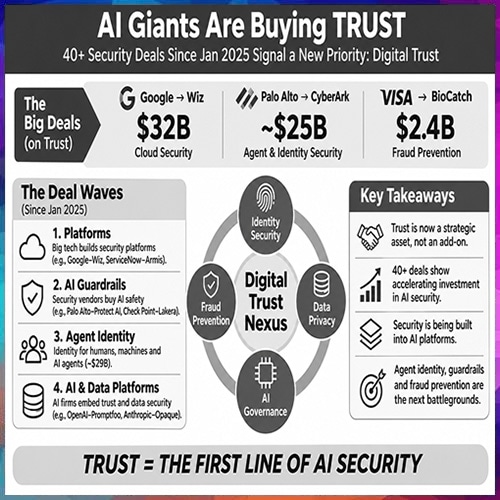
The acquisition landscape tells a compelling story. Google's $32 billion Wiz deal, Palo Alto Networks' approximately $25 billion CyberArk transaction and Visa's proposed $2.4 billion BioCatch acquisition demonstrate the growing strategic importance of digital trust.
Key Highlights
-
Trust Is the New AI Currency: Cybersecurity drives billion-dollar acquisitions.
-
$57 Billion in Mega Deals: Google–Wiz and Palo Alto–CyberArk lead.
-
40+ Security Deals: AI security investments are accelerating.
-
Agent Identity Takes Centre Stage: Authentication and governance become critical.
-
Digital Trust Nexus Emerges: Identity, privacy, fraud prevention and AI governance converge.
Since January 2025, more than 40 reported security acquisitions have highlighted an accelerating convergence of AI, cloud infrastructure, cybersecurity and identity management. These investments reflect an industry preparing for increasingly autonomous digital environments.
The first wave focuses on platform consolidation. Technology giants are pursuing integrated security capabilities, with Google's Wiz acquisition and ServiceNow's reported investments in Armis and Veza illustrating the demand for comprehensive protection.
The second wave centres on AI guardrails. Cybersecurity vendors are acquiring specialised capabilities for prompt injection defence, model protection, red teaming and autonomous threat monitoring rather than developing every capability internally.
Agent identity represents another critical battleground. As AI agents independently access systems, execute transactions and make decisions, organisations must establish identity, authorisation, accountability and continuous verification.
Companies including CrowdStrike, Cisco and Palo Alto Networks are strengthening identity capabilities to address emerging machine-to-machine risks. The challenge is determining which agent acts, whose authority it carries and what permissions apply.
Meanwhile, AI platforms are incorporating security directly into their ecosystems. Investments involving OpenAI, Anthropic, Snowflake and Databricks illustrate growing recognition that trustworthy AI requires embedded governance and data protection.
Financial services face equally significant disruption. Behavioural biometrics, fraud intelligence and continuous authentication are becoming essential as autonomous agents increasingly participate in payments and other sensitive financial activities.
The message is unmistakable: TRUST must become the first line of AI security. Tomorrow's winners will combine identity, privacy, fraud prevention and AI governance into unified trust architectures. Cybersecurity is no longer an operational expense; it is the foundation of sustainable AI growth.