Alibaba Unveils 2.4T-Parameter Qwen3.8-Max
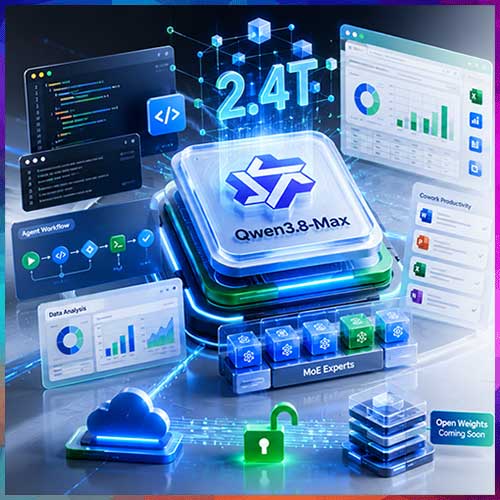
Alibaba has officially launched Qwen3.8-Max, its most powerful artificial intelligence model to date, featuring an enormous 2.4 trillion parameters. The release marks another major milestone in China's rapidly accelerating AI race, positioning Alibaba alongside leading global AI developers including OpenAI, Anthropic, Google, and Moonshot AI.
Qwen3.8-Max is a multimodal foundation model capable of understanding and processing text, images, videos, and documents while supporting an exceptionally large context window of up to one million tokens. Alibaba says the model employs a Mixture-of-Experts (MoE) architecture, activating only about 95 billion parameters per request, significantly improving inference efficiency while reducing computational costs. The company also claims the model ranks among the world's top frontier AI systems, although many of these performance claims still await independent validation.
Unlike many proprietary frontier models, Alibaba intends to make Qwen3.8-Max available as an open-weight model, allowing developers and enterprises to customize and deploy it for their own applications. Preview access is already available through Alibaba Cloud's AI platforms, with broader availability expected soon. The announcement comes shortly after Moonshot AI introduced its 2.8-trillion-parameter Kimi K3, underscoring the intense competition among Chinese AI companies.
China's AI Strategy Is Shifting the Global Competitive Landscape
The launch of Qwen3.8-Max signals that the AI race is no longer defined solely by the United States. Chinese technology companies are rapidly narrowing the capability gap by combining massive-scale models with lower operating costs and increasingly open development strategies. Rather than competing only on model size, firms are focusing on cost-efficient inference, multimodal intelligence, and enterprise adoption.
The model also reflects an important technological shift. Massive parameter counts no longer translate directly into higher computing costs because sparse MoE architectures activate only a fraction of the model during inference. This enables frontier-scale AI while keeping operational expenses manageable, making large-scale deployment more economically viable.
Another strategic advantage lies in Alibaba's cloud ecosystem. By integrating Qwen3.8-Max into Alibaba Cloud, developer platforms, enterprise AI services, and coding assistants, the company is creating a vertically integrated AI stack similar to strategies pursued by Microsoft, Google, and Amazon. This integration could accelerate enterprise adoption across Asia while strengthening Alibaba's cloud business.
However, important questions remain. Alibaba has not yet released comprehensive technical documentation, independent benchmark methodology, or a detailed model card supporting claims that Qwen3.8-Max ranks among the world's leading AI models. Independent evaluation will ultimately determine how it compares with GPT, Claude, Gemini, and other frontier systems.
The broader implication extends beyond a single model release. AI leadership is increasingly becoming a contest over computing infrastructure, cloud platforms, custom silicon, open ecosystems, and developer adoption rather than model size alone. As China continues investing heavily in sovereign AI capabilities despite export restrictions on advanced chips, global competition is entering a new phase where innovation, affordability, and ecosystem strength will be as decisive as raw model performance.

See What’s Next in Tech With the Fast Forward Newsletter






Tweets From @varindiamag
Nothing to see here - yet
When they Tweet, their Tweets will show up here.