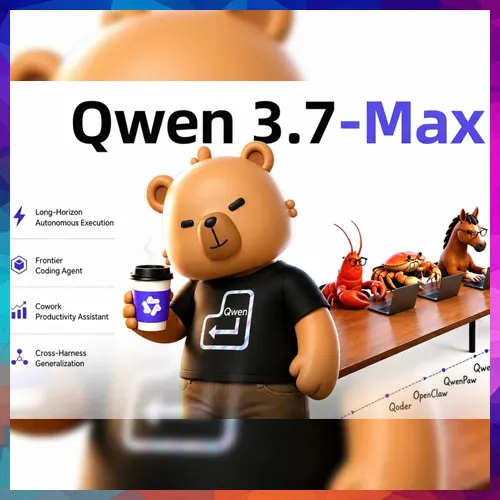
Chinese technology giant Alibaba Cloud has introduced its next-generation AI model, Qwen 3.7-Max, during its inaugural international Qwen Conference in Singapore, marking a significant step toward the era of autonomous “agentic AI.” The launch reflects a major transformation in artificial intelligence, where systems are evolving from content generators into digital agents capable of reasoning, coding, decision-making, and executing complex multi-step tasks independently for extended durations.
Alibaba Cloud positioned Qwen 3.7-Max as a model built specifically for autonomous enterprise workflows. According to Li Fei Fei, the future of AI will revolve around “human-agent harmony,” where intelligent AI agents operate continuously alongside humans to enhance productivity across enterprises, governments, and digital ecosystems. The company believes agentic AI will fundamentally reshape enterprise operations by automating repetitive processes while accelerating decision-making and innovation.
At the center of the announcement was Qwen 3.7-Max, reportedly developed with over one trillion parameters and featuring a one-million-token context window. Alibaba claims the model can autonomously execute tasks for up to 35 hours without noticeable degradation in performance. Unlike conventional generative AI systems that primarily answer prompts, Qwen is optimized for agentic workflows involving tool usage, planning, memory retention, workflow orchestration, and autonomous execution with minimal human supervision.
To strengthen its AI ecosystem, Alibaba also launched Qwen Cloud, an AI-native cloud platform designed for both humans and AI agents, alongside the JVS Agent Suite that allows developers to build secure enterprise-grade AI agents. The company additionally unveiled a new “skills portal” capable of converting functions from more than 60 cloud products into AI-agent-compatible capabilities, enabling agents to interact directly with enterprise infrastructure and cloud services.
The launch highlights the growing global shift from generative AI to agentic AI. While first-generation AI systems focused on generating text, images, or summaries, agentic AI aims to create autonomous digital workers capable of executing tasks independently. These systems can coordinate software operations, manage workflows, analyze data, write and test code, and perform business functions across departments. This development places Alibaba into direct competition with global AI leaders such as OpenAI, Google, and Anthropic, all of which are investing heavily in autonomous AI ecosystems.
Singapore’s role as the launch destination also carries strategic importance. The city-state has emerged as Southeast Asia’s leading AI innovation hub through its advanced digital infrastructure, regulatory clarity, talent initiatives, and government-backed AI programs. During the conference, Desmond Tan stressed that AI adoption must focus on “AI that works for workers,” highlighting rising concerns around workforce displacement caused by autonomous AI systems.
To address these concerns, Alibaba Cloud partnered with Singapore’s NTUC Tech Talent Assembly and ST Telemedia Global Data Centres to launch an AI upskilling initiative for over 1,000 SMEs and students. Starting June 2026, participants will gain access to Alibaba’s AI tools, training workshops, and subscriptions to Qoder, the company’s AI-powered coding assistant platform. This initiative reflects a broader global trend where governments increasingly link AI deployment with workforce transformation and reskilling programs.
The launch also underscores China’s accelerating efforts to narrow the AI gap with Western firms despite semiconductor restrictions and export controls imposed by the United States. Chinese companies including Baidu, Tencent, and ByteDance are aggressively expanding sovereign AI capabilities. Alibaba’s focus on Southeast Asia further demonstrates China’s ambition to strengthen AI influence across ASEAN markets while competing directly against US cloud and AI providers.
Qwen 3.7-Max vs Anthropic Mythos
| Feature | Qwen 3.7-Max | Anthropic Mythos |
|---|---|---|
| Developer | Alibaba Cloud | Anthropic |
| Core Focus | Agentic AI workflows and autonomous execution | Enterprise reasoning and systems-level analysis |
| Architecture | 1 trillion+ parameters | Advanced enterprise reasoning architecture |
| Context Window | 1 million tokens | Large enterprise-context reasoning |
| Autonomous Runtime | Up to 35 hours | High-level analytical simulations |
| Primary Use Cases | AI agents, coding, workflow orchestration | Infrastructure mapping, risk analysis, financial simulations |
| Cloud Integration | Qwen Cloud and JVS Agent Suite | Claude enterprise ecosystem |
| Strategic Positioning | Digital workforce automation | AI governance and enterprise intelligence |
| Regional Strategy | ASEAN and global cloud expansion | US and enterprise-heavy adoption |
| Key Concern | Workforce displacement and AI autonomy | Systemic risk and deep enterprise visibility |
Alibaba’s Qwen 3.7-Max launch demonstrates that the global AI race is rapidly evolving beyond model intelligence toward operational AI ecosystems capable of autonomous execution. However, as AI agents gain greater independence, enterprises and governments will face increasing challenges around governance, accountability, cybersecurity, compliance, and workforce disruption. The future AI economy may ultimately be defined not by standalone models, but by trusted ecosystems where humans and autonomous AI agents collaborate safely at scale.

See What’s Next in Tech With the Fast Forward Newsletter





Tweets From @varindiamag
Nothing to see here - yet
When they Tweet, their Tweets will show up here.