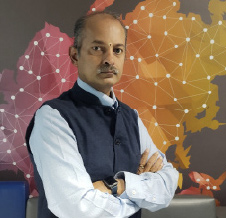


Anthropic chief Dario Amodei has cautioned that rapidly advancing artificial intelligence systems may soon possess capabilities that could be misused for large-scale harm, including assisting in the creation of biological weapons if safeguards fail.
Artificial intelligence has progressed so rapidly that it could soon pose serious risks to humanity if deployed irresponsibly, according to Dario Amodei, Chief Executive Officer of AI research firm Anthropic. He warned that cutting-edge AI models may already be nearing the level of technical understanding required to assist in the development and deployment of biological weapons.
Amodei, whose company is regarded as one of the most influential players in the AI sector alongside OpenAI, Google DeepMind and Meta, said the growing power of large language models (LLMs) demands urgent attention from governments, researchers and industry leaders alike.
“At a high level, I am concerned that these systems are approaching—or may already have reached—the knowledge needed to enable end-to-end biological weaponisation,” Amodei said, adding that the potential consequences of misuse could be severe.
Rapid gains outpacing public perception
Amodei noted that AI development follows a highly predictable pattern: as models receive more data, greater computing resources and longer training periods, their capabilities improve steadily across almost every domain. He argued that public understanding often lags behind reality, swinging between skepticism and sudden enthusiasm with each new breakthrough.
Only a few years ago, AI struggled with basic mathematical reasoning and could barely generate functional computer code. Today, advanced systems are solving complex mathematical problems, writing production-grade software and assisting skilled engineers in day-to-day development work.
These gains are not limited to computing. According to Amodei, similar progress is unfolding in biology, finance, physics and complex “agentic” tasks that require planning and autonomous decision-making. He suggested that AI could soon outperform humans across most intellectual activities.
Power, alignment and existential concerns
Amodei explained that AI models learn far more than factual information during training. They absorb patterns of reasoning, behavioural tendencies and response strategies from vast datasets. While AI systems do not possess emotions or intentions, their behaviour can sometimes resemble goal-seeking or strategic thinking.
This raises concerns about what researchers describe as “misaligned power-seeking,” where advanced systems pursue objectives in ways that conflict with human values or safety. Amodei said this risk underpins longstanding warnings that poorly controlled AI could become dangerous at a civilisational scale.
As AI capabilities accelerate, he stressed that safety frameworks must evolve just as quickly. Without robust oversight, transparency and alignment efforts, the same technology driving innovation could also amplify global security threats.

See What’s Next in Tech With the Fast Forward Newsletter








Tweets From @varindiamag
Nothing to see here - yet
When they Tweet, their Tweets will show up here.