
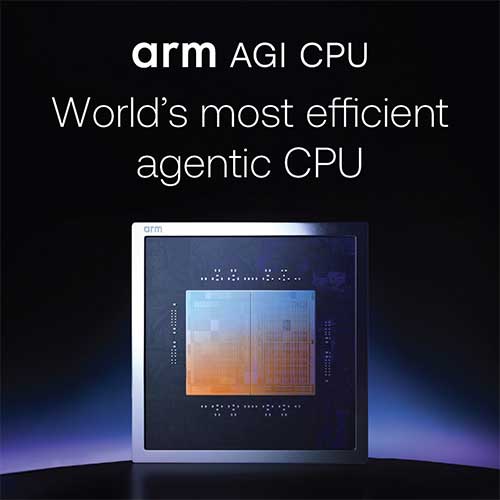
Arm Holdings on Tuesday introduced a new artificial intelligence-focused data center processor, marking a decisive move beyond its traditional licensing business and into full-scale chip production.
The processor, dubbed the AGI CPU, is designed to support emerging “agentic AI” systems—software capable of independently carrying out tasks with minimal human intervention. This represents a shift from conventional AI models that primarily respond to user prompts, such as chatbots.
The announcement reflects a broader surge in demand for high-performance computing infrastructure, particularly central processing units from firms like Intel and Advanced Micro Devices, as enterprises race to deploy more autonomous AI systems.
Investors responded positively to the news, sending Arm’s shares up 6.5% in after-hours trading. The stock had earlier closed down 1.4% but remains up roughly 22% so far this year.
Historically, Arm—majority-owned by SoftBank Group—has built its business by licensing chip designs to partners such as Qualcomm and Nvidia, earning royalties based on unit shipments.
However, the launch of the AGI CPU marks the company’s first major step into designing and producing its own chips, a capital-intensive effort that can cost hundreds of millions of dollars. The initiative follows earlier signals from Arm that it was investing heavily in internal chip development and recruiting experienced leadership to support the transition.
“This is a defining moment for Arm,” CEO Rene Haas said, emphasizing the long-term significance of the shift.
The company projects that the AGI CPU could generate approximately $15 billion in annual revenue within five years. Overall, Arm expects to reach $25 billion in annual revenue and earnings per share of $9 over the same period, with its core intellectual property business also set to double.
The chip has been developed in collaboration with Meta Platforms, which will serve as the lead partner. Additional customers include OpenAI, Cloudflare, SAP, and SK Telecom.
Manufacturing will be handled by Taiwan Semiconductor Manufacturing Company using its advanced 3-nanometer process. The chip features a dual-die architecture—two silicon components working together as a single unit—to deliver enhanced performance.
Arm has already received functional test units and plans to begin mass production in the second half of this year.
“It’s back, it’s operational, and it’s meeting our expectations,” Haas said, referring to the early performance of the chip.
Beyond the processor itself, Arm is also collaborating with hardware manufacturers such as Lenovo and Quanta Computer to deliver complete server systems built around the new chip.

See What’s Next in Tech With the Fast Forward Newsletter








Tweets From @varindiamag
Nothing to see here - yet
When they Tweet, their Tweets will show up here.