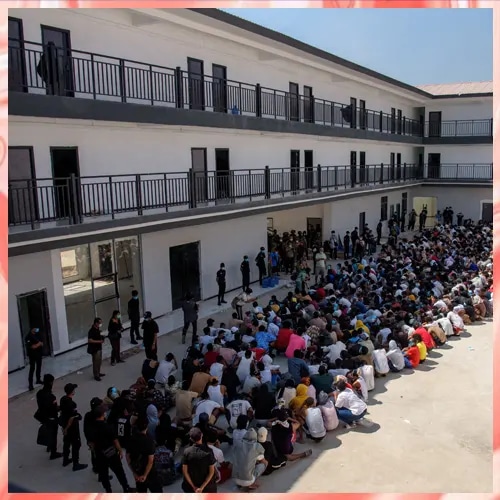
In spite of a significant multinational crackdown spanning several weeks, illegal scam centres along the Thai-Myanmar border remain fully operational. The scam employs an estimated 50,000 to 100,000 individuals, according to senior Thai police officials.
Thailand spearheads the crackdown, while it faces an uphill battle against scam centres that are deeply entrenched in Myawaddy, an area notorious for online fraud and cybercrime operations.
Voluntary Workers or Victims?
According to the United Nations, these facilities are part of a sprawling Southeast Asian criminal network generating billions of dollars annually. Often, individuals working at these centres are victims of trafficking, tricked by promises of legitimate employment.
Pol Gen Thatchai Pitaneelaboot, Inspector-General of the Royal Thai Police and the lead figure in the crackdown, however, stated that early assessments indicate hundreds of the rescued workers went to Myawaddy voluntarily.
“Many individuals use Thailand as a transit point to reach Myawaddy, not just for call centre scams but also for online gambling and various other professions,” explained Pol Gen Thatchai in a recent interview.
Pol Gen Thatchai’s statement challenges widespread beliefs that most scam centre workers are trafficked against their will. While many reports detail harrowing stories of victims tricked into forced labour, the general maintains that many individuals entered the region willingly.
These scam centres attracted global attention following the kidnapping and rescue of Chinese actor Wang Xing from Myawaddy earlier this year. The incident triggered significant backlash on Chinese social media, prompting Beijing to collaborate on rescue operations and dispatching authorities to Thailand.
Since then, over 5,200 individuals have been extracted from scam centres in Myawaddy. Approximately 3,500 have returned home via Thailand, which has also halted essential supplies such as electricity, fuel, and internet to disrupt scam operations.
However, Pol Gen Thatchai acknowledges that the crackdown has only impacted a small segment of these extensive operations.
International collaboration – the need of the hour
With workers hailing from over 20 countries, Thai authorities are advocating for multinational cooperation to repatriate victims and prosecute offenders effectively. Pol Gen Thatchai stressed the urgency of setting up an international coordination centre to streamline investigations, facilitate repatriations, and strengthen regional law enforcement collaboration.
“These individuals should be prosecuted in their respective home countries, and the Thai police are committed to supporting these efforts,” he said.
One victim, Shaik Hussain from Hyderabad, vividly described his terrifying ordeal in a recent FIR filed by Telangana Cyber Security Bureau. Hussain, 25, was lured through a fake data-entry job, transported to Myawaddy, and then forcibly taken by armed personnel linked to the Border Guard Force (BGF), a military group supporting Myanmar’s Junta.