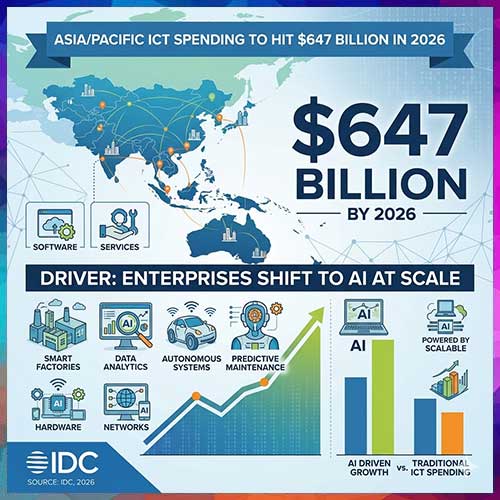
IDC forecasts that ICT spending across Asia Pacific excluding Japan and China (APEJC) will reach $647 billion in 2026, with the market projected to exceed $758 billion by 2029 as enterprises accelerate large-scale AI adoption.
The region is expected to grow by 5.4% in 2026, outpacing global averages, driven by a transition from experimental AI deployments to full-scale industrial execution. IDC notes that organizations are no longer investing in technology solely for growth, but increasingly to avoid becoming obsolete in an era shaped by “agentic AI.”
Software remains a major component of spending, accounting for roughly 24% of the total, with priorities shifting toward data sovereignty and cybersecurity. As geopolitical tensions intensify and cyber risks rise, enterprises are investing heavily in security platforms and enterprise resource management systems, which are becoming foundational to AI-driven operations.
Spending on services has also emerged as a critical pillar, representing over 23% of ICT budgets. Companies are increasingly relying on outsourcing and managed services to bridge what IDC describes as an “execution gap,” particularly as many legacy systems are not yet equipped to support AI at scale. The rapid expansion of global capability centers in India and Southeast Asia is further boosting demand for specialized IT and business services.
Hardware continues to be the largest spending category, accounting for more than half of total ICT expenditure and growing at 3.6% annually. This growth is being fueled by supply chain realignments and the “China Plus One” strategy, with manufacturing shifting toward countries like India, Vietnam, and Thailand. As a result, demand is rising for advanced infrastructure, including AI-optimized servers, edge computing systems, and specialized hardware for smart manufacturing.
Key industries driving spending include banking, software and information services, and government sectors, which are collectively expected to account for more than $100 billion in 2026. These sectors are increasingly adopting AI for autonomous decision-making and advanced analytics.
Mario Allen Clement said the region has moved beyond the early adoption phase of AI, with organizations now under pressure to demonstrate measurable returns on technology investments. He noted that companies are reallocating budgets away from pilot projects toward foundational capabilities such as data management, cybersecurity, and skilled services.
Geopolitical shifts and supply chain diversification are also playing a key role in shaping spending patterns. India is emerging as a central growth engine, supported by its digital public infrastructure and push toward sovereign AI capabilities, while Southeast Asian nations are investing in connectivity and data compliance frameworks to attract global technology investments.
As enterprises prepare for the next wave of automation, IDC’s outlook suggests that success will increasingly depend on the ability to build resilient, secure, and scalable digital foundations capable of supporting AI-driven transformation at scale.
The region is expected to grow by 5.4% in 2026, outpacing global averages, driven by a transition from experimental AI deployments to full-scale industrial execution. IDC notes that organizations are no longer investing in technology solely for growth, but increasingly to avoid becoming obsolete in an era shaped by “agentic AI.”
Software remains a major component of spending, accounting for roughly 24% of the total, with priorities shifting toward data sovereignty and cybersecurity. As geopolitical tensions intensify and cyber risks rise, enterprises are investing heavily in security platforms and enterprise resource management systems, which are becoming foundational to AI-driven operations.
Spending on services has also emerged as a critical pillar, representing over 23% of ICT budgets. Companies are increasingly relying on outsourcing and managed services to bridge what IDC describes as an “execution gap,” particularly as many legacy systems are not yet equipped to support AI at scale. The rapid expansion of global capability centers in India and Southeast Asia is further boosting demand for specialized IT and business services.
Hardware continues to be the largest spending category, accounting for more than half of total ICT expenditure and growing at 3.6% annually. This growth is being fueled by supply chain realignments and the “China Plus One” strategy, with manufacturing shifting toward countries like India, Vietnam, and Thailand. As a result, demand is rising for advanced infrastructure, including AI-optimized servers, edge computing systems, and specialized hardware for smart manufacturing.
Key industries driving spending include banking, software and information services, and government sectors, which are collectively expected to account for more than $100 billion in 2026. These sectors are increasingly adopting AI for autonomous decision-making and advanced analytics.
Mario Allen Clement said the region has moved beyond the early adoption phase of AI, with organizations now under pressure to demonstrate measurable returns on technology investments. He noted that companies are reallocating budgets away from pilot projects toward foundational capabilities such as data management, cybersecurity, and skilled services.
Geopolitical shifts and supply chain diversification are also playing a key role in shaping spending patterns. India is emerging as a central growth engine, supported by its digital public infrastructure and push toward sovereign AI capabilities, while Southeast Asian nations are investing in connectivity and data compliance frameworks to attract global technology investments.
As enterprises prepare for the next wave of automation, IDC’s outlook suggests that success will increasingly depend on the ability to build resilient, secure, and scalable digital foundations capable of supporting AI-driven transformation at scale.