
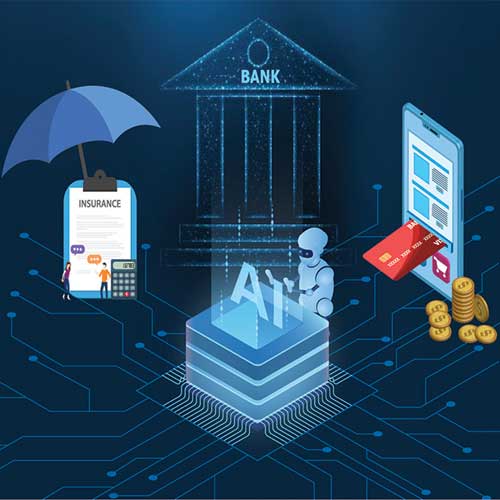
Frontier technologies like Artificial Intelligence (AI), Machine Learning (ML), robotics etc. are influencing various industry verticals be it BFSI, manufacturing, retail, healthcare etc. These days consumers are flooded with choices and options. They are not restricted to local retails only and this has triggered the need competition in the market. And to cater these customers efficiently, the companies should to understand the needs and requirements of the consumers. In order to maintain the existing customers and acquire new ones, businesses are leveraging various tools, methods models to analyse the customer, their behaviour, the pattern of their spending etc.
AI or to be precise ML and Predictive Analytics are used by various verticals for different usages. The finance and eCommerce companies are taking up ML in a big way for last few years. On the other hand Predictive Analytics are being used by telecom companies for predicting faults in network, eCommerce use it for customer behaviour, and finance companies leverage it for customer analysis and behaviour prediction to offer right and innovative products to the market.
The BFSI has witnessed a paradigm shift due to technological innovations. It is a very crucial industry vertical and rapidly embracing modern technologies so that by analysing the data the organizations can better offer relevant products with superior customer experience. In the insurance industry the predictive analytics is used for better customer reach and customer experience. The BFSI sector is also using it to reduce the underwriting business risk as well as the financial risk.
Lets delve deep into the matter with the technology experts of the BSFI industry.
BFSI leveraging predictive analytics not only for better customer reach and customer experience but also to reduce the underwriting business risk
 Naseem Halder
CISO, Acko General Insurance
AI and Predictive Analytics
AI and Predictive analytics is the new black horse for the marketers to get the targeted customers. AI has the power to analyse large sets of data, including competitor’s data (e.g. product, positioning) and predictive analytics indicates what is happening and what will be the next step.
AI is an umbrella term for a wide range of technologies, which help to get the data, read it, predict the behaviour of the users or customers and offer the most relevant products. There was a study published that AI could unlock up to $2.6 trillion in business value in marketing and sales.
Predictive analytics is the tool to use data to predict the future of businesses or products. For example, predictive analytics can answer questions like, “What will be the chance that any client will buy my product in the next month?” or “What are other products we can pitch to the customer?”
Additionally, predictive analytics also offer value-added services to the customers.
Predictive Analytics helps businesses to grow
As a leading trend in technology, Artificial Intelligence (AI) is gaining huge popularity among marketing and sales professionals and has grown to be an essential technology for companies that is willing to explore a super-personalized customer reach and exceptional customer experience; additionally it will help in cost optimization, high availability and error-free data capturing. The combination of AI/ML along with predictive analytics completes the customer journey.
The combination of Artificial Intelligence and Machine Learning is a complete package to gather customer data, understand their nature, behaviour and enable the brands to gain an accurate understanding of its customer needs which allow them to offer the right set of products. Unlike traditional analytics applications, AI/ML is simultaneously learning and improving from the data and statistical models, and is able to anticipate customer behaviour. This became an opportunity to the brands to provide highly relevant content, increase sales opportunities, and improve the customer journey.
BFSI using predictive analytics to aid data-driven marketing
Predictive analytics is a methodology that uses data modelling, statistics, and machine learning to predict future events or understand the needs of the customer. In marketing and sales, this can be used to make better decisions regarding media planning, product positing, customer needs, customer reach and customer experience. Using this tool, marketers can gain a better understanding of which campaigns are working and what sort of advertising will lead to an increase in sales in the future.
Every industry has their own way to use the predictive analytics. As on date, the insurance industry is using predictive analytics not only for better customer reach and customer experience; it also helps BFSI to reduce the underwriting business risk as well as the financial risk.
Let’s understand the same from couple of examples:
For a Bank – if they have data of a person’s loan and payment history along with credit history it can provide some indication about credit risk. At the same time, the bank also have my salary details and credit card expense details; banks can perform the predictive analytics and offer any pre-approved car loan, home loan or personal loan. Bank can use this opportunity for cross- selling as well.
For Insurance Company – If any insurance company have the data about an individual – whose driving license age is very old, the car rarely cross the highway tolls, data about travel route and condition of road, traffic of the road additionally who uses 5-6 times cab services weekly – then any insurance company can offer very attractive premium to such customers. At the same time, the company can offer very minimum documentation to enrich the customer experience through auto-fill service from stored data.
Another way – Let’s say any customer wants to process their claim with any insurance company and company offer an application to upload the photo of damages and using analytics company can verify the authenticity of the image and predict the damage to offer an instant claim settlement. In this process, customer will get a great hassle-free experience and at the same time company is going to save lot of resources; instantly company will pass additional 1-2% benefits to the customer which will ensure the customer loyalty and future business of the company – a win-win situation for both.
"Marketers use predictive analytics to qualify and prioritize leads, consumer behaviour allows marketers to identify ideal audience segments that are closer to conversion”“
 Bhaskar Rao
Asst. General Manager-I.T, Vasai Vikas Sahakari Bank
AI and Predictive Analytics
Predictive analytics is a form of analysis conducted by leveraging AI/ML to combine the insights generated through various datasets, algorithms and models to predict future behaviours derived from the predictive analysis to determine the future and set the goal for new marketing strategies.
Today the consumers are having more choices and options than ever before. The consumers are no longer confined to their local store has in stock or availability, today they can order whatever they want, whenever they want. In the ever changing competitive world, to retain the existing customer and acquire new customer, the business drivers and marketers are using various tools, methods, models to analyse the customer, their behaviour, the pattern of their spending, their likes, dislikes, their past purchases or their spending history, the choice of brand, demographical data etc.
Today the marketers use predictive analytics to qualify and prioritize leads, consumer behaviour allows marketers to identify ideal audience segments that are closer to conversion. The AI demonstrates how likely a consumer is to act, allowing marketing teams to devote more attention to those consumers and minimize the wastage of resources on consumers who will not respond to marketing.
Predictive Analytics helps businesses to grow
Predictive Analytics helps the business to grow many ways, by using different tools and business strategy. With the emergence of huge historical data for the prediction, the business teams are using the AI-powered predictive analytics to increase the revenue, reduces costs, optimize resources, optimize spending, build competitive advantage prioritise their goals, to improve ROI and the very basic objectives to retain the customers and explore the new avenues.
BFSI using predictive analytics to aid data-driven marketing
Co-operative banks are less adaptive to the AI/ML as compared to the Commercial / PSU Banks. Co-operative banks are having a specific customer base, there are very few co-operative banks who are using the AI/ML, this is still very new to most of the co-operative banks.
Presently we are also not using the AI/ML in our organization.
Data Analytics helping Mahindra Finance to identify potential customers with right products
 NEERAJ BHOPLE
Head - Technology and Engineering - DFB, Mahindra Finance
AI and Predictive Analytics
AI is a very generic term. I would say ML and Predictive analytics are certainly growing to be indispensable parts of all industries and organizations. ML has been used by Finance & eCommerce organizations a lot in the last few years. Predictive analytics has been emerging faster in the last couple of years. With better and faster tools, it is only going to grow more in coming years. In Telcos it is being used for predicting faults in the network, eCommerce organizations have been using it for predicting customer behaviour and hence able to finetune their strategy better. In Finance domain as well, customer analysis and behaviour prediction is being used to sell the right products and also to bring innovative products into the market.
Predictive Analytics helps businesses to grow
Predictive analytics can be used to improve performance of the organization by predicting possible issues before they happen - be it at process level or technical level. Similarly it can also help in better behaviour prediction of prospective customers that can then be used to not only sell the right product to them but also to sell them in the right way, through the right and preferred channel. Better prediction means better hit ratio and more efficient revenue generation.
BFSI using predictive analytics to aid data-driven marketing
We are using data analytics to identify potential customers and targeting them with the right products. Identifying the right customer who is likely to take our products based on a lot of factors, and also likely to repay the loans taken without becoming a NPA, is the key to our business and we are able to do that only with good analytics.
“It is clear that if digital is first lever, Predictive Analytics or AI is next lever for growth”
 Sivakumar Nandipati
CDO, Fedbank Financial Services
AI and Predictive Analytics
Machine learning, an AI technique, is a continuation of the concepts around predictive analytics, with one key difference: The AI system can make assumptions, test, and learn autonomously. Predictive analytics is the analysis of historical data as well as existing external data to find patterns and behaviours. In the BFSI sector, especially NBFC Industry - selecting the right target audience is most important. The results for analytics may drastically vary when the selection of audience and demographics is not proper. In Today’s digital world, marketing can be done across all portals. Let us consider social media and for sake of ease Facebook for now. Let us take a simple example of driving R&F – Reach & Frequency Campaigns for the branch presence area in Facebook. CPM – Cost Per Mile – Reach number is around 10-20 depending on the audience and demographics selected. Even on the higher side, 20 INR spent for 1000 people is 2 paisa per person. This is much less if we compare to physical branding costs of making a pamphlet which will be easily around 1 rupee. While the 50th part of physical branding costs is digital, using predictive analytics we can reduce another 50% cost from 2 paise to 1 paisa. With various amount of campaigns done across demographics, the easier way of classification at tier of city, age, radius etc. are considered in target audience. The selection of criteria can be refined by successful cases of clicks on R&F or Lead filling data on Leads campaigns. Predictive analytics helps to inform and make us reach the optimum classification to be done better TG and there by higher RoMI. AI does the same autonomously. It is clear that if digital is first lever, Predictive Analytics or AI is next lever for growth and leverage.
BFSI using predictive analytics to aid data-driven marketing
The Predictive Analytics can help the banks and NBFC – grow at digital marketing, R&F, Leads campaigns as discussed. It can also be used in Google – for refining SEM and App Installs as well. This when coupled with seasons/times and considering relevant data from other tables becomes too powerful to deduce important inferences which can help for growth of revenue as well as cost cutting. An optimized sourcing solution and budget allocation is fairly possible with predictive analytics and can be refined further with AI. Coming to the core solution, we can look at all relevant data from multiple tables for NPA accounts and derive a few insightful inferences which can further be input to risk algorithms to make the company better.
Data-driven marketing helps marketers to reach the right people at right time

AI and Predictive Analytics
When it comes to AI driven marketing, historical data is always a driver for strategy and planning and Predictive Analytics is the use of data, statistical algorithms and AI techniques to identify possible future outcomes and stay ahead of the curve and assess the future of marketing. The main benefit of data-driven marketing is that we get the clarity on the target audience. So data-driven marketing allows marketers to reach the right people at the right time. Using behavioural data with customer journeys, one can predict engagement points on when one think a customer may convert. We can also track “drop-off points” and see where we may be losing people whether it is due to confusing content or a dead end in the journey. By mapping these patterns, at both one-to many and one-to-one marketing, we can give insight into the outcomes of campaigns and help drive to the outcomes that one want. Using the big data in our business model Data is the most accurate way to predict a customer’s next move.
Predictive Analytics help businesses to grow
Predictive analytics evaluates historical and transactional data patterns that can be processed further for finding out future risks and opportunities. Enterprises now are leveraging it to realize their customer base to boost revenue, the efficiency of marketing budget and profits.
BFSI using predictive analytics to aid data-driven marketing
In order to make the best use of data-driven marketing the following steps are followed:
1. The Bank's Resource department (Business) determines which business questions they want the data to answer, like “How many of my products is a repeat customer likely to buy in the next 12 months?”
2. Accordingly the Data collection is done. The plan is prepared for the data we need, the plan is prepared about how to collect it, and the best ways to organize it.
3. The data is analysed for useful information and form conclusions about the customers.
4. The conclusions are then tested.
5. Modelling is done to predict the customer’s future behaviour.
6. The data is then utilized to inform marketing strategies and implement tactics.
7. Model monitoring is done to track and report on the effectiveness of predictive data-driven campaigns.
AI and Predictive Analytics transforming
Finance industry big way
 Dominic Vijay Kumar
VP & CTO, ART Housing Finance (India)
AI and Predictive Analytics
Artificial Intelligence and Predictive Analytics in finance is transforming the way we interact with money. AI is helping the financial industry to streamline and optimize processes ranging from credit decisions to quantitative trading and financial risk management. With its power to predict future scenarios by analyzing past behaviours, AI helps banks & FI’s predict future outcomes and trends. This helps banks & FI to identify fraud, detect anti-money laundering patterns and make customer recommendations. Further to the concept of utilizing large customer data sets, AI is paramount in developing successful marketing strategies. In recent years, open banking protocols have helped financial institutions to share data and facilitate the ‘big data’ revolution.
However, examining this data in a constructive manner can be incredibly time-consuming, so the need for AI is clear. The systems do not simply scan the data and compile informative spreadsheets: AI can actively identify changes and patterns to formulate novel approaches to marketing opportunities. To drive new customer acquisition, banks & FI can utilize these features to automate the clustering of potential leads into interest-specific groups. With analytical tools like response modelling, AI-enhanced systems can develop personalized and targeted marketing campaigns with high success rates.
Predictive Analytics help businesses to grow
Data and text mining, simulations of future marketing trends, and predictions of how to optimize operations will help your business grow and stay relevant. Predictive analytics concerns itself with the better efficiency of business operations, buyer behaviour, and market trends and all correlations in between.
BFSI using predictive analytics to aid data-driven marketing
We at AHFL always look for new methods to make our marketing campaigns more targeted and effective. Doing this improves marketing ROI, customer experience and customer retention. To stay competitive, we are leveraging innovations including predictive analytics through unified marketing measurement, marketing analytics tool, AI, and Machine Learning. Finally, Predictive Analytics assists us in customer retention efforts as we are able to better understand consumers’ needs. This helps us with product and schemes offerings that complement and also sheds light on cross-sell and upsell opportunities that are not worth exploring.

See What’s Next in Tech With the Fast Forward Newsletter






Tweets From @varindiamag
Nothing to see here - yet
When they Tweet, their Tweets will show up here.