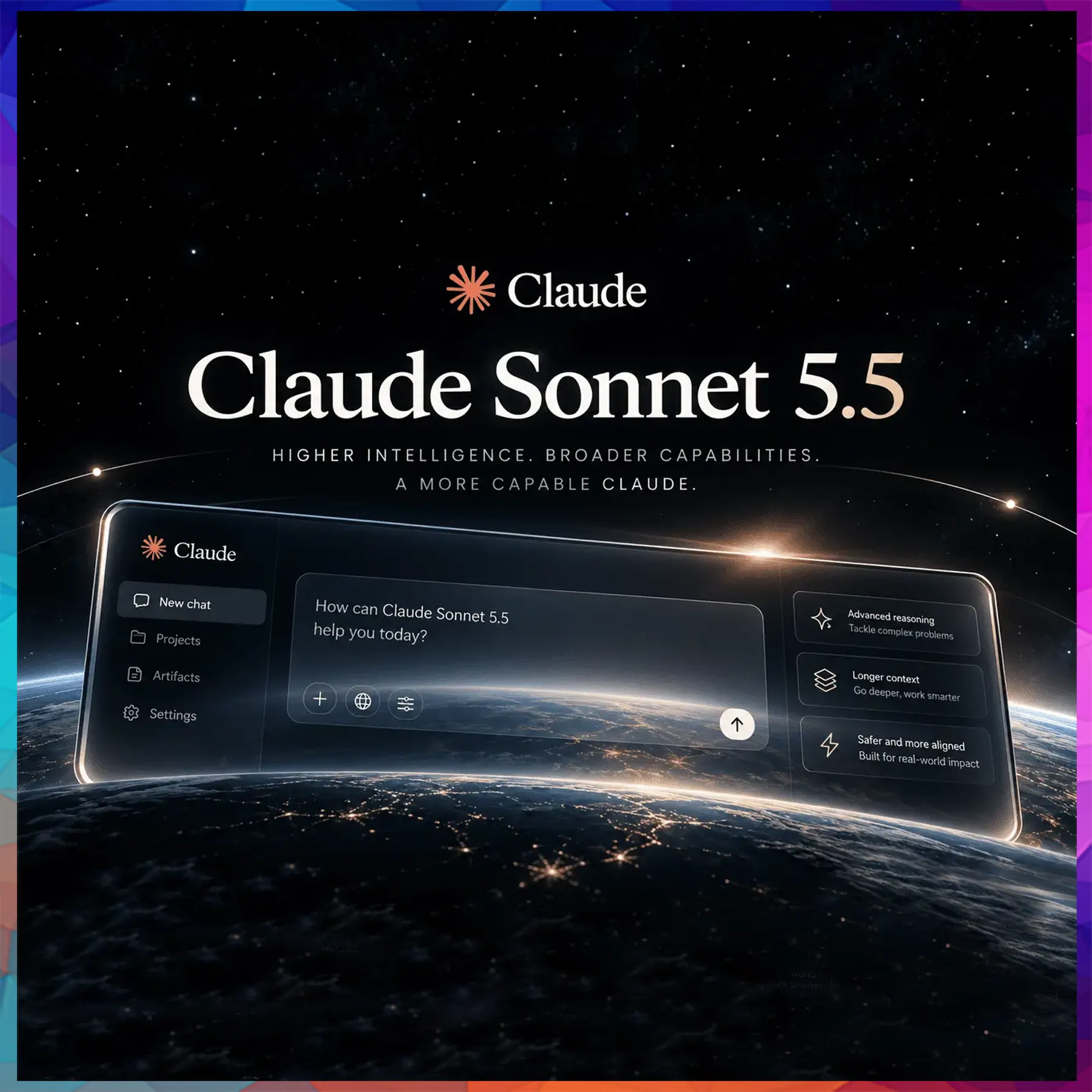
Anthropic has launched Claude Sonnet 5.5, its second Claude 5.5 model, only days after releasing Opus 5.5 and shortly after CEO Dario Amodei called for slowing the development of frontier AI. The apparent contradiction highlights the competitive pressure shaping today’s AI industry.
Sonnet 5.5 is designed as the faster, lower-cost alternative to Opus 5.5. Anthropic says it generates output more than 30% faster than Sonnet 5 and can cost up to 30% less per task while retaining pricing of $2 per million input tokens and $10 per million output tokens.
Its biggest improvement is agentic coding. Sonnet 5.5 scored 70.6% on Terminal-Bench 4.0, compared with 10.3% for Sonnet 5. Anthropic also positions it for bug fixing, long-running tasks, image understanding and creating professional documents, presentations and spreadsheets.
Safety is equally significant. Anthropic says Sonnet 5.5 improves or matches its predecessor across most alignment measures and introduces stronger cybersecurity safeguards because its cyber capabilities now approach those of more powerful Claude models.
For enterprises, the bigger disruption could therefore be economics rather than benchmark leadership. Faster models requiring fewer tokens can reduce the cost of deploying AI agents across software development, customer service, analytics, research and knowledge work.
This could intensify the emerging AI price war. OpenAI, Anthropic and other model providers increasingly face pressure to deliver greater intelligence at lower inference costs, potentially accelerating enterprise adoption while squeezing margins for model providers.
The industry is consequently entering a new phase: AI is becoming faster, cheaper and increasingly autonomous at the same time. The competitive advantage may shift from simply building the smartest model toward delivering the best combination of intelligence, cost, speed, security and controllability—making AI governance as important as AI performance.