New semantic layer, knowledge graph and GPU-accelerated processing aim to help AI agents deliver better answers at lower cost, with PowerScale security upgrades and production services also announced.
Dell Technologies has expanded its Dell AI Data Platform, the data foundation of the Dell AI Factory, with new data orchestration and storage capabilities. The company says the additions will help AI systems give better answers, cost less to run and reach production faster by supplying applications and agents with trusted, current context drawn from a company’s own data.
Why data, not the model, is the bottleneck
Dell argues that for most enterprises the obstacle to scaling AI is the data rather than the model. Valuable information is scattered across files, databases, cloud services and multiple sites, and most of it was created long before AI agents were expected to read it. Because it was never labelled or connected for machine use, agents spend tokens rebuilding answers that should already exist, which means more steps, more compute, higher cost and less reliable results.
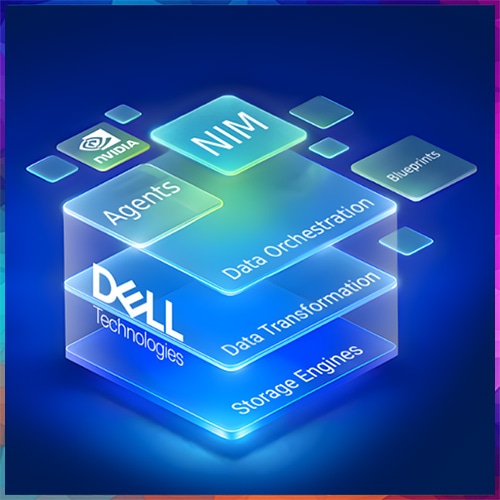
The platform is built end to end, from storage through to the point where agents use the data. Storage feeds accelerated compute, orchestration connects and prepares data, and analytics and search transform and index it. NVIDIA Nemotron Retriever models handle document parsing, embedding and reranking, while NVIDIA cuVS accelerates vector indexing and search.
Three new features for context
Dell is adding three features. The Unified Semantic Layer gives structured and unstructured data consistent business meaning through rules, definitions and a searchable glossary, so that if one system says “client” and another says “account,” AI recognises them as the same thing. Users can import existing ontologies and taxonomies, and Dell is enabling NVIDIA Auto-Ontology, an open-source library that builds knowledge graphs from enterprise data.
The Enterprise Knowledge Graph maps how data is related, using metadata, lineage and query history to keep refining itself. A manufacturer, for example, could trace an odd sensor reading to the machine, its repair history, the supplier batch and the orders at risk. Knowledge Agents then use this context, each acting as an adviser on one topic, with customers setting the rules on guidance, data access, quality and spending. All three components stay inside the platform in the customer’s data centre and do not lock customers into any single model, data or storage provider.
Faster processing and tighter security
In Dell’s testing, the Dell Data Processing Engine, powered by NVIDIA cuDF on NVIDIA RTX PRO 4500 Blackwell Server Edition GPUs, processed data nearly four times faster on average than CPUs alone, and up to 20 times faster on batch workloads. Apache Arrow will let jobs query data in place.
Dell PowerScale now supports up to 500 tenants in a single cluster, with mTLS over NFS and more granular role-based access control. A new Dell Storage Performance Tool helps customers size AI infrastructure by testing S3-compatible object storage across training, inference and checkpointing. Dell is also expanding implementation services to move deployments into production.
Executives’ views
Venkat Sitaram, Senior Director and Country Head, Infrastructure Solutions Group, India, Dell Technologies, said: “Indian enterprises are generating and managing more data than ever before. However, data without context is just noise. Most enterprises have spent years making their data accessible. That’s not the same as making it usable. An agent that can find a customer record but doesn’t know what it means, how it connects to everything else, or whether it can be trusted isn’t intelligent. It’s just fast. The companies that solve it won’t just deploy AI faster or run more agents. They’ll get more out of the data they already have.”
Jason Hardy, vice president of storage technology at NVIDIA, said: “AI agents are only as effective as the data they can access, understand, and trust, and NVIDIA accelerated computing and AI software help turn governed data into AI-ready context. By bringing NVIDIA cuDF acceleration directly into the Dell Data Processing Engine, Dell helps shorten the path from stored data to GPU-accelerated AI-ready data their agents can use to drive real world innovation.”
Availability
The Unified Semantic Layer, Enterprise Knowledge Graph and Knowledge Agents will be released in the first half of 2027. Data Processing Engine enhancements with the NVIDIA stack arrive in December 2026, with Apache Arrow acceleration expected in the first half of 2027. PowerScale security and multitenancy upgrades are due in November 2026. The Dell Storage Performance Tool and AI-ready data services are available now.