
Enterprise technology is evolving. Systems now interact continuously across applications, data platforms, AI models, devices, and security layers. This shift brings not only greater capability but also deeper interdependence.
Many organizations still expect failures to occur only at obvious breakdown points. However, modern digital systems often fail differently.
They fail much earlier, when they stop holding together.
These early failures manifest as strain rather than outages. Integration backlogs increase, data becomes inconsistent, and AI models act unpredictably outside their training context. Security controls become reactive, and teams spend more time coordinating than delivering.
Operational friction often signals underlying structural issues.
“Indian enterprises are entering a phase where digital scale is no longer the challenge, coherence is. The ability to manage interactions across systems will define the next wave of technology leadership.” - Deepak Kumar Sahu, MD & Editor, VARINDIA
A new failure pattern
Previously, digital systems failed at the component level, such as server outages, unavailable databases, or broken network links.
Today, failures often arise from interactions among systems.
For example, an AI model may consume data from multiple pipelines, trigger decisions in downstream applications, and influence real-world actions. While each step functions independently, the overall system can behave unpredictably.
This shift from component to interaction failures changes how risk accumulates. Dependencies multiply across systems, teams, and domains, allowing small misalignments to propagate rapidly. Coordination becomes the primary cost, often hidden from architecture diagrams and investment decisions.
In India, this trend is accelerating. Enterprises are rapidly scaling digital platforms across sectors such as banking, healthcare, manufacturing, and public infrastructure. AI adoption andintegration layers are expanding quickly, increasing the surface area of interaction faster than the governing structures.
As a result, systems may appear functional but remain fragile, a situation familiar to many technology leaders.
Why current approaches fall short
Most enterprise practices were designed for a previous era.
Architectures focus on components and layers. Integration connects systems but does not guarantee coherence. Data platforms organize information but often lack alignment across use cases. AI adds intelligence but can also increase unpredictability.
Security and governance are frequently added after systems are built, attempting to control already complex behaviors.
This approach creates a fundamental imbalance. Capability grows faster than coordination capacity. As more systems and interactions emerge, maintaining coherence becomes increasingly difficult.
The core issue is not technology, but the absence of structural discipline that prioritizes interaction as the main design focus.
From layers to threads
Digital Weaving introduces this discipline by reflecting how modern systems operate through continuous interaction.
It begins with a shift in perspective: systems are not merely stacked layers, but threads that interact continuously.
Layers describe structure. Threads describe behavior.
Connectivity links systems, sensing digitizes the physical world, data organizes information, intelligence interprets and acts, and trust governs behavior throughout.
These are not separate layers. They are interdependent threads.
When these threads align, systems remain cohesive. As they drift, strain develops, and accumulated strain leads to loss of coherence.
Digital Weaving clarifies one of modern IT’s most complex challenges: managing interconnected systems at scale. It enables organizations to move beyond integration and design for coherence.
The operating discipline
Designing for interaction requires a new approach.
Rather than building systems and stabilizing them afterward, Digital Weaving treats coherence as an ongoing process. The operating rhythm is straightforward: layer, test, adapt, and repeat.
Each layer introduces new interactions, and each test reveals their real-world behavior. Adaptation realigns threads before strain accumulates, and this cycle continues as systems evolve.
This discipline enables three critical capabilities.
First, visibility: interactions must be observable, as hidden dependencies often cause failures.
Second, reversibility: systems must be able to reverse decisions, which is essential as AI systems gain autonomy.
Third, embedded governance: trust must be designed into every interaction, not added as a final control layer.
This is especially important as AI becomes more integrated into enterprise workflows. Models influence decisions and actions, and without structural control, small errors can escalate quickly.
What this means for enterprises
The implications are immediate.
Enterprises must move beyond integration as the primary goal. While connecting systems is necessary, the real challenge is ensuring these connections remain coherent under load.
This is evident in sectors where digital scale is outpacing structural alignment, such as banking platforms and public digital infrastructure.
AI adoption should include governance during design. Delaying control until after deployment increases risk and cost. Trust must be built into systems from the outset.
Platforms should make interactions visible, as visibility is essential for managing complexity.
This shift also changes architectural priorities. Leaders must focus on managing relationships between systems, making coordination a design priority rather than an operational afterthought.
Organizations that adapt will build scalable, reliable systems. Those that do not will face increasing coordination costs and unpredictable behavior.
Systems that hold
The next generation of digital systems will be defined not by their capabilities, but by their ability to remain cohesive under pressure.
This demands a new discipline that treats interaction as fundamental, coherence as measurable, and trust as structural.
“We are no longer building systems that run in isolation. We are shaping environments in which systems continuously influence one another. Digital Weaving ensures those interactions remain coherent, governed, and trustworthy.” — Syam Madanapalli, Author, The Digital Weaver
As enterprises expand their digital capabilities, the key question shifts from building more systems to ensuring those systems remain cohesive as they grow and evolve.
Digital Weaving is designed to address this challenge.
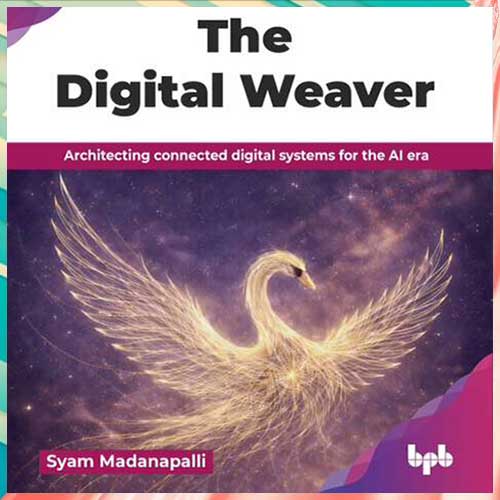
This perspective is explored in The Digital Weaver, which presents a structured approach to designing, governing, and sustaining connected digital systems in an age of continuous interaction.