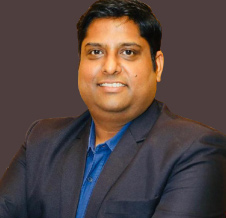
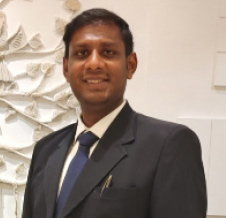
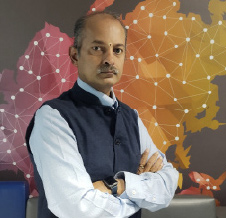
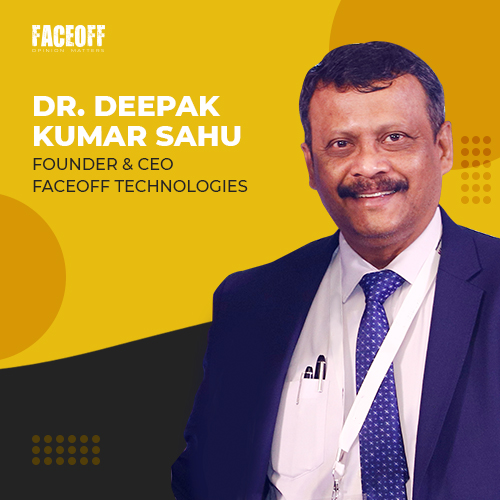
DR. ARINDAM SARKAR
CHIEF ARCHITECT, FACEOFF TECHNOLOGIES INC.
“Defending against deepfakes and synthetic identity fraud begins with confronting a difficult reality: most enterprise AI systems fail because they are not architected with privacy by design. Privacy today is not about concealing data; it is about embedding trust mathematically and structurally into digital systems. When organizations deploy AI without integrating differential privacy, tokenization, anonymization, secure multi-party computation, and edge-native controls, they create invisible vulnerabilities. As quantum computing advances, the risk multiplies. Encryption standards such as RSA and ECC, which underpin global digital infrastructure, will gradually weaken. The ‘harvest now, decrypt later’ model is already a strategic threat, making post-quantum cryptography an urgent requirement rather than a theoretical upgrade.
At FaceOff, our approach to digital trust is engineering-led and evidence-driven. Through our Adaptive Cognito Engine, we combine multimodal behavioural biometrics, contextual intelligence, federated privacy frameworks, and quantum-safe cryptographic standards including CRYSTALS-Kyber and CRYSTALS-Dilithium. We have introduced adaptive neural cryptography that dynamically adjusts encryption strength depending on attacker capability and computational risk. Our Deepfake Finder platform performs granular frame- by-frame video inspection, GAN fingerprint tracing, spatial and frequency domain forensics, temporal anomaly detection, and voice inconsistency analysis. We believe security systems must be explainable. That is why we follow a glass-box AI model where every decision is auditable, traceable, and supported by intermediate forensic evidence rather than opaque algorithmic outputs.
With evolving IT regulations mandating the labelling of AI-generated media and strict compliance timelines for takedown, detection must be precise, transparent, and fast. Our verification engine evaluates 468 facial parameters, identifies forged identity artifacts, measures physiological indicators such as heart rate and oxygen saturation through standard cameras, and strengthens digital onboarding and payment authentication using behavioural biometrics. We also enable encrypted machine learning so sensitive information can be processed without exposing plaintext. The future of cybersecurity lies in responsible AI, quantum resilience, and privacy-enhancing computation. Digital trust must be proactive, adaptive, and cryptographically prepared for the challenges of tomorrow.”

See What’s Next in Tech With the Fast Forward Newsletter







Tweets From @varindiamag
Nothing to see here - yet
When they Tweet, their Tweets will show up here.