
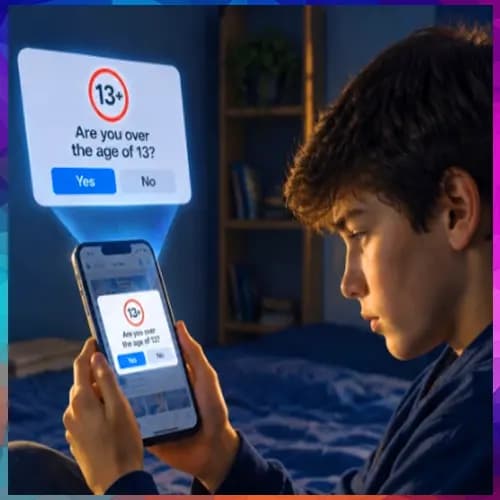
European Commission chief Ursula von der Leyen has unveiled plans to restrict young people's use of social media across the bloc, part of a broader global effort to shield minors from online harms and addictive platform features.
European Commission President Ursula von der Leyen has proposed a bloc-wide rule barring children under 13 from using social media, while introducing tighter restrictions for older teenagers. The move, if adopted, would be the European Union's first attempt at a unified age limit for social platforms and forms part of a larger international drive to protect children online.
Tiered restrictions for different age groups
Under the proposal, teenagers between 13 and 15 would only be permitted "mini accounts" that come with parental oversight, restricted features, and capped usage time. Those between 15 and 18 would be entitled to platforms built with "safe design" principles in mind. The plan must still pass through debate and approval by all 27 EU member states a process likely to stretch on for years — and could reignite friction with the Trump administration, which has repeatedly pushed back against Europe's approach to regulating technology.
Delivering her annual State of the European Union address in Strasbourg, von der Leyen rejected the notion that tech giants hold unchecked power, arguing that addictive design features, exposure of children to extreme content, and AI-generated sexualised imagery of girls are not inevitabilities society must tolerate. Her remarks build on comments she made earlier this year, when she suggested children should be eased into social media use gradually rather than given unrestricted access.
Major platforms including Facebook, Instagram and TikTok technically already prohibit under-13 users, though regulators have long argued enforcement has fallen short, with children routinely slipping through age checks.
Critics question whether plan goes far enough
Digital rights advocates have raised doubts about the proposal's depth. EDRi policy adviser Simeon de Brouwer argued the measure sidesteps the core issue platforms' advertising-driven business models that thrive on constant user engagement — and merely pushes back the age at which young people become targets, since companies will still pursue them the moment they age out of restrictions.
The EU's move mirrors a wider international pattern, with Spain, Portugal, Australia and New Zealand all pursuing their own youth social media restrictions. Not all such efforts have held up legally, however; France's constitutional court recently struck down a similar under-15 ban, prompting President Emmanuel Macron to pledge a revised version. Separately, Meta Platforms agreed last month to pay as much as $18 billion and strengthen child-safety protections on its apps to settle sweeping US litigation over teen addiction.
Following von der Leyen's address, European Parliament figure Manfred Weber suggested the EU adopt an Australian-style option letting users disable social media algorithms entirely. Von der Leyen also touched on artificial intelligence oversight, signalling the Commission's intent to engage AI developers on safety coordination with allies such as Canada and the UK.