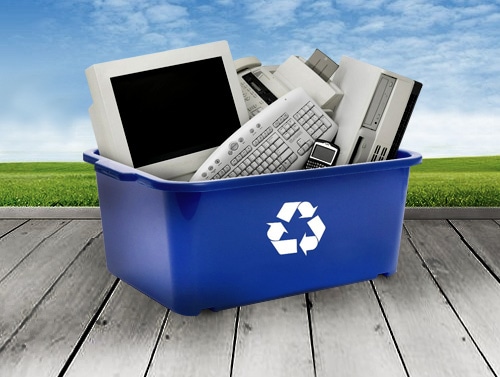
 As per Guidelines on Implementation of E-waste (Management) Rules, 2016, the E-waste collection target for FY2022-23 would be 70 per cent of E-waste generation.
Initially, E-waste collection target for the financial year 2016-17 would be 15 per cent of the estimated E-waste generation, and for the year 2017-18, the collection target would be 30 per cent. These targets would increase to 40 per cent for next 2 financial years between 2018-20, 50 per cent for the financial years between 2020-22 and 70 per cent of the estimated E-waste generation for the financial years 2022 – 2023 onwards.
Estimation of target for collection shall be based on estimated generation calculated for each EEE (Estimated E-waste Generation) code for a specific financial year as specified in the table below.
The collection targets would be applicable depending on life of the product and accordingly, if a producer enters the business in the year 2016-17 for a particular item code, the collection targets for which would be applicable from the year 2021-22 at 50 per cent collection target.
E-Waste (Management & Handling) Rules, 2011 were notified in 2011 and had come into force since 1st May, 2012. In order to ensure effective implementation of E-waste rules and to clearly delineated the role of producers in EPR, ministry of environment & forest, government of India in supersession of E-waste (Management and Handling) Rules, 2011 has notified the E-waste (Management) Rules, 2016 vide G.S.R. 338(E) dated 23.03.2016 called as Guidelines on Implementation of E-waste (Management) Rules, 2016 which will be effective from 01-10-2016.
These rules are applicable to every producer, consumer or bulk consumer, collection centre, dismantler and recycler of e-waste involved in the manufacture, sale, purchase and processing of electrical and electronic equipment or components.
Two categories of electrical and electronic equipment namely - IT and telecommunication equipment and consumer electricals and electronics such as TVs, washing machines, refrigerators air conditioners including fluorescent and other mercury containing lamps are covered under these rules.
Average Life of Equipment EEE (Estimated E-waste Generation) Equipment - Average life of equipment IT & Telecom Equipment Mainframe - 10 Minicomputer - 5 Personal Computing: Personal Computers - 6 Personal Computing: Laptop Computers - 5 Personal Computing: Notebook Computers - 5 Printers including cartridges - 10 Copying equipment - 8 Electrical and electronic typewriters - 5 User terminals and systems - 6 Facsimile - 10 Telex - 5 Telephones - 9 Pay telephones - 9 Cordless telephones - 9 Cellular telephones - 7 Feature phones - 7 Smartphones - 5 Answering systems - 5 Consumer Electrical and Electronics Television sets (including sets based on LCD and LED) - 9 Refrigerator - 10 Washing Machine - 9 Air Conditioners (excluding centralised air conditioning plants) - 10 Fluorescent and other Mercury containing lamps - 2 Source: Guidelines on Implementation of E-waste (Management) Rules, 2016
Target based approach for implementation of EPR has been adopted in the E-waste (Management) Rules, 2016, which stipulate phase wise collection target to producers for the collection of E-waste, either in number or weight, which shall be 30 per cent of the estimated quantity of waste generation during first two year of implementation of rules followed by 40 per cent during third and fourth years, 50 per cent during fifth and sixth years and 70 per cent during seventh year onwards.