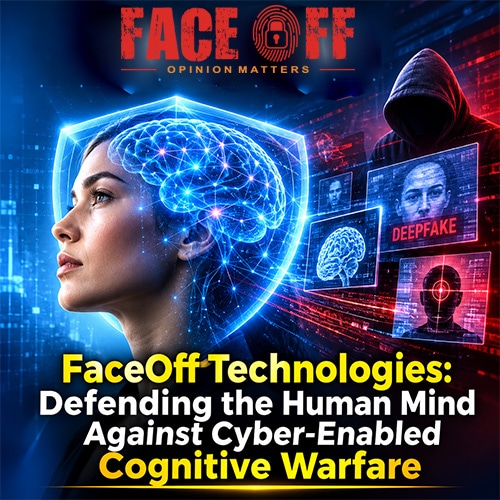
Building a sovereign AI-powered trust layer to counter deepfakes, digital deception, synthetic identities and information manipulation.
The Next Battlefield Is Human Trust
Cyber warfare is entering a dangerous new phase. The objective is no longer limited to stealing data, disrupting networks or compromising critical infrastructure. Increasingly, adversaries are targeting human perception, decision-making, institutional credibility and public trust.
This emerging threat is known as Cyber-Enabled Cognitive Warfare (CECW), where artificial intelligence, social engineering, deepfakes, disinformation and coordinated cyber operations are used to manipulate what people see, hear, believe and ultimately decide.
Unlike conventional cyberattacks, cognitive warfare does not always require breaching a firewall. A fabricated video, cloned voice or convincing impersonation can influence financial decisions, damage reputations, create public panic or undermine confidence in institutions.
The new battlefield is not merely the computer network. It is the human mind.
FaceOff's Mission: Protecting Digital Truth
Recognising this evolving threat landscape, FaceOff Technologies is developing a sovereign, AI-powered digital trust ecosystem designed to strengthen resilience against cyber-enabled deception and cognitive manipulation.
At the heart of its technology is the proprietary Adaptive Cognito Engine (ACE®), which combines multimodal AI intelligence to examine digital identities, facial characteristics, voice signals, behavioural patterns and contextual indicators.
Rather than relying on a single image, voice recording or biometric match, ACE® evaluates multiple signals to identify inconsistencies that may indicate synthetic content, impersonation or fraudulent interactions.
Its Trust Factor and Confidence Score framework is designed to help organisations assess digital authenticity before taking critical decisions.
Five Pillars of Cognitive Defence
FaceOff's approach to cyber-enabled cognitive warfare is built around five interconnected capabilities:
-
Deepfake and Synthetic Media Detection: Identifying manipulated videos, cloned voices, AI-generated images and fabricated digital identities that could be used to spread misinformation or impersonate trusted individuals.
-
Multimodal Identity Assurance: Combining facial, voice, liveness and behavioural signals to strengthen verification of individuals involved in sensitive communications and transactions.
-
AI-Powered Threat Intelligence: Analysing suspicious digital content and patterns associated with impersonation, coordinated deception and emerging social-engineering campaigns.
-
Continuous Behavioural Trust: Using behavioural analytics and contextual signals to detect suspicious changes during digital interactions, rather than relying exclusively on initial authentication.
-
Sovereign and Privacy-First Deployment: Supporting on-premises, private-cloud and isolated deployment models for institutions handling sensitive information and national-security-related workloads.
Together, these capabilities form a defensive framework for protecting digital evidence, trusted communications and high-risk decision-making.
From Cybersecurity to Cognitive Security
Consider a scenario where a senior government official appears in a fabricated video announcing an emergency. Within minutes, the content spreads across social media, creating confusion and potentially influencing public behaviour.
In another scenario, cybercriminals clone the voice of a bank executive to authorise a fraudulent transfer. The attacker may never compromise the bank's core network; instead, the attack exploits the trust placed in a familiar voice.
FaceOff's technology is designed to support verification in such situations by analysing the authenticity of media, identity and interaction signals, flagging anomalies and enabling further investigation.
The objective is to help institutions move from reactive incident response towards proactive deception detection and evidence-based verification.
However, automated detection is not infallible. High-impact decisions must retain human oversight, forensic validation and appropriate safeguards against false positives.
Strategic Relevance for India
India's expanding digital economy, UPI ecosystem, e-governance platforms, defence infrastructure and interconnected communications networks create significant opportunities for innovation—but also expose institutions to sophisticated AI-enabled deception.
Cyber-enabled cognitive attacks could target financial institutions, public services, corporate leadership, emergency communications and the wider information ecosystem.
FaceOff Technologies aims to contribute to India's indigenous cyber-defence capabilities through its Make in India, Made for the World approach, with applications across BFSI, law enforcement, government, critical infrastructure and enterprise security.
Its sovereign architecture is particularly relevant where sensitive identity information and forensic evidence must remain within controlled environments.
Building a Cognitive Trust Shield
The next generation of cyber resilience will require collaboration among technology providers, cybersecurity teams, intelligence analysts, regulators, media organisations and public institutions.
FaceOff's longer-term opportunity lies in integrating deepfake forensics, identity assurance, threat intelligence and continuous trust assessment into an interoperable defensive architecture.
Such an architecture could help organisations identify manipulated information, verify sensitive communications, preserve digital evidence and reduce the likelihood of deception-driven decisions.
The ultimate objective is not to control human thinking, but to protect people's ability to make informed decisions based on authentic information.
The Future of Warfare Is a Battle for Trust
As generative AI makes digital impersonation increasingly accessible, the distinction between authentic and fabricated information will become a defining security challenge.
Traditional cybersecurity protects networks, applications and data. Cognitive security must also protect the integrity of information and the decisions that depend on it.
FaceOff Technologies is working towards this next frontier: transforming digital authenticity, behavioural intelligence and sovereign AI into a defensive trust layer against cyber-enabled cognitive warfare.
The future of national and enterprise security will depend not only on protecting what we know, but also on verifying what we are made to believe.
FaceOff's guiding principle: Verify Before You Trust.