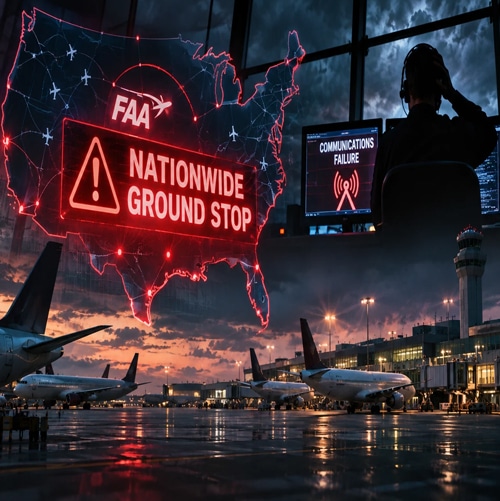
A major aviation disruption across the United States has exposed vulnerabilities in the country's aging air traffic control infrastructure, raising serious concerns about communication reliability, operational resilience, and aviation safety.
The Federal Aviation Administration (FAA) temporarily suspended departures nationwide after technical failures disrupted critical communication systems connecting air traffic controllers, radar facilities, and aircraft.
Preliminary findings suggest the disruption originated during a telecommunications modernization project involving the replacement of aging copper communication lines with advanced fiber-optic infrastructure.
According to reports, a malfunctioning network router generated more than 1,000 connection attempts every four to five seconds, overwhelming interconnected systems and triggering widespread communication instability.
The excessive network traffic reportedly affected multiple air traffic control centers, disrupting the transmission of essential radar information and communication services required for safe aircraft operations.
With controllers unable to guarantee consistent communication with pilots, the FAA implemented a nationwide ground stop as a precautionary safety measure, preventing potentially dangerous situations during takeoffs and flight movements.
The disruption reportedly affected thousands of flights, causing cancellations, delays, passenger inconvenience, and operational challenges for airlines. International carriers, including Air India, issued advisories regarding possible schedule disruptions.
Importantly, authorities reported no evidence of cyberattacks or foreign interference. Investigators are examining whether defective equipment, installation errors, or inadequate network safeguards contributed to the cascading technical failure.
The incident highlights the risks associated with interconnected digital infrastructure. Even routine technology upgrades can trigger widespread failures when network segmentation, redundancy, monitoring, and recovery mechanisms are insufficient.
The larger lesson is that technological modernization without resilience creates systemic vulnerability. Aviation authorities must prioritize intelligent network monitoring, automated fault isolation, redundant communication systems, and rigorous infrastructure testing. For technology providers, the incident reinforces the importance of building AI-assisted predictive maintenance and resilient architectures that can detect anomalies before they escalate into nationwide operational emergencies, while ensuring human oversight of safety-critical decisions.