
Before believing any post on social media, FaceOff Technologies empowers users to verify its authenticity. Our advanced DeepFake and DeepVideo Detection platform performs a comprehensive forensic analysis of images and videos, identifying AI-generated manipulations, face swaps, synthetic media, voice cloning, editing artifacts, and other signs of tampering.
The platform ,with the central processing engine provides an explainable trust score and detailed authenticity report, enabling users to distinguish genuine content from manipulated media before they share, believe, or act on it. By transforming digital verification into a simple, real-time process, FaceOff Technologies helps individuals, enterprises, governments, and social media platforms combat misinformation, prevent online fraud, and build trust in the age of generative AI.
FaceOff Technologies is expanding its deepfake and synthetic-media detection capabilities to address a growing category of digital risk: AI-generated content that targets teenagers. Built on its DeepFake and DeepVideo Detection platform, the initiative is designed to identify manipulated, synthetic, or harmful visual content before it can inflict emotional, psychological, or reputational damage on young users.
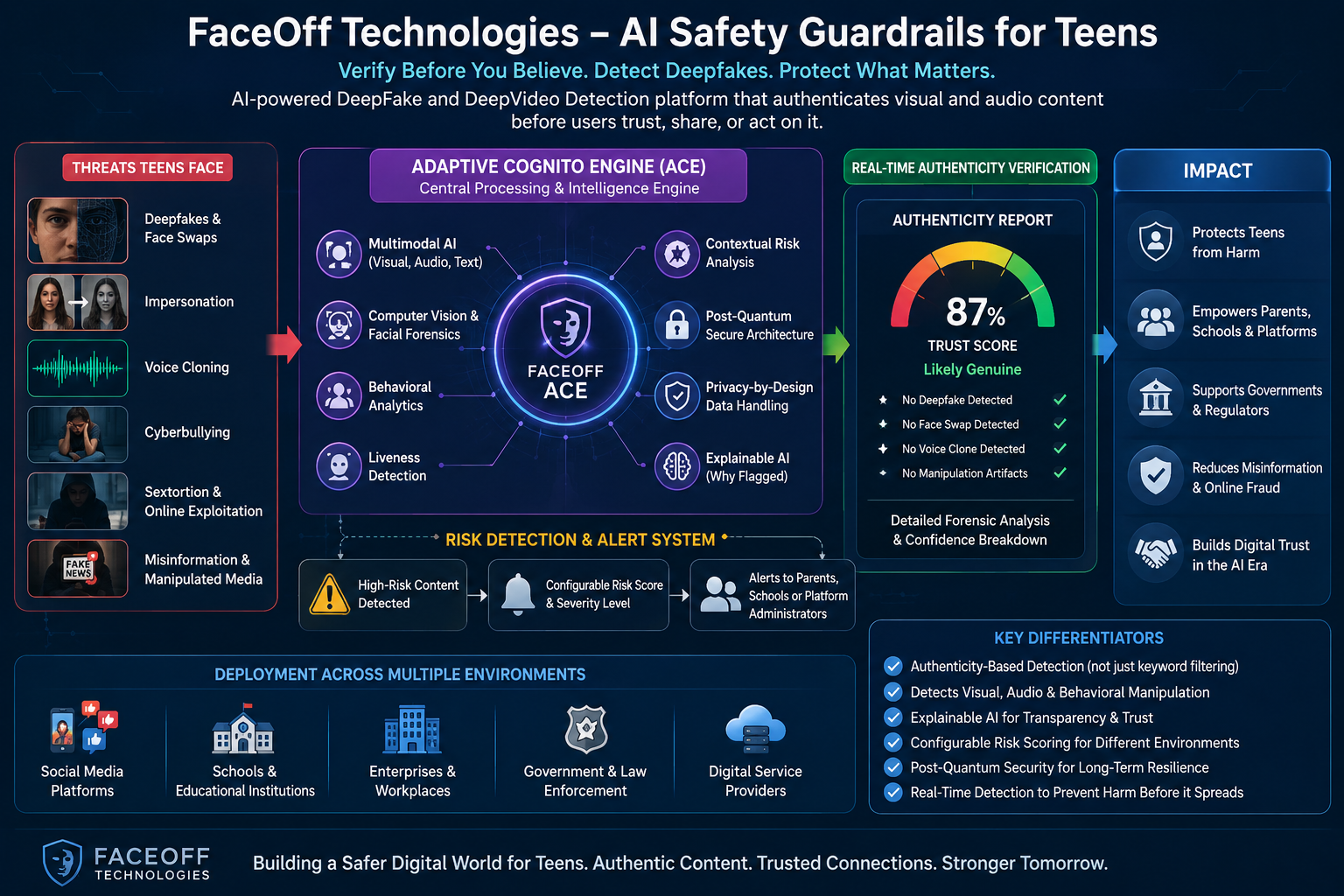
At the core of the system is FaceOff's proprietary Adaptive Cognito Engine (ACE), which fuses multimodal AI, computer vision, facial forensics, behavioral analytics, liveness detection, and contextual risk analysis. Rather than depending on keyword filters, ACE evaluates the authenticity of visual and audio media alongside behavioral signals, allowing it to flag synthetic images, videos, face swaps, and cloned voices in real time. This approach extends the platform's reach into risk categories that disproportionately affect minors: grooming, impersonation, cyberbullying, sextortion, and deepfake-based abuse.
When the system detects high-risk content, it generates a configurable risk score and routes alerts to parents, schools, or platform administrators, depending on deployment context. Privacy-by-design principles govern how data is handled, and explainable AI outputs let human reviewers see why content was flagged, a safeguard against false positives that also builds trust with the institutions relying on the system.
The underlying architecture is post-quantum-secure, positioning FaceOff's offering for long-term deployment across social platforms, schools, and digital service providers as they look to get ahead of manipulated media before it spreads rather than reacting after the fact.
Market context: This move places FaceOff in a space that's rapidly gaining regulatory and commercial urgency. Meta, Instagram, and OpenAI have all rolled out teen-safety features this year focused on text-based conversational risk (suicide, self-harm, grooming language). FaceOff's play is differentiated in that it targets the visual and audio layer, deepfakes, face swaps, cloned voices, rather than conversational text. That's a meaningful gap: text-moderation tools generally can't detect a fabricated video or a cloned voice used for sextortion, so a platform combining both could offer more complete coverage.
Technical differentiation: The claimed shift from keyword-based to authenticity-based detection is significant if borne out in practice. Keyword systems are brittle against evasion (misspellings, coded language); a system that evaluates the media itself rather than surrounding text is harder to game, though it also raises the bar for accuracy, since visual forensics on fast-evolving generative models is an ongoing arms race, as new deepfake generation methods regularly outpace detectors trained on prior ones.
Trust and adoption levers: Two features stand out as adoption enablers rather than pure technical flourishes:
● Explainable AI reduces the "black box" objection that often stalls enterprise and school procurement of AI safety tools, since reviewers need to justify actions taken against a minor's account or content.
● Configurable risk scoring lets schools, platforms, and parents set their own thresholds, which matters because risk tolerance and legal obligations differ a lot between a K-12 school district and a social media platform.
Open questions: A few things aren't addressed in the description and would matter to anyone evaluating this commercially: what accuracy/false-positive rates look like in practice, how the system handles cross-border regulatory differences (COPPA, UK Online Safety Act, EU DSA), and whether detection works on encrypted or ephemeral content (a common evasion route in sextortion cases). These are the kinds of details that typically show up in a technical whitepaper or pilot results rather than a product announcement.
Positioning risk: Because FaceOff's core business has historically centered on financial fraud and identity verification, moving into child-safety is a credibility-sensitive pivot — claims here will likely draw more scrutiny (from regulators, child-safety NGOs, and press) than claims in the fraud-prevention space, so validation data (audits, third-party testing, pilot partnerships with schools or platforms) would strengthen the announcement considerably.
In summary, FaceOff Technologies is enhancing teen safety through AI-powered DeepFake and DeepVideo Detection. Using its Adaptive Cognito Engine (ACE), the platform authenticates images, videos, and audio, detecting synthetic media, impersonation, and online abuse. With explainable trust scores, privacy-by-design, and post-quantum security, it helps users verify content before trusting or sharing it.