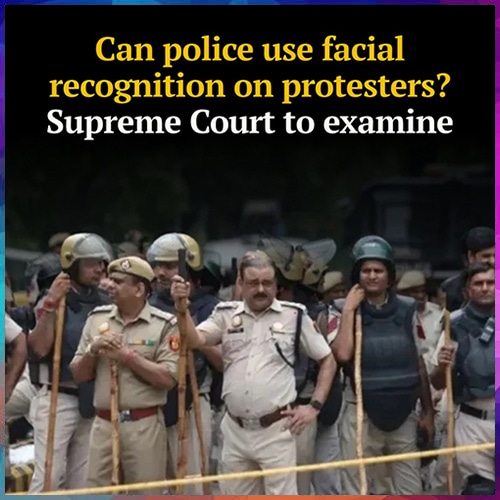
The Supreme Court is examining whether Delhi Police's use of facial recognition technology during protests at Jantar Mantar constitutes unlawful State interference, raising fundamental questions about privacy, surveillance and constitutional freedoms.
The petitioners, represented by advocate Prashant Bhushan, have demanded transparency regarding surveillance technologies, their legal authorisation, data collection practices and safeguards against potential misuse.
Key Arguments
-
Privacy: Public participation does not automatically eliminate constitutional privacy protections.
-
Legal Authority: Biometric surveillance requires a clearly established and applicable legal framework.
-
Proportionality: Security measures must be necessary, targeted and proportionate.
-
Accuracy: Facial recognition errors can lead to wrongful identification and harassment.
-
Data Protection: Biometric records require strict retention, access and deletion safeguards.
-
Human Oversight: Automated matches must never independently justify coercive police action.
-
Democratic Freedom: Surveillance must not discourage lawful protests or undermine freedom of expression.
Justice Joymalya Bagchi questioned whether conventional CCTV monitoring can be equated with AI-powered facial recognition capable of identifying individuals across massive databases.
The distinction is significant. While cameras observe public activities, automated biometric identification can potentially track individuals, establish identities and create persistent surveillance records without their knowledge.
Solicitor General Tushar Mehta defended police surveillance as a legitimate security measure, arguing that individuals protesting publicly cannot expect complete privacy from cameras installed for public protection.
However, the Court highlighted concerns surrounding automated identification accuracy, database matching and potential State interference. Authorities maintained that facial recognition matches undergo physical verification before enforcement action.
The debate also involves India's Criminal Procedure (Identification) Act, 2022, which permits specified biometric collection but raises questions about its application to ordinary protesters.
Separately, Delhi traders argued that prolonged demonstrations disrupt commercial activities and livelihoods. The Court acknowledged competing constitutional interests involving peaceful protest, public safety and economic freedom.
Chief Justice Surya Kant emphasised that designated protest spaces cannot be occupied indefinitely, particularly when other groups also seek opportunities to exercise their democratic rights.
The larger question extends beyond policing: Can governments deploy powerful biometric surveillance without creating a chilling effect on dissent? India's eventual judicial approach could establish crucial boundaries for AI surveillance, proportionality, accountability and democratic freedoms in public spaces.