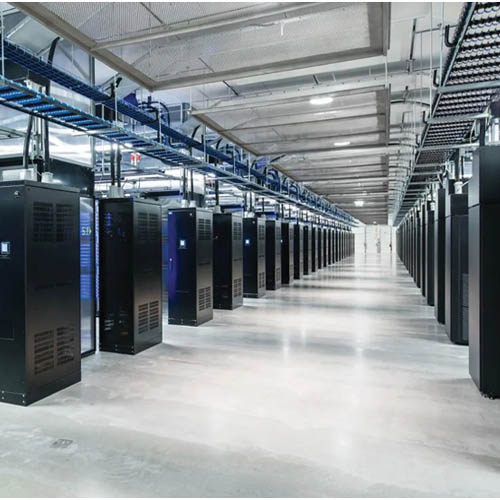
The rapid adoption of Artificial intelligence (AI), especially large models and generative AI, has driven unprecedented demand for high-performance compute capacity. Traditional data centers aren’t optimized for these workloads, which need far more processing power and memory.
The result - purpose-built AI data centers with advanced GPUs and AI accelerators are becoming essential infrastructure for enterprises and cloud providers alike.
They support large-scale AI workloads, including machine learning, deep learning, and data analytics and are equipped with high-performance computing resources to efficiently process massive datasets.
AI-ready data centers feature redesigned infrastructure to accommodate higher power density, advanced cooling (including liquid cooling), and optimized networking to handle sustained, compute-intensive workloads. These enhancements help boost performance and scalability while supporting next-generation AI applications. These help to accelerate AI model training and inference, enabling faster insights, predictions, and automation for businesses and research.
The main components of artificial intelligence (AI) datacenters are hardware, software, and services. Hardware refers to physical computing and networking components such as servers, storage devices, networking switches, and cooling/power infrastructure that enable AI workloads and data processing. It includes various data center types such as hyperscale data centers, colocation data centers, edge data centers, and others.
AI data centers are becoming critical infrastructure for sectors like finance, healthcare, manufacturing, and cloud computing, supporting innovation and enabling services that were previously impractical due to computational limits. Enterprises see them as key enablers of digital transformation.
 |
 |
 |
| VIPIN JAIN PRESIDENT, HYPERSCALE GROWTH, DELIVERY & INNOVATION, CTRLS DATACENTERS |
PIYUSH PRAKASHCHANDRA SOMANI PROMOTER, MANAGING DIRECTOR AND CHAIRMAN, ESDS |
PARITOSH PRAJAPATI CEO GX GROUP |
 |
 |
 |
| PANKAJ MALIK CEO AND WHOLE-TIME DIRECTOR AT INVENIA-STL NETWORKS |
MANOJ PAUL MD EQUINIX INDIA |
BHARATH DESAREDDY FOUNDER AND CHIEF EXECUTIVE OFFICER OF SMARTSOC |
AI DATACENTER MARKET SIZE
The AI data center market has seen strong growth and investment, with the global sector expanding rapidly and forecast to continue doing so. Increased enterprise adoption of AI services and cloud-based AI deployments fuels long-term demand for scalable, efficient AI data center capacity.
The AI Datacenters market size has reached to $16.57 billion in 2024, according to the Business Research Company. The market is further expected to grow to $59.39 billion in 2029 at a compound annual growth rate (CAGR) of 29%.
This growth can be attributed to increasing demand for high-performance computing, rising cloud service deployment, increasing investments in data center infrastructure, growing need for energy-efficient solutions, and rising demand for automated operations.
AI WORKLOADS INFLUENCING DATACENTER DESIGN
As is seen in the recent times, the surge of AI applications has contributed to unprecedented demand on data centre infrastructure. Existing facilities are no longer fit for purpose and AI-ready capacity is in short supply.
As AI, machine learning, and GPU-intensive workloads move from experimentation to production, datacenters are facing sustained increases in power density and thermal load. Unlike conventional enterprise applications, AI workloads generate concentrated heat over longer durations, making cooling design and operational efficiency critical to performance, uptime, and energy management.
“In this context, AI readiness is increasingly defined by how effectively a datacenter can manage heat at scale,” points out Piyush Prakashchandra Somani, Promoter, Managing Director and Chairman, ESDS. “At ESDS, AI-ready infrastructure is approached through measured capacity enablement, hybrid cooling architectures, and operational controls that align with real- world workload requirements.”
ESDS’s current datacenter capacity is configured to support AI and GPU-intensive workloads. This capacity is supported by higher rack power densities, resilient power infrastructure, and optimized airflow management designed to handle elevated thermal loads.
“AI readiness is assessed and enabled at the rack and zone level, rather than being uniformly applied across entire facilities. This approach enables higher-density deployments to coexist alongside traditional enterprise workloads, while maintaining thermal stability and operational continuity,” explains Piyush.
As AI workloads continue to influence datacenter design parameters, cooling strategies must balance adaptability with operational discipline. ESDS’s approach emphasizes selective AI readiness, hybrid cooling deployment, and data-driven thermal management, ensuring that higher compute densities are supported without compromising efficiency, reliability, or compliance.
“AI workloads today span model training, inference, and data-in-motion, each with distinct performance and connectivity requirements. A significant and expanding share of Equinix’s global and India footprint is purpose-built to support all three,” explains Manoj Paul, MD, Equinix India. “Our newest facilities, CN1 in Chennai and the soon-to- launch MB3 in Mumbai, are engineered as AI- ready datacenters supporting higher power densities with advanced cooling capabilities, and the enormous fiber interconnection required for GPU clusters. While these Equinix facilities are designed to support centralized AI training workloads, they are very uniquely designed and positioned to support latency-sensitive AI Inferencing closer to users with interconnection solutions to reduce latency.”
“We are also scaling liquid-cooling readiness across our platform, with deployments booked in 17 metros globally and plans to expand advanced liquid-cooling technologies such as direct-to-chip to more than 100 IBXs in over 45 metros. Taken together, these investments mean a large portion of our data center capacity is already AI-workload ready, with readiness increasing rapidly as demand grows,” Manoj adds.
Agrees Vipin Jain, President, Hyperscale Growth, Delivery & Innovation, CtrlS Datacenters, who believe that the Indian datacenter industry is at an inflection point, particularly when it comes to cooling and infrastructure design.
“Cooling systems are undergoing a fundamental transformation, and the industry is actively exploring Liquid cooling and chiller-less architectures that can significantly improve efficiency and sustainability. As rack densities rise and AI-driven workloads become mainstream, traditional cooling and layout assumptions will no longer suffice, prompting a complete rethinking of how data halls are designed and operated,” says Vipin.
“We are already seeing early indicators of this shift in physical infrastructure. Floor loading capacities are expected to increase, while the ratio between electrical infrastructure and server will increase. Power subscriptions are set to rise sharply, driven largely by AI workloads, which are far more power intensive and fluctuating than conventional computing.”
He further continues, “At CtrlS, we have designed our cooling infrastructure to meet the explosive growth of AI workloads. Our facilities are built with modular and hybrid cooling architectures—combining high- efficiency air cooling with advanced liquid and direct-to-chip cooling readiness. We are deploying high-efficiency cooling systems that dynamically adjust to real-time IT load, ensuring energy is not wasted during partial-load operations. Reducing cooling energy consumption is another strategic priority to improve datacenter power usage efficiency. We are approaching this through a combination of design innovation, advanced controls, and responsible operations.”
Pankaj Malik suggests that cooling resilience is treated as mission-critical within AI infrastructure, supported by proactive operational design, intelligent control systems, and fault-tolerant architecture. “The objective is clear - eliminate cooling- related downtime even as computational and thermal loads intensify. Redundancy is built into the cooling layer through N+1 and 2N architectures, ensuring uninterrupted operation even in the event of component failure. AI-powered temperature monitoring and predictive analytics identify emerging hotspots early, preventing thermal runaway before performance is impacted. Cooling is dynamically aligned with workload intensity through software-defined controls, avoiding sudden stress peaks during high AI utilisation. High-density GPU environments are stabilised using a combination of liquid cooling, in-row cooling, and hot-aisle cold- aisle containment, designed to manage concentrated heat loads at rack and chip level,” he explains.
“The result is resilient operations under sustained high-density AI workloads, maximum uptime, and consistent protection of AI performance at scale,” he says.
AIR COOLING VS LIQUID COOLING – WHICH IS BETTER
AI workloads are pushing datacenters to their thermal limits, demanding advanced cooling strategies. Traditional air-cooling can’t efficiently support high-density racks powered by GPUs and accelerators.
Operators now require liquid cooling, immersive systems, and real-time thermal analytics to maintain performance, reduce energy costs, and prevent downtime. Ensuring AI-readiness means modernizing cooling infrastructure, improving heat management efficiency, and adopting scalable designs for future high-density deployments.
Pankaj Malik, CEO and Whole-time Director at Invenia-STL Networks recounts, “Our standard deployments continue to leverage proven air-cooled solutions, which remain the most practical and widely adopted cooling approach across data centre environments today. However, as the industry approaches a tipping point driven by compute-intensive GPUs and rapidly rising rack densities, cooling architectures must evolve in parallel.”
He further continues, “As a system integration company, we are proactively addressing this shift through a hybrid cooling architecture that forms the cornerstone of our future-ready infrastructure strategy. This approach enables a seamless transition from traditional air-cooling to liquid-assisted and direct-to-chip cooling introduced precisely where workload intensity and performance demands require it, without operational disruption.”
By integrating these technologies within a unified architecture, Pankaj explains that they ensure continuity, scalability, and resilience across customer environments. “This positions us to support customers as their performance, density, and sustainability requirements evolve, while allowing us to design, recommend, and implement the most appropriate cooling solution tailored to each customer’s specific operational, technical, and business needs.”
Equinix operates a hybrid cooling model designed to balance performance, sustainability, and regional climate considerations. In India, we primarily deploy air-cooled chiller systems, which are extremely water-efficient and well-suited to local infrastructure contexts.
“Globally and in India, we also support advanced liquid-cooling technologies, including direct-to-chip, immersion, and rear- door heat exchangers, and offer a vendor- neutral approach so customers can deploy the hardware that best meets their AI density needs. We have liquid-cooling deployments across all three regions, including our new data centers in Chennai and Mumbai. Earlier this year, we demonstrated a full liquid-cooling environment in Hong Kong in collaboration with Dell and Schneider Electric and this facility is open for POC for enterprises planning to deploy liquid cooling for their private Ai deployment,” explains Manoj Paul.
SEMICONDUCTOR BREAKTHROUGHS RESHAPING AI DATACENTER PERFORMANCE
The rapid adoption of AI workloads is reshaping semiconductor priorities toward delivering higher performance efficiency, faster development cycles, and closer alignment between silicon design and system requirements. Advanced chip technologies, especially specialized processors like GPUs, ASICs, and customer AI accelerators are unlocking new levels of performance and efficiency that were previously unattainable with general-purpose CPUs alone.
As AI chip architectures grow in size and complexity, manufacturers are under pressure to improve performance per watt while managing power, thermal, and deployment constraints. To meet these demands, the industry is advancing toward smaller process nodes such as 2nm, 1.8nm, and below, along with wider adoption of advanced 3D packaging technologies including system-on-integrated-chip, system-on-wafer, and chip-on-wafer-on- substrate architectures. These approaches enable higher levels of integration and scalability, which are essential for supporting large-scale AI workloads in datacenter environments.
“At the same time, semiconductor manufacturers are placing greater emphasis on hardware-software co-design, recognizing that silicon performance alone is insufficient to meet AI datacenter requirements,” explains Bharath Desareddy, Founder and Chief Executive Officer of SmartSoC Solutions, A Virtusa Company. “Closer alignment between chip engineering, system software, cloud infrastructure, and application layers helps shorten development cycles, improve system-level efficiency, and support faster deployment of AI-driven datacenter platforms. Virtusa’s integration of SmartSoC aligns with this priority by bringing semiconductor engineering closer to the broader software and infrastructure stack.”
Paritosh Prajapati, CEO, GX Group states that new semiconductor designs are making AI chips much faster and more energy-efficient, allowing datacenters to process far more data in less space. “AI- ready datacenters are no longer defined by floor space, but by how effectively they can manage thermals and move data at scale,” he believes. “The rise of AI is pushing semiconductor manufacturers to move away from general-purpose processors toward chips purpose-built for AI workloads. Energy efficiency, high-speed memory, and faster, lower-loss data movement between chips have become top priorities.
He further continues, “This is where quantum and photonics technologies play a critical role, which is why GX has established its dedicated R&D and design hub in India under GX Quantum Photonics Pvt Ltd to advance optical interconnects and next-generation architectures. At the same time, manufacturers are working more closely with large cloud providers to secure long-term supply and co-design solutions that meet real, high-density datacenter requirements.”

See What’s Next in Tech With the Fast Forward Newsletter






Tweets From @varindiamag
Nothing to see here - yet
When they Tweet, their Tweets will show up here.