

As demand for AI infrastructure accelerates, competition among semiconductor vendors is intensifying, with Nvidia, AMD, Broadcom, Marvell and Infineon emerging as the companies to beat across key AI hardware segments, according to Gartner.
The analyst firm has identified market leaders across more than 40 AI technology categories under its "Company to Beat" research, evaluating vendors on criteria including technical capabilities, customer deployments, market potential, business model, strategic partnerships and ecosystem strength.
"In the AI vendor race, semiconductor front-runners have massive opportunities to capitalize on the shift toward next-generation infrastructure and the unprecedented demand for compute cycles," said Kevin Knox, practice vice president at Gartner.
"While current frontrunners are outpacing competition through deep technical expertise, software capabilities and ecosystem control, their status is being actively challenged by rivals capitalizing on supply chain diversification, the adoption of open industry standards, and the growing demand for efficient, inference-optimized architectures," Knox said.
Gartner named Nvidia the company to beat in AI network fabric, citing its dominance in AI accelerators and broad portfolio of data center networking technologies. The firm said Nvidia's proprietary technologies, including NVLink, SHARP, SHIELD and NVHS, continue to provide advantages in performance and reliability for large AI clusters.
The analyst firm has identified market leaders across more than 40 AI technology categories under its "Company to Beat" research, evaluating vendors on criteria including technical capabilities, customer deployments, market potential, business model, strategic partnerships and ecosystem strength.
"In the AI vendor race, semiconductor front-runners have massive opportunities to capitalize on the shift toward next-generation infrastructure and the unprecedented demand for compute cycles," said Kevin Knox, practice vice president at Gartner.
"While current frontrunners are outpacing competition through deep technical expertise, software capabilities and ecosystem control, their status is being actively challenged by rivals capitalizing on supply chain diversification, the adoption of open industry standards, and the growing demand for efficient, inference-optimized architectures," Knox said.
Gartner named Nvidia the company to beat in AI network fabric, citing its dominance in AI accelerators and broad portfolio of data center networking technologies. The firm said Nvidia's proprietary technologies, including NVLink, SHARP, SHIELD and NVHS, continue to provide advantages in performance and reliability for large AI clusters.
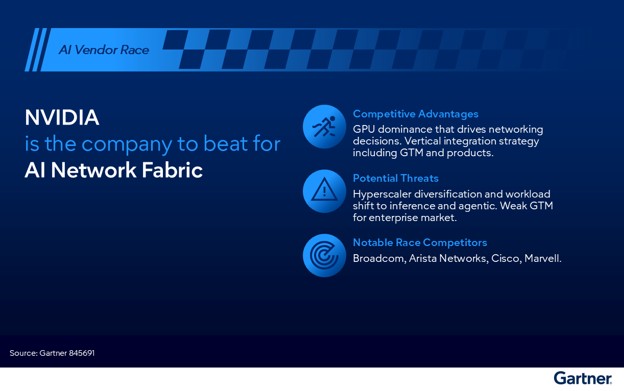
However, Gartner noted that the industry's transition from AI training workloads toward inference and agentic AI applications could reshape the competitive landscape. The analyst firm said hyperscale cloud providers are increasingly adopting open, Ethernet-based networking alternatives, creating opportunities for competitors.
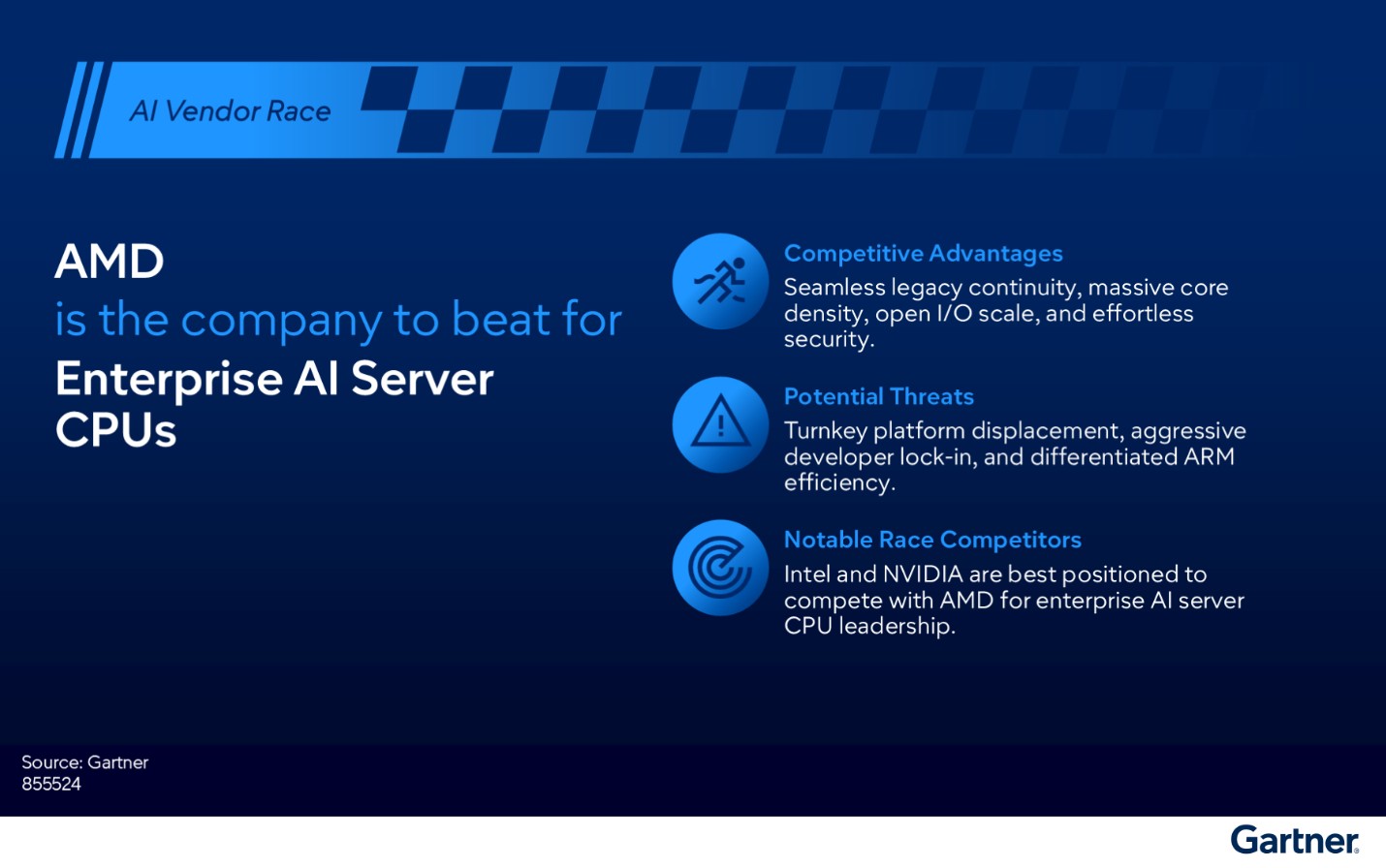
AMD was identified as the leader in enterprise AI server CPUs. Gartner credited the company with strong roadmap execution, broad ecosystem support, high I/O bandwidth and server consolidation capabilities, positioning it well for agentic AI deployments.
The firm cautioned, however, that AMD faces increasing competition from vendors offering tightly integrated hardware and software stacks as well as ARM-based processors that deliver improved performance per watt.
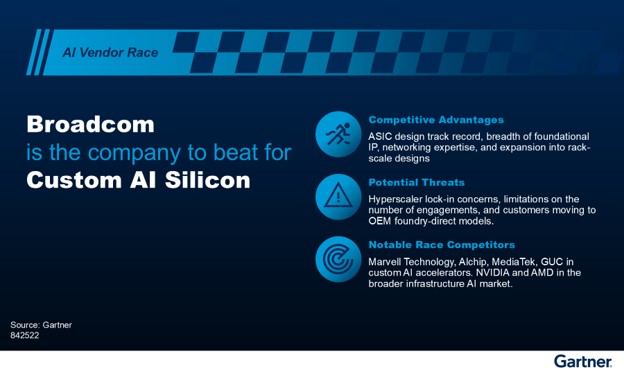
In custom AI silicon, Gartner named Broadcom the company to beat, highlighting its strengths in ASIC design, networking technologies, advanced packaging, memory and foundational intellectual property. According to the firm, competitors can narrow the gap by strengthening their IP portfolios, supporting system-level designs and collaborating with third-party IP providers or industry consortiums.
Marvell emerged as Gartner's leader in AI data center optical connectivity, driven by its portfolio spanning optical digital signal processors, analog optical components, linear receive optics and co-packaged optics technologies. Gartner said Marvell's position could face challenges from hyperscaler vertical integration, execution risks around co-packaged optics and emerging photonic architectures.
In AI data center power semiconductors, Gartner identified Infineon as the company to beat, citing its end-to-end power management portfolio across silicon, silicon carbide (SiC) and gallium nitride (GaN) technologies, supported by in-house manufacturing capabilities.
Gartner said Infineon's leadership is likely to face increasing competition as rivals expand their SiC and GaN portfolios, develop next-generation power solutions and strengthen partnerships across the emerging 800V DC data center ecosystem.
The rankings underscore how competition in AI infrastructure is expanding well beyond AI accelerators to include networking, processors, optical interconnects, custom silicon and power delivery technologies. As enterprises, hyperscalers and governments continue to invest heavily in AI infrastructure, Gartner expects competition across the semiconductor ecosystem to intensify as vendors seek to address growing demand for AI compute while improving efficiency, scalability and performance.