
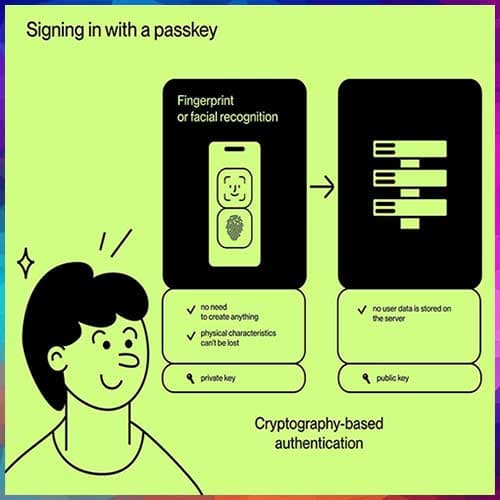
The era of relying solely on passwords is rapidly coming to an end. As cybercriminals increasingly weaponize artificial intelligence to automate phishing, credential theft, deepfakes, and account takeover attacks, technology companies are rethinking digital identity. Google's continued investment in passkeys and biometric authentication for Gmail reflects this broader industry shift toward stronger, phishing-resistant identity verification rather than a reaction to any single AI model or event.
Traditional passwords have become one of the weakest links in cybersecurity. Even two-factor authentication based on SMS is vulnerable to SIM-swapping, phishing proxies, and social engineering. Passkeys address many of these weaknesses by using cryptographic credentials secured within the user's device and unlocked through biometrics such as facial recognition or fingerprints. Importantly, the biometric data remains on the user's device rather than being transmitted to Google's servers, improving both privacy and security.
This transition is occurring as AI systems become increasingly capable of assisting attackers. Modern AI can generate highly convincing phishing emails, automate credential harvesting, write malicious code, and help identify software vulnerabilities. Industry demonstrations of increasingly capable cyber-focused AI have reinforced the need for authentication methods that cannot be easily stolen, guessed, or replayed through fake login pages.
However, biometric authentication alone does not solve every security challenge. Once a user has successfully authenticated, attackers may still exploit compromised sessions, remote access malware, deepfake-assisted fraud, insider threats, or stolen devices. Security therefore needs to evolve from one-time authentication toward continuous trust verification throughout the user's digital session.
This is where FaceOff Technologies' technology vision aligns with the industry's direction. While passkeys verify possession of a trusted device and a legitimate biometric, FaceOff focuses on continuously validating the human behind the device. Its Sovereign AI platform combines behavioral biometrics, facial liveness detection, deepfake detection, voice forensics, device intelligence, and contextual risk analysis to distinguish genuine users from attackers in real time. Rather than relying on a single authentication event, the platform evaluates trust continuously as users interact with applications and services.
The two approaches are complementary rather than competing. A passkey can establish a strong initial login, while behavioral intelligence can help detect unusual typing patterns, abnormal mouse movements, suspicious device behavior, synthetic voices, deepfake video, or other indicators that an authenticated session may have been compromised. Together, they support a Zero Trust model in which trust is continuously earned instead of assumed.
Looking ahead, there are several areas where technologies with capabilities like Google's authentication infrastructure and FaceOff's behavioral intelligence could complement each other if organizations chose to integrate such approaches. Initial login could rely on passkeys, while continuous behavioral verification could monitor for account takeover attempts. AI-driven risk scoring could trigger adaptive authentication when suspicious behavior is detected. Deepfake-resistant video verification and voice forensics could add protection for sensitive account recovery, high-value transactions, and privileged administrative actions. Explainable AI, audit trails, and privacy-preserving behavioral analytics could further strengthen compliance with emerging regulations.
As AI-enabled cyberattacks continue to evolve, the future of digital identity will extend beyond passwords—and even beyond biometrics alone. The next generation of security is likely to combine device trust, cryptographic authentication, behavioral intelligence, continuous monitoring, and human oversight. In that future, the objective is no longer simply verifying who logged in, but ensuring that the trusted human remains behind every digital interaction.