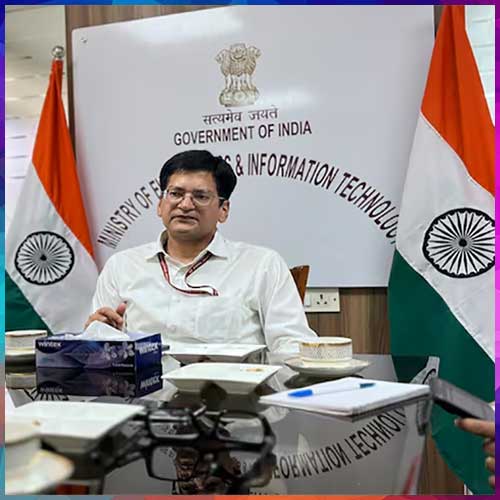
The Indian government will acquire equity stakes in semiconductor startups under the newly approved Semicon 2.0 initiative, with plans to exit its investments as the companies scale and mature, India Semiconductor Mission CEO Amitesh Kumar Sinha said.
Speaking at a media roundtable a day after the Union Cabinet approved Semicon 2.0, Sinha said the government would co-invest alongside venture capital (VC) funds rather than function as a controlling shareholder.
The scheme, approved with an outlay of Rs 1.27 lakh crore, introduces equity funding as a key intervention to help Indian semiconductor startups raise growth capital.
Under the proposed framework, the government will match private investment at every stage of funding—from seed capital through Series A, B and C rounds—on the same commercial terms as private investors.
"On the basis of that requirement, government will also match... half of the money they will bring from the market," Sinha said.
"Depending upon the terms and conditions of the VCs... we will match the same amount of money with the same kind of stake."
Sinha clarified that the Centre would remain a financial investor and would not seek to be a shareholder.
"We don't want those things," Sinha said when asked whether the Centre would seek board representation.
"We want to enable the company. We don't want to interfere in their day-to-day working." The detailed operational guidelines will be issued separately, he added.
According to Sinha, the equity model is designed to ensure founders retain control of their companies while gaining access to larger pools of capital.
"The moment the company starts earning revenue, they will be comfortable and happy to buy the government's share," he said.
"By buying government shares, they can take control of their company." He added that promoters would continue to hold controlling stakes, while the government's equity participation would generally remain below 50%.
The framework also allows startups the flexibility to pursue acquisitions instead of buying back the government's stake.
The framework also allows startups the flexibility to pursue acquisitions instead of buying back the government's stake.
"If they want to sell their company to anybody else, we are not binding any company," Sinha said. "Whatever equity valuation of the government, we will take that money and monetise."
He said the broader objective is not only to finance individual startups but also to recycle public capital into future semiconductor ventures.
"We believe that once the startup takes back that money by selling their company... he or she will come and start a new chip design project," he said.
The equity funding mechanism is one of the new features under ISM 2.0, which expands the government's semiconductor strategy beyond fabrication and assembly.
The second phase places greater emphasis on chip design, advanced packaging, semiconductor materials, chemicals, equipment manufacturing, research and talent development, while continuing support for fabrication facilities through pari-passu incentives.
For larger and more established companies, the government will adopt a royalty-based funding mechanism instead of taking equity.
"Royalty part is basically kept for big companies," Sinha said. "In equity we are matching... In royalty... when the revenue starts flowing, we'll take back 1.5 times the amount the government has given."
The Centre expects ISM 2.0 to attract around Rs 4 lakh crore in investments and catalyse a deeper domestic semiconductor ecosystem spanning design, manufacturing, materials and equipment over the coming years.

See What’s Next in Tech With the Fast Forward Newsletter





Tweets From @varindiamag
Nothing to see here - yet
When they Tweet, their Tweets will show up here.