Hewlett Packard Enterprise has launched four new ProLiant Gen13 servers built for agentic AI, inference and high-performance computing, featuring industry-first automatic encryption, multi-person authorization and post-quantum readiness, with availability from late 2026 into 2027.
Hewlett Packard Enterprise today announced the first four servers in its HPE ProLiant Gen13 line, powered by 6th Generation AMD EPYC processors. The systems expand compute, memory and I/O capabilities to help enterprises accelerate agentic AI and inference, analytics, virtualization, simulation and modelling, while tightening security, simplifying operations and improving reliability across distributed IT environments.
As AI systems move from generating insights to taking autonomous action, trust becomes a prerequisite for scale. McKinsey’s 2026 AI Trust Maturity Survey found that nearly two-thirds of respondents cited security and risk concerns as the top barrier to fully scaling agentic AI. HPE says ProLiant Gen13 addresses these barriers with a trusted infrastructure foundation that pairs HPE iLO 8 innovations, covering automatic protection, infrastructure trust and post-quantum readiness, with enhanced visibility and control from HPE Compute Ops Management.
Krista Satterthwaite, senior vice president and general manager, Compute at HPE, said: “Organizations need to turn their investments in agentic AI and inference into business value without adding operational complexity or risk. For these workloads, HPE ProLiant Gen13 brings together optimized performance, built-in, automatic security, intelligent operations, and proven reliability. It gives customers a trusted foundation to modernize and innovate today and adapt as their requirements evolve.”
Dan McNamara, senior vice president and general manager, Compute and Enterprise AI, AMD, said: “AI is moving into the applications and operations that run the enterprise, fundamentally changing what organizations demand from their infrastructure. Across generations of AMD EPYC CPUs and HPE ProLiant servers, our teams have worked side by side to turn advances in processor and system design into practical value for customers. With 6th Gen AMD EPYC processors and HPE ProLiant Gen13, we are delivering the performance, efficiency and flexibility enterprises need to scale AI while modernizing the critical workloads their businesses depend on.”
Four servers for AI and high-performance workloads
Combining HPE engineering with 6th Gen AMD EPYC processors delivers higher core density, memory bandwidth and I/O capacity, according to the company.
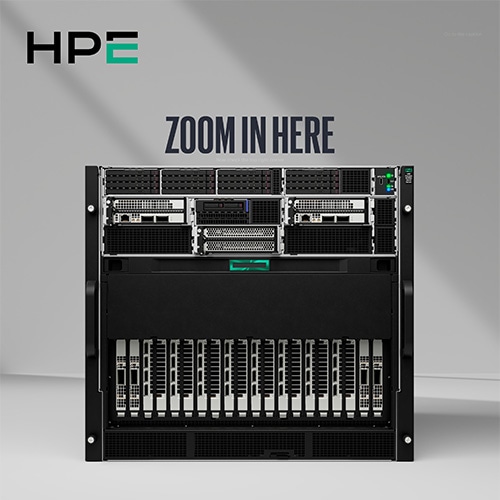
The HPE ProLiant DL585a Gen13 is a high-density platform that supports up to eight double-wide PCIe GPUs, two 6th Gen AMD EPYC processors and PCIe Gen6 connectivity. It is aimed at demanding workloads such as AI inference, virtualization, retrieval-augmented generation (RAG) model fine-tuning, analytics and emerging agentic AI.
The HPE ProLiant DL525 Gen13 is a compact 1U, single-socket system with one 6th Gen AMD EPYC processor of up to 256 cores. It offers 16-channel memory supporting DDR5 and MRDIMM, along with PCIe Gen6, making it suited to high-throughput tasks including fraud detection, market-data processing, risk and pricing models, electronic design automation (EDA), simulation and AI inference.
For large-scale, compute-intensive applications, HPE is also introducing two OCP-compliant systems that combine high-density compute with shared power and cooling:
· HPE ProLiant XD245 Gen13: a one-Open Rack Unit (1OU), four-node, direct liquid-cooled design powered by up to eight 6th Gen AMD EPYC processors.
· HPE ProLiant XD285 Gen13: a two-Open Rack Unit (2OU), two-node, air-cooled design that extends the architecture to a broader range of data centre environments.
Built to process large simulations, complex models and datasets at rack level, the two systems target CPU-intensive work such as computer-aided engineering (CAE), weather and climate modelling, scientific research and financial modelling. HPE said ProLiant Gen13 will expand beyond these systems, adding options for mainstream enterprise, edge, virtualization, software-defined infrastructure, database and AI workloads.
Automatic security and simpler operations
ProLiant Gen13 combines automatic security from HPE Integrated Lights-Out 8 (iLO 8) with upgraded HPE Compute Ops Management capabilities to protect data and system integrity while easing deployment and lifecycle management. HPE describes the following as industry-first features:
· Auto-SED: automatic self-encrypting drive capability that protects data at rest from first boot, with no added configuration, external key managers or manual activation.
· Multi-person authorization (MPA): requires two authorized users to approve high-impact actions such as key provisioning and secure erase, reducing the risk of single-user error or misuse.
· Expanded post-quantum cryptography (PQC) readiness: extends beyond firmware to help protect server communication paths from emerging threats.
· Enterprise-grade component verification: built on HPE’s Silicon Root of Trust, it validates the authenticity and integrity of critical components as they are added, replaced or modified.
New HPE Compute Ops Management capabilities include low-touch onboarding, compliance monitoring and near real-time power capacity insights. HPE said organizations using the tool spent 50 per cent less time managing servers and generated a 209 per cent ROI.
Reliability and availability
HPE said each new ProLiant generation undergoes more than 1,000 tests and 10,000 hours of validation, including stress and corner-case testing that pushes systems beyond published operating limits. Reliability has been the leading purchase driver for ProLiant customers for four consecutive years, with 81 per cent citing reliable performance as a key differentiator. HPE Tech Care Service, the company added, delivers up to 97 per cent less unplanned downtime.
The DL525 Gen13 will be available later in 2026, the DL585a Gen13 in early 2027, and the XD245 and XD285 Gen13 in 2027. The servers can be financed through HPE Financial Services’ 90/9 Advantage programme, which offers no payments for 90 days, followed by nine months at 1 per cent per month.