Domestic manufacturers are increasingly meeting demand for critical electronics components while expanding exports, as ECMS investments surpass targets and the government pushes deeper localisation across materials, machinery, design and supply chains.
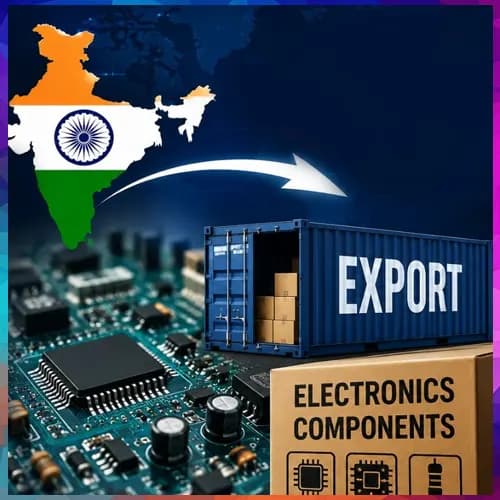
India’s electronics component manufacturing sector is reportedly showing signs of a major structural shift, moving beyond the traditional objective of replacing imports to developing an export-oriented manufacturing base. Union Minister for Railways, Electronics and Information Technology Ashwini Vaishnaw said domestic companies are now supplying a significant portion of the country’s component requirements and are beginning to serve overseas markets.
According to reports, Vaishnaw highlighted the progress made across several component categories. India is now fully self-reliant in enclosures, anode materials, optical transceivers and relays, while domestic manufacturers meet around 60% of lithium-ion cell demand, 80% of laminate requirements and 75% of connector demand.
ECMS investment crosses original target
The expansion is being supported by growing investment under the government’s Electronics Component Manufacturing Scheme (ECMS). Investments approved under the programme have reached Rs 69,000 crore, exceeding the original target of Rs 59,000 crore. The number of approved companies has also climbed to 106 after the government cleared 31 additional applications on Monday (August 17), well above the initial expectation of around 60 companies.
The latest approvals include projects from Wipro Global Engineering, Dixon Technologies, Tata Electronics, Kaynes Circuits, Motherson, Yuzhan Technology and Secure Circuits, among others.
Vaishnaw, however, stressed that investment approvals need to translate into operational manufacturing facilities. He said 38 projects have already entered production, while another 16 are currently at the construction or machinery-installation stage.
The 106 approved projects are projected to generate 74,628 direct jobs. According to the minister, the wider employment impact could reach approximately 2.5 lakh opportunities.
The emergence of exports is another indication of the sector’s changing trajectory. Components such as anode materials and optical transceivers are already being shipped to international markets, while some Indian manufacturers have also begun exporting products to China.
Focus shifts to materials and manufacturing equipment
Vaishnaw pointed to the changing nature of India’s electronics manufacturing ecosystem, noting that the country has progressed from assembling finished products to producing modules and components. The next phase, he said, will involve strengthening capabilities in advanced materials and the equipment required to manufacture those components.
Current domestic production meets about 55% of transducer demand, 40% of permanent magnet requirements and 20% of capacitor demand, in addition to the higher localisation levels achieved in several other categories.
“This is a huge step in resilience of our industry,” Vaishnaw said, underlining the significance of greater domestic sourcing for the electronics ecosystem.
The minister called for greater industry participation in developing indigenous capital equipment, including machinery used to manufacture electronic components. He urged industry associations to conduct workshops and prepare a roadmap for building capabilities in this segment.
Vaishnaw also outlined four areas that he said should remain central to the industry’s next phase: strengthening design capabilities, building a domestic supply chain, adopting Six Sigma quality and lean manufacturing practices, and developing skilled talent.
He encouraged manufacturers to examine their complete bill of materials and identify components, sub-components and even smaller elements that could be produced domestically. Such deeper localisation, he indicated, will be critical if India is to move from being a large electronics market to a globally competitive manufacturing and export hub.