
FROM ASSEMBLY LINES TO INNOVATION LABS: TRADE AGREEMENT PROMISES DUTY-FREE ACCESS, SLASHED COMPONENT COSTS, AND A STRUCTURAL RESET FOR INDIAN ELECTRONICS— BUT EXECUTION WILL DETERMINE IF THE $50 BILLION EXPORT DREAM BECOMES REALITY
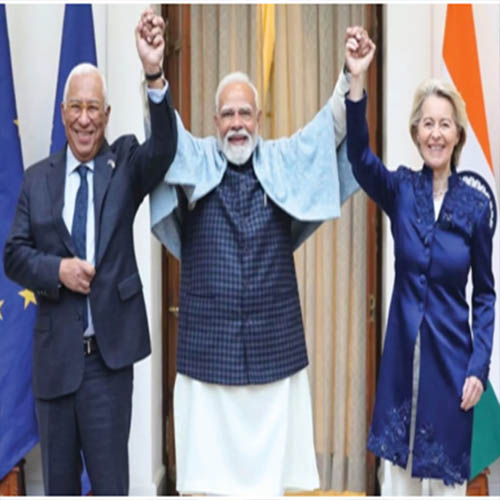
The recent India-European Union Free Trade Agreement has Prime Minister Narendra Modi calling it a "turning point" in bilateral relations. Industry leaders went further, dubbing it the "mother of all deals." For India's technology sector—particularly electronics manufacturing—the hyperbole may be warranted. With bilateral trade already at $136 billion and duty-free access proposed for over 93 percent of Indian goods, the agreement represents more than incremental trade facilitation.
It's a potential structural reset that could finally propel India from its current role as an assembly hub into a global design and manufacturing powerhouse.
The opportunity is enormous: a $750 billion European market opening up with zero-duty access, mutual certifications fast- tracking compliance, and tariff cuts on critical components that currently face import duties exceeding 40 percent. Industry projections suggest electronics exports could scale from $18 billion to $50 billion by 2031, spanning LEDs, appliances, IT hardware, semiconductors, and IoT devices. But beneath the optimism lies a more complex reality—one that demands domestic capability building, infrastructure investment, and policy consistency to translate paper commitments into tangible gains.
THE INPUT COST REVOLUTION: ADDRESSING MANUFACTURING'S HIDDEN BOTTLENECK
While much attention focuses on export opportunities, industry leaders emphasize that the FTA's most transformative impact may come from the supply side. Indian electronics manufacturers have long struggled with a fundamental cost disadvantage: 35-40 percent of production costs stem from imported high-value components, precision testing equipment, and advanced machinery— much of it sourced from Europe and currently facing tariffs of 40 percent or higher.
"The underappreciated input-side shift is massive," explains Pankaj Rana, CEO of Hisense India. "Precision components, testing gear, lithography tools currently face 40 percent-plus import duties from European suppliers, now dropping significantly, enabling unprecedented cost reductions while elevating quality via mutual certifications and faster EU compliance."
This tariff rationalization addresses what Rajeev Singh, Managing Director of BenQ India and South Asia, calls "one of the sector's long-standing challenges: the cost and complexity of sourcing high-quality components and technologies critical for innovation-led products." For manufacturers producing displays, professional AV systems, medical imaging equipment, and smart classroom solutions, access to European precision engineering at competitive prices could fundamentally alter their cost structures and competitive positioning.
Murali Mantravadi, Joint Managing Director of Energy Bots, frames it as an "input-side revolution" that directly tackles manufacturing bottlenecks. "This dual engine of cheaper European supply chains and higher export realizations creates unprecedented scale," he notes, projecting 3-5x growth for companies building sophisticated IoT devices and sustainable technology solutions.
The implications extend beyond simple cost reduction. European components often come with stringent quality certifications and sustainability credentials that align with global market expectations. As Indian manufacturers integrate these inputs, their products automatically gain credibility in international markets—a soft power benefit that's difficult to quantify but invaluable for market entry.
FROM ASSEMBLY TO INNOVATION: MOVING UP THE VALUE CHAIN
India's electronics sector has achieved remarkable growth over the past decade, but largely through assembly and contract manufacturing. The country has excelled at putting together smartphones, televisions, and consumer electronics—yet the high- value activities of design, R&D, and intellectual property creation have remained largely offshore. The India-EU FTA creates conditions that could finally shift this equation.
"The FTA can accelerate India's transition from being primarily an assembly-led market to becoming a design, innovation, and value- added manufacturing hub," Singh emphasizes. "Europe brings deep expertise in precision engineering, sustainability standards, and R&D-driven product development. Easier collaboration in these areas can help Indian operations move up the value chain."
This isn't merely aspirational. The agreement facilitates technical collaborations, joint R&D initiatives, and knowledge transfer in areas where Europe maintains technological leadership: advanced semiconductors, automotive electronics, industrial automation, and green technology. For Indian companies willing to invest in capabilities rather than just capacity, the FTA provides a framework for genuine technology partnerships.
Aditya Khemka, Managing Director of CP PLUS, highlights how the agreement enables "collaboration on standards, certification, and R&D. Stronger testing and standard formation will lift product quality and global trust, while faster time-to-market benefits manufacturers and customers alike." The standardization dimension deserves particular attention. Indian manufacturers have often struggled with fragmented standards across different export markets, requiring multiple certifications and compliance regimes. Alignment with European technical standards provides a single framework that's recognized globally, reducing time-to-market and certification costs while building institutional capabilities
in quality management.
THE EXPORT OPPORTUNITY: A $50 BILLION TARGET
The numbers tell a compelling story. Industry projections suggest Indian electronics exports to the EU could grow from approximately $18 billion currently to $50 billion by 2031—a nearly threefold increase driven by duty-free access and improved competitiveness. This growth spans multiple categories: LED lighting, home appliances, IT hardware, semiconductors, automotive electronics, and increasingly, sophisticated IoT and smart devices.
For a country that has long aspired to become a global electronics manufacturing hub, this represents validation. European OEMs are already exploring "Make in India" partnerships to serve global markets, attracted by improving quality standards, competitive costs, and now, favorable trade terms. The agreement positions India as an alternative manufacturing base for companies seeking to diversify supply chains away from over- concentration in East Asia.
Ravi Agarwal, Co-founder and Managing Director of Cellecor, views this as "encouragement to invest deeper in manufacturing, strengthen quality and compliance standards, and build consumer technology that is rooted in Indian households while being globally competitive and future ready."
The sustainability dimension adds another layer of opportunity. European markets increasingly demand products that meet stringent environmental and social governance criteria. India's growing capabilities in renewable energy, electric vehicles, and green technology align well with these expectations. Companies like Energy Bots, building smart water management devices with sustainable IoT, see the FTA as enabling them to "penetrate EU homes, industries, and green infrastructure markets" with solutions addressing Europe's net-zero ambitions.
"This isn't just export growth to $50 billion by 2031," Mantravadi argues. "It's a structural reset enabling 'Made in India' electronics to compete globally on cost, quality, and sustainability—finally delivering the 'from India to the world' promise while aligning with Europe's net-zero demands."
Beyond Manufacturing: Digital Infrastructure and Services While electronics manufacturing dominates discussions, the FTA's implications extend into digital infrastructure and technology services. Sunil Bharti Mittal, Founder and Chairman of Bharti Enterprises, emphasizes opportunities in "digital infrastructure, space connectivity, and secure networks, offering European investors a compelling opportunity to innovate and scale with India for global markets."
This bidirectional potential—Indian companies investing in European digital infrastructure while European firms scale operations in India—reflects the agreement's broader strategic dimension. In an era of technological decoupling and supply chain reconfiguration, the India-EU partnership represents an alternative model based on democratic values, rule of law, and market economics.
"In a changing global economic order, the agreement sends a powerful signal of trust, stability, and long-term partnership," Mittal notes. For technology companies navigating geopolitical complexity, this institutional framework provides predictability and confidence for long-term investments.
THE IMPLEMENTATION CHALLENGE: TURNING PROMISE INTO PERFORMANCE
Despite the compelling opportunity, industry leaders strike notes of caution about execution. Trade agreements create enabling conditions; they don't automatically deliver results. India's track record on FTA utilization has been mixed, with businesses often failing to leverage available benefits due to complexity, documentation requirements, or simple lack of awareness.
Singh emphasizes that "to fully unlock these benefits, the agreement must be complemented by domestic readiness. This includes skill development in advanced manufacturing, faster regulatory clearances, and consistent policy support for high-value electronics production."
The skills gap represents a particular challenge. Moving from assembly to design and innovation requires engineers, technicians, and managers with different capabilities— expertise in R&D, intellectual property management, advanced manufacturing processes, and global quality standards. India's education system is producing large numbers of graduates, but not always with the specialized skills that high-value electronics manufacturing demands.
MSMEs face additional hurdles. While large corporations can navigate complex certification processes and invest in compliance infrastructure, smaller manufacturers often lack resources and expertise. "MSMEs, in particular, will need support to integrate into EU-aligned supply chains," Singh notes, highlighting the need for government facilitation, industry associations, and capacity-building programs. Infrastructure remains another constraint.
Electronics manufacturing requires reliable power, efficient logistics, and supportive ecosystems of component suppliers and service providers. While India has made progress through initiatives like Electronics Manufacturing Clusters, gaps persist— particularly in tier-2 and tier-3 cities where much of the expansion is expected.
Regulatory predictability matters enormously for long-term investment decisions. Technology companies plan in multi-year horizons; they need confidence that today's incentives and policies will remain stable tomorrow. India's occasional policy reversals and bureaucratic complexity create hesitation among investors who might otherwise commit capital and technology.
STRATEGIC IMPLICATIONS: RESHAPING GLOBAL SUPPLY CHAINS
Beyond bilateral trade, the India-EU FTA carries broader strategic significance for global technology supply chains. Both partners seek to reduce dependency on single-country manufacturing concentrations while building resilient, values-aligned partnerships. For India, this represents validation of its "trusted partner" positioning in an increasingly fragmented global economy.
Khemka frames it as "a timely step toward building a more balanced and resilient technology ecosystem. Deeper trade and technology exchange with the EU can help this corridor move away from over- reliance on limited geographies and toward a diversified, innovation-led supply chain."
European companies gain access to a massive domestic market—India's 1.4 billion consumers with rapidly growing purchasing power—while securing alternative manufacturing capacity. Indian companies gain technology, standards, and market access that accelerate their global competitiveness. The mutuality creates foundations for sustained partnership rather than extractive trade relationships.
This aligns with broader trends in global trade: the shift from pure efficiency optimization toward resilience and values alignment. In sectors like semiconductors, telecommunications equipment, and critical infrastructure, governments increasingly prioritize trusted partners over lowest-cost suppliers. The India-EU FTA positions both parties favorably in this reconfigured landscape.
THE ROAD AHEAD: EXECUTION WILL DETERMINE OUTCOMES
As implementation begins, several factors will determine whether the FTA delivers on its promise. First, businesses must actively leverage available benefits rather than waiting for automatic gains. This requires investment in understanding rules of origin, certification requirements, and compliance frameworks— areas where industry associations and government agencies must provide support.
Second, India must accelerate complementary reforms: skill development programs aligned with industry needs, infrastructure investments in manufacturing clusters, streamlined regulatory processes, and consistent policy signaling. The FTA creates opportunity; domestic capability determines whether India can capture it.
Third, both sides must maintain political commitment through implementation challenges. Trade agreements inevitably create winners and losers; managing domestic constituencies while preserving overall momentum requires sustained leadership.
Finally, businesses must think beyond immediate cost arbitrage toward long- term capability building. The real prize isn't cheap exports but transformation into a genuine innovation hub—one that not only manufactures products but conceives, designs, and owns the intellectual property behind them.
"Overall, the India–EU FTA is less about short-term trade gains and more about long- term capability building," Singh concludes. "If executed thoughtfully, it can position India as a trusted global partner in high-quality, sustainable electronics manufacturing."
The "mother of all deals" offers India's technology sector a generational opportunity. Whether it becomes a watershed moment or merely another unrealized potential depends entirely on execution. The pieces are in place; now comes the hard work of making it real.

See What’s Next in Tech With the Fast Forward Newsletter








Tweets From @varindiamag
Nothing to see here - yet
When they Tweet, their Tweets will show up here.