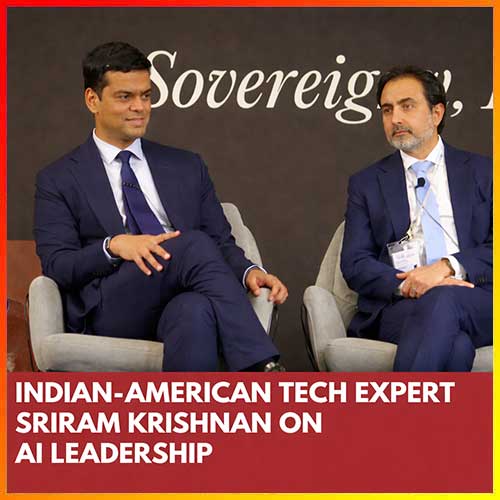
Indian-American tech expert and Senior White House Policy Advisor on AI Sriram Krishnan recently underscored the strategic importance of artificial intelligence in shaping national security and global competitiveness. As AI becomes central to geopolitical rivalry—particularly between the United States and China—countries are racing to secure leadership in foundational technologies, including large language models (LLMs).
In India, a controversial remark by a U.S. leader suggesting that the country may never build its own foundational LLM ignited intense debate. The statement sharpened an ongoing discussion: should India rely on global AI platforms, or invest heavily in sovereign models tailored to its needs?
Critics argue that building a frontier-scale LLM—comparable to GPT or Claude—requires enormous computational infrastructure, billions in funding, and elite research ecosystems. Industry leaders such as TCS CEO K. Krithivasan and Infosys co-founder Narayana Murthy suggest that adapting existing global models with Indian datasets may be more practical and cost-effective.
Yet the sovereignty argument remains powerful. Advocates contend that India must develop indigenous AI systems to safeguard data privacy, reduce foreign dependence, and ensure accurate representation of its linguistic and cultural diversity.
Importantly, India has already begun moving in this direction. Initiatives such as Param-1 and Sarvam 1 demonstrate domestic capability, while startups like Sarvam AI are fine-tuning open-source architectures to support Indic languages and local applications.
Moreover, government-backed programs under IndiaAI are strengthening infrastructure, expanding datasets, and supporting research in Indic NLP. Rather than chasing trillion-parameter benchmarks, India appears focused on building scalable, context-aware systems for real-world deployment.
The debate ultimately reflects a strategic balancing act. India continues to deepen U.S. tech cooperation through frameworks like iCET while simultaneously pursuing long-term technological sovereignty. The question is no longer whether India can build an LLM—but how it chooses to define leadership in the AI era.