With the lessons learnt from the past year, Industry leaders are focusing more on Cyber Security, Data and Cloud Adoption
Unlike the last year, the year 2022 is going to be the year of digital transformation. The chief executives and their boards will be looking for tech chiefs to build on their recent digital transformation achievements, from assuming new responsibilities to delivering great customer experiences and onto sustainable IT. AI and automation will take center stage, as cloud and collaboration continue to impact IT agendas - and IT leaders keep apprised of disruptive technologies on the horizon. Running the IT business means delivering business value. The coming year will see the best CIOs to take their focus on customer experience to a new level. To know more about the upcoming technology trends for the year 2022 let’s learn from the tech chiefs.
Data center infrastructures are going to be more costly
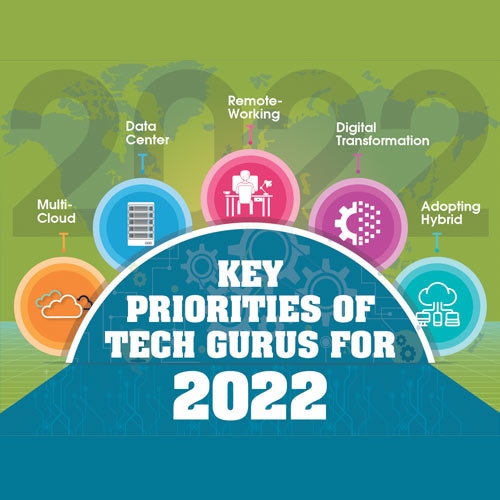
 The key priorities for the year 2022
The key priorities are Cyber Security, Strategic Alignment, Automation and Staff Skill Enhancement.
Expectations from the OEMs
Support is always a painful point for CIO’s / CISO. Infrastructure has to be easy to configure and maintain, should the systems tend to fail the recovery has to be an easy way out. The entire orchestration has to be automated with simple plug and play tools instead of high jargon configurations.
Data center infrastructure strategy
Exempting organizations that are hard pressed by regulators, Data centers are moving to cloud or hybrid mode. The strategy of having only BCP in the cloud is slowing down. Many Dev & production environments are moving to the cloud. With Pandemic hitting the supply chain of semiconductors, Data center infrastructures are going to get more costly to build and there will be delay in projects lined up.
Adoption of hybrid and multi-cloud strategies
Multicloud has been the game changer for faster development, devsecops and optimizing costs. Business owners have seen tremendous cost and value improvements with multicloud ensuring high scalability & availability besides balanced costs.
MANIKANT R SINGH
Vice President & Chief Information Security Officer,
DMI Finance
Data storage is critical to every business
 The key priorities for the year 2022:
1. Roll-out of Gas Insulated Substation (GIS).
2. Deployment of Edge Datacenters (EDCs) across identified Tier-2 cities in India
3. Roll out of SD-WAN, DCIE, Metro, Multi-Cloud Connect, CtrlS Industry cloud, Govt Community Cloud, PCI-DSS Ratified Fintech Cloud, RBI Mandated Bank-in-a-Box offering, Healthcare in a Box and Insurance in a Box.
4. New service offerings for Oracle EBiz and Oracle Linux and enhance SAP Basis combined with AMS Support
5. Enhance Corporate Employee Security with EDR/Disk Encryption/MFA/SIEM and achieve GDPR Compliance.
6. Focus on sustainability through introduction of Green Energy (Solar) and reduction of carbon footprint across our facilities aligned with Sustainable Development Goals (SDG)
7. Enhance customer experience management through our UCP (Multi-Cloud Unified Customer Portal), SHOP (Self-Healing Operations Platform) with AIOps and MLOps, Build Automation
8. SAP Implementation within organization.
Expectations from the OEMs
My expectation from storage vendors is that they should bring in a combination of intelligent and software defined storage, work towards improvisation of Nonvolatile memory express (NVMe), and introduce innovative green storage technologies. I personally believe the efforts of DNA, and Nanomaterial based storage of data holds a bright future.
Data center infrastructure strategy
Our data center infrastructure management strategy focused on building resilience, powered by technology, people, processes and innovation. We are focused on providing high availability for our customers. So far, our efforts have paid-off rich dividends as we have delivered 100% uptime to our customers since inception. We have embraced automation across the process within our data centers to enhance efficiency, productivity and achieve cost optimization – customer satisfaction has been a focus of such an approach. We have robotic process automation (RPA) and software robots delivering error results. Soon, we plan to introduce AI/ML as part of data center automation and make informed and intelligent decisions. Our efforts have been to integrate DCIM tools with CMDB, ALCM, IT Asset Management, BMS etc to gain holistic operational overview.
Anil Nama
CIO, CtrlS
In Data Center strategy, Security is the decision influencer
 The key priorities for the year 2022
2020-21 were the years when remote working became the only way of working. Almost every organization transformed digitally at a pace never seen before. 2022 is likely to be the year of return to offices. Therefore, it would be the time when physical working and remote working would continue to be evaluated as a choice and most likely the working would be a good mix of remote and physical office working. Hence, some of the key priorities would be to evaluate productivity in this mix environment and optimize usage of digital technologies such that physical interactions continue to hold its own importance and org can continue to be digital for the sake of higher productivity.
Data center infrastructure strategy
My organization is a data center user organization. For such organizations, Data Center Strategy needs to be fully aligned with business. Hence, business objectives must drive data center strategies and not the other way around. I think it is a top down approach which looks at important parameters like risk tolerance, technology requirements, costs and future visibility as important factors can determine the organization decision on data centers. In our Data Center strategy, security factor becomes a decision influencer.
Understanding the implications, and possible consolidation and/or optimization savings over time, are core components to DC strategy with future projected capabilities, while also aligning and simplifying the ROI of technology and facilities infrastructures from a CAPEX and OPEX perspective.
Expectations from the OEMs
CIOs expectation is to speed up IT processes and make tasks more reliable and predictable. Automation and Orchestration achieve this goal on a different level: Automation speeds up simple, single-goal tasks. Orchestration streamlines a group of automated tasks and optimizes more complex processes
In the cloud, orchestration is often key to ensuring that automated spin-up activities like auto-scaling take place in the right order, with the right security rules and permissions in place.
Adoption of hybrid and multi-cloud strategies
Most organizations do see hybrid cloud as a practical solution for their data and analytics platforms. Because most organizations have a distributed and heterogeneous data ecosystems and this is the best way to manage them. Criticality of hosting of disparate systems is an important point and finally the cost factor with ROI plays an important factor in decision of on-prem or cloud. That’s I mention that DC strategy has to be in line with business requirements.
Sanjeev Sinha
President- Digital Transformation, India Power Corporation
Cyber Security needs to be strengthened more
 The key priorities for the year 2022
These days Cyber threats have increased as the rapid migration to Digital migration due to Covid was done as an urgent measure to ensure Business Continuity. Covid has forced IT Teams to migrate their users and applications to online model overnight. Normally it would have taken lot of planning and phasewise migration. Therefore our key priorities would be to safeguard the Enterprise Information and Application from the latest threats. Cyber Security, including OT Security would have to be strengthened. Lessons from the last two years would help us identify the bottlenecks and work on their mitigation.
Apart from Cyber Security next priority area would be leveraging Industry 4.0 initiatives like AI / ML and RPA to optimally leverage the data available and assist management to take decision based on Data Science. RPA would help us automate the processes and increase efficiency.
Expectations from the OEMs
Virtualization has already happened on the Server and endpoints, providing ease of management and scalability like never before. Storage virtualization is has been gaining traction from last few years. Different OEMs have created their native solutions, which creates compatibility issues and lockin concerns. Obviously standardization & orchestration of storage infrastructure support is the logical step. It allows you to use any commodity Storage compatible with the standards and get the uniform access to the Storage features and services. Storage is one component in the datacenter which would have the highest amount of growth in terms of capacity.
Data center infrastructure strategy
I believe that Hybrid Cloud would be in use by more than 95% of the organizations in 2025. On Prem and cloud solutions both have their strengths and use cases, therefore most organizations would be using a mix of On-Prem and cloud services. In areas where in-house maintenance is high or team lacks the skill set, would be migrated to cloud. Legacy applications, Unix Applications or areas where you already have infrastructure in place and no major capacity up-gradations have been planned can be a use case for On-Prem solution. Cloud solution too would be the mix of public / private cloud as it would depend on the industry specific statutory laws on data and privacy.
Adoption of hybrid and multi-cloud strategies
We would migrate the less critical applications on the cloud, and gradually build on that experience, and offload more applications on the cloud, private clouds would be the preferred choice for the applications like ERP & CRM, whereas the applications like Website and mailing can leverage the cost efficiency of the public cloud. One should keep in mind the compatibility, interfaces and ease of use while opting for multi-cloud environment. IT Admins should not be using 20 different cloud applications to manage their Cloud applications. This would result in huge effort and possible mistakes. In case of multi-cloud environment proper integration and centralized dashboard for simple management is crucial.
Pankaj Sharma
AGM IT, Shree Cement
Technology is evolving at a tremendous space
 The key priorities for the year 2022
This past year has seen numerous companies entering the digital space more than ever. Be it going completely remote, or even joining the ever growing blockchain network, going digital also comes with the risk of unauthorized access to a company’s database or even hacking. Technology is evolving at a tremendous space and we aim to keep evolving with it so we can help our clients maintain their security.
Expectations from the OEMs
Without going into technicalities, I would have to say that that the most basic expectation would be that the OEM’s should provide hardware equipment that are up to date so that it becomes easier for the IT team to focus on the software end of it. There are times that certain equipment is old and outdated. Like everything else, security threats are always evolving so having proper equipment will help us strengthen the whole infrastructure.
Data center infrastructure strategy
Data centers have been around for a while now, more and more companies are switching away from traditional physical data centers towards virtual networks. It’s still too early to say whether this is a step in the right direction.
Adoption of hybrid and multi-cloud strategies
We have certain plans in place that I cannot disclose and given that hybrid and multi-cloud strategies are both still not completely refined, there’s room for trial and errors to see what works the best.
Manan Shah
Founder& CEO, Avalance Global Solutions
Data is a company’s biggest asset

The key priorities for the year 2022
With current pandemic and maximum work running out of remote / home locations treats are increasing we need to improve concentrate on Develop an incident response plan and practice it frequently – and learn from your mistakes. So data security along with it cloud security is another aspect to it.
Data is a company’s biggest asset and regulators globally are increasingly looking to create data privacy laws to ensure that organizations are taking sufficient care of the data that they gather we need to develop policy to secure the same, by means how to use, Policy backed by good people, process and technology to support the same is the key priority for the all the CIO/CISO’s.
We need to drive internal training program that defines the knowledge status self and team should attain. It also allows to build out the cloud security knowledge within one organization so ongoing training programs for continuous learning and mentoring for better security.
Expectations from the OEMs
Measuring TCO and ROI is CIO’s responsibility how to make it simpler is what they look at OEMS so what I feel ease of access, deploy, manage and work as elastic growth as we demand, have few knowledge transfer session to keep pace with the expanding market as market is so dynamic now daily something new come up difficult to keep in pace of same; we would want session on going bases for the same.
Data center infrastructure strategy
Consolidation and Migration along with that Managed service comparing same with current TCO and TCO after migration both in Tangible and non-tangible benefits; Principle is simple understand and consider the following:
· Consolidation plan: The infrastructure to move the data center clear understanding and roadmap is must on same
· Mitigation: risk analysis and plan to tackle them should be in first place
· Migration: Proper migration plan
Above three hold key to success it can be complete cloud, hybrid cloud, private or public cloud based on requirement.
Adoption of hybrid and multi-cloud strategies
We have already started the same infact tied up with a service provider for the same; Step one would be to have single cloud work on same already started and step two may be by August current year would be have multi cloud solution.
Jaaswinder Singh
CTO, High Street Corporate Centre
Data analytics and Self-service data portals are new priorities
 The key priorities for the year 2022
After last 2 years of business uncertainly, we are looking forward to higher business momentum in 2022. Our key priorities in 2022 are -Security, Disaster readiness and availability to ensure Zero disruption for highly dependent transactional systems.
We had a great journey of business transformation over two years which we have been setting culture for Data first, Digital first approach which we shall continue, with this focus is always on discovering new ways of working what we call New WoW, simplification of processes. Data analytics and Self-service data portals are something on priority. Priority is to help business team with data insights, actionable and save time on data preparations. From mod ern technology point of view, IOT for field assets and production floor. In summary Cloud, Security, Data analytics, process digitization and automation, IOT will be in focus for us.
Expectations from the OEMs
Well, I am not having in-depth inputs on this area as we use 90% cloud, but for sure this is much in demand. With adoption of hybrid, multi-cloud strategy, CIOs are looking for efficient tools to manage hybrid or multi-cloud data management or orchestration. Every organization is looking for IT agility with least manual intervention, as CIO I would be watch out this space for more open standard solutions which may help leveraging diverse infrastructure.
Data center infrastructure strategy
We have cloud centric landscape with limited footprint on-premises with Cloud First strategy in place. No doubt DC infrastructure landscape is going through lot more changes with all the talks about green energy, hyper converged infrastructure. Of course, this must get aligned with business strategy along with factors like compliance need, plans for IOT/AI/ML & newer technology implementation which are cloud native, Opex vs Capex philosophy.
Adoption of hybrid and multi-cloud strategies
We have adopted cloud first strategy as with have multi-locational dependencies for business-critical applications. This has helped us managing availability of applications 100% for last 3 years where more than thirty separate locations are accessing applications. Currently we do have multi-cloud set-up which is further getting expanded. I believe one should not compare only cost while evaluating cloud, benefits are beyond just cost comparison.
Dhaval Mankad
Vice President IT, Havmor Ice Cream
Hybrid approach helps to bridge the gap to bring greater flexibility
 Adoption of hybrid and multi-cloud strategies
The COVID-19 pandemic has ushered in a new reality. At a time when even the disruptors have been disrupted, being an adaptable, digital enterprise is of paramount importance. While the pandemic accelerated the shift towards digital, it also highlighted the need to reimagine and rethink our business strategies to build a sustainable future through collective actions including secure digital investments. I believe the key to unlocking success and curbing risk, lies in focusing on strengthening the human firewall with automation that overcomes silos, both technological and departmental. A hybrid approach can help bridge the gap and provide greater flexibility and control over data to the customers as they design and adopt cloud strategies.
Data center infrastructure strategy
At Tech Mahindra, we are working towards transforming the core infrastructure operations using next-generation services to enable operational scalability and ensure a seamless user experience. With our platform-enabled solutions powered by AI and Automation, we are also bringing organizational change for future-readiness through joint transformative roadmaps and co-innovation. Our focus is on enabling enterprises to develop a secure, future ready, cost-effective infrastructure aligned to their core business needs. Going forward, we will continue to unlock the NXT in Infrastructure Services to enable complete data control, mitigate skills shortages, and drive agile, digital-powered business growth for all.
Jagdish Mitra
Chief Strategy Officer and Head of Growth, Tech Mahindra
Hybrid cloud strategy cost-effectively run workloads in the public cloud
 The key priorities for the year 2022
· Increasingly digital or remote workforce.
· Driving and embedding digital transformation in the organisation
· Being responsive to internal clients.
· Dealing with industry disruption.
· Finding and retaining top I.T. talent.
· Focusing more on cybersecurity
· Focusing more on customer data security
· Reworking on the I.T. budget
· Upgrading the system where ever required
Expectations from the OEMs
Determine optimal amount of storage space needed in a storage pool to meet the capacity requirement of services. Create a disaster recovery plan to meet the recovery time objective of services. Ensure that the management process software and staffing are appropriate to provide services. Return service to the users within agreed time period in the event of service failure. Validate changes to the storage infrastructure for creating or modifying a service.
Data center infrastructure strategy
Get clear on the objectives for data centre strategies. Understand the current I.T. Environment, Understand how the I.T. environment is evolving, Assess the current data centre facility, Determine if being in the data centre business is the best option and if so to what extent. Understand the current data centre TCO, Document the data centre requirement, Develop the proposed scenario, Colocation services ,managed leads, managed hosting’s, data centre build outs, improving current facility, Compare the current state to each proposed scenario, Choose the best strategy and develop a roadmap to execute it.
Adoption of hybrid and multi-cloud strategies
Multicloud and hybrid cloud strategies offer compelling benefits to enterprises. Perhaps one of the greatest benefits is flexibility. These strategies give enterprises the freedom to choose where and how to deploy workloads, thus avoiding the business risks of vendor lock-in. Multicloud and hybrid cloud also promote more flexible data management, for enhanced data sovereignty and compliance, availability, and durability.
For enterprises that seek to achieve maximum business agility through a DevOps culture, a hybrid cloud strategy is pretty much a prerequisite. At the very least, it provides self-service resources for developers to cost-effectively run dev/test workloads in the public cloud.
Manikkam Subramaniam
SVP, Heritage Group
‘Hybrid cloud strategy’ provides greater flexibility by moving workloads
 The key priorities for the year 2022
Data management agility has become a mission-critical priority for any organizations in an increasingly diverse, distributed, and complex environment. To reduce human errors and overall costs, data and analytics leaders are looking beyond traditional data management practices and shift toward modern solutions like AI-enabled data integration. 2022 is going to have increased challenges like digitisation, driving and embedding digital transformation in the company business strategy. Being responsive to internal clients, finding and keeping top IT talent resources, addressing evolving security challenges etc would be the key priorities.
Expectations from the OEMs
In the last few years, trend changed and started shopping and exploring out of the enterprise boundaries to buy infrastructure as cloud (IAAS , SAAS or PAAS). This trend is primarily driven by following factors: Increased pace in procurement and the agility required today for businesses to build new digital applications and decreased cost on cloud services. CIOs today are looking at service providers who can be partners in making their vision a reality, which includes cloud, operational automation, business process as a service etc.
Data center infrastructure strategy
Modern Data Centres are now offering converged infrastructure, and the trend is further moving towards hyper-convergence. This has brought many advantages for Data Centre operations and has also solved problems that paralyzed companies earlier.
The reports key findings are top data centre priorities and challenges identified are the need to strengthen security. Fending off ransomware attacks is top of mind, and remote work presents potential security risks as employees access internal networks outside of the office.
Adoption of hybrid and multi-cloud strategies
A hybrid cloud strategy provides greater flexibility by moving workloads between cloud solutions as needs and costs fluctuate. Hybrid cloud deployment can also be multi-cloud if it uses several public clouds. Hybrid cloud offers the benefits of multiple deployment models at once.
Hybrid cloud strategy is how organizations determine which applications and data should reside on which parts of a hybrid cloud infrastructure. Simply, hybrid cloud strategy defines what goes on public cloud infrastructure, and what goes on private cloud infrastructure.
D V Seshu Kumar
Assistant Vice President, Orient Cement
OEM’s are the most critical influencers in adoption of technology infrastructure
 The key priorities for the year 2022
Automation and Actionable intelligence such as AI and analytics with quality of data collected by in the enterprise is the key. Artificial intelligence and machine learning will be critically important in 2022 and will significantly Influence the decision making. Also we will continue to lean heavily on the cloud and collaboration tools for creating seamless operations and enhances experience.
Expectations from the OEMs
As a CIO job is to propel company towards becoming a digital leader in rapidly evolving business and technology landscape. Role of a CIO is become more consultative and align strategies in leverage technology to drive the business outcomes. OEMs play vital role in this journey and most critical influencers in adoption of technology infrastructure. Should provide capabilities specific to key vertical markets delivers exponentially more value than generic one-size fits all offerings. Should bring together sales, technical expertise and services skills, and apply them to solve specific pain points and focus on enabling true business value as a service.
Data center infrastructure strategy
The best strategy may not always the most cost effective strategy with the abundance of choice regarding cost, hosting solutions, data centre, capabilities re-evaluating every 3 to 4 years is the better strategy. This is a continuous journey for any CIO for alignment of business and technology goals.
Adoption of hybrid and multi-cloud strategies
Everything has its pros and cons, so with hybrid multi-cloud have, features that this strategy adheres to are not comparable to in house datacentres especially in factors like security, flexibility, Integration, Risk Management. Opting for the right strategy will provide you with the solutions to the problems. Hybrid Multi-cloud is the only answer to data severity and workload specialization, without dependency and right resources. Need to also consider the Integration and Business connectivity while adopting the Hybrid models. In next 3 years we will optimize the models to its best capacities and managed costs.
Kiran Komatla
SVP & Head-IT, Burger King India
The focus will be on hybrid model for business continuity
 “The key priority to support the customer through effective system i.e. streamlining the multiple interaction points with Customer. Standardization of the Infrastructure / Connectivity / Security across all branches and partners is expected. There will not be any change in Data center infrastructure strategy. Certain application is already running on Cloud, the focus will be on hybrid model only for business continuity.”
Sanjeev Saxena
General Manager IT, IFB GLOBAL
The growth of edge is important to transform the user experience
 The key priorities for the year 2022
Some of the key priorities for enterprises in FY22 as we at HPE see are:
1. The growing focus on fast forwarding digital transformation with data first modernization. Any transformation would be incomplete without data first modernization spanning edge to cloud environments. With most data in enterprises in disarray and the exponential growth at the edge with the need to have the cloud experience everywhere makes data control an absolute priority. Companies are becoming more concerned with managing data than storage.
2. As more customers are evolving towards a “service-oriented” model with HPE GreenLake based solution, they are becoming less concerned about the specifics of what infrastructure is being used to store the data. Whether the deployment is on something like HPE dHCI, software-defined x86 scale-out, or traditional arrays, more focus is laid on the desired business outcomes around the data and ensuring requirements are met in accordance with the storage deployment details.
Artificial Intelligence (AI) and Machine learning (ML) – As data is growing exponentially it is becoming more important to harness the same. Growing capabilities around data handling through a process of collecting data, connecting data, analyzing data, deriving actionable insights need technologies like AI and ML. These technologies enable driving decision velocity.
4. High Performance Computing (HPC) – The growth of data and need for AI is ensuring that HPC is getting play in many commercial use cases. Large scale AI demands computational capability that now is growing to Exascale needs.
5. Container adoption will scale – With applications driving digital transformation and container technologies providing portability, efficiency, agility, faster delivery, improved security, faster app startup, easier management, and flexibility we continue to see leveraging of containers and Kubernetes.
6. The battle of the edge will intensify – The growing idea of edge computing and data accumulation is intensifying and would be tightly linked with mobile computing and a growing device population being part of the Internet of Things (IoT). The growth of edge is very important in transforming the user experience for customers.
7. Multi-Cloud Computing – As adoption of multi clouds grows and enterprises look for best of breed solutions multi-cloud computing provides improved agility, resiliency and scalability and matches business needs with the right provider.
8. Hybrid Cloud Computing – Hybrid clouds combine private and public cloud capabilities and hence is the most preferred enterprise option today for deploying IT resources. Hybrid cloud provides the right mix for enterprises to leverage the best of both worlds by eliminating the age-old issues of the public cloud deployments like security, latency, data gravity, costs.
Expectations from the OEMs
CIO’s across organizations are looking at digital transformation to react quickly to meet opportunities to support and grow their businesses. Data is at the heart at what our customers are doing and they are looking for a data driven transformative approach to their business.
There are two major themes which emerge –
1. Managing storage at scale is rife with complexity – while storage has gotten faster, managing single or 2/3 arrays is now a lot simpler, managing storage at scale when you deploy fleets of arrays as customers continue to gather, store and lifecycle their data this process is still complex. Now data spans from edge to core to cloud. And now with public cloud there is an additional element of multi cloud environments that’s has been added to their data sprawl.
2. Need to shift from managing storage to managing data – IT has a desire to mobilize, protect and provision data seamlessly across lifecycle and across locations where it is stored.
Data center infrastructure strategy
Today’s data center infrastructure is core to any business enterprise and is in fact the prime enabler of businesses. HPE has a strong portfolio of all data center infrastructure that form and support a data center. Servers and storage are, of course, a major form of data center infrastructure along with networking routers and switches, racks, power and cooling devices etc. With hybrid cloud enabled solutions, HPE enables you to accelerate digital transformation and to harness the power of your applications and data with data center’s security, agility, and economic efficiency to support any workload.
Kamal Kashyap
Director, Storage, Hewlett Packard Enterprise, India
To achieve the efficiencies businesses need to be cloud committed
 The key priorities for the year 2022
· Improving Digital dexterity
· Strengthening cyber security across business process flow chain
· Automation Progressions
· Committing to sustainability
Expectations from the OEMs
OEM’s should be partnering the initiatives & demonstrate how their offerings can underpin, support, enable, and accelerate the digital transformation to remain relevant to business. OEM’s should be able to articulate value in business terms impacting to key performance indicators (KPIs). They should be presenting relevant industrial experience along with lessons learned from previous implementations.
Data center infrastructure strategy
In current hybrid cloud world, to achieve the Efficiencies from automation and software optimization, businesses need to be committed to cloud platforms. Consolidating the business-critical applications & migrating to the cloud platforms is the most selected choices of the CIO’s now-a-days.
Nilkant M. Borase
CIO, Indinfravit Services