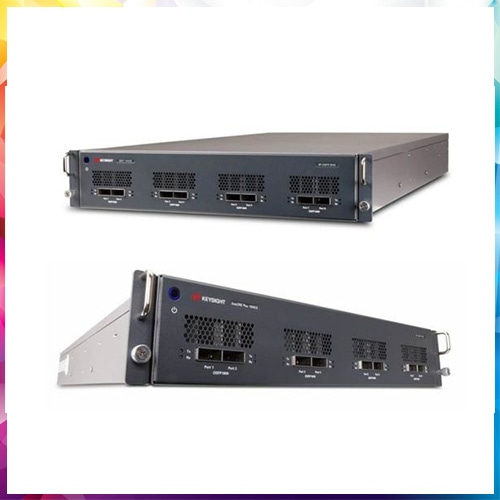
The company’s SERT 1600GE and AresONE Plus 1600GE are designed to let engineers test AI and hyperscale networks under realistic conditions, including emulated AI workloads, before the infrastructure goes into production.
Keysight Technologies has announced two new 1.6T Ethernet test platforms aimed at validating next-generation AI data center and hyperscale networks. The products are Switch and Edge Router Tester (SERT) 1600GE and AresONE Plus 1600GE.
The company says AresONE Plus 1600GE sets a new benchmark by fitting eight 1.6T Ethernet ports into a single 2U appliance, while also generating stateful, realistic AI workloads with mix-of-experts emulation. SERT 1600GE, meanwhile, targets data center switch fabric and edge router validation. Together, the two give customers a common test foundation for device qualification, routing and AI fabric validation, as well as performance, interoperability and control-plane evaluation as networks scale.
What the platforms offer
High-density switching: AresONE Plus 1600GE packs eight OSFP1600 ports into a 2U chassis and delivers 12.8T of line-rate traffic at 64 bytes. It supports 1600GE PAM4 signalling over 224G SerDes, with backward compatibility to 112G, and flexible breakout options of 1x1600GE, 2x800GE, 4x400GE or 8x200GE.
Switch and edge router testing: SERT 1600GE comes in an eight-port 2U configuration for switch fabric scale testing. Like AresONE Plus, it can be time-synchronised using Precision Time Protocol (PTP), allowing test environments to grow with larger topologies.
Protocol and control-plane validation: Both platforms support BGP, ECMP, VXLAN and SONiC validation across routing, bridging and access use cases. AresONE Plus 1600GE also provides core routing scale for control-plane testing.
Optics flexibility: Both support DAC, ACC, AEC, AOC and coherent optics in IHS and RHS form factors. AresONE Plus 1600GE can switch between an eight-port mode for data center switch qualification and a four-port mode for AI benchmarking on the same chassis, so teams can use one appliance across multiple scenarios.
AI workload emulation and the NVIDIA link
AresONE Plus 1600GE integrates with Keysight AI Data Center Builder software for mix-of-experts emulation, with support for RoCEv2, Priority Flow Control (PFC), Explicit Congestion Notification (ECN) and Ultra Ethernet Consortium (UEC) standards. This lets customers exercise network protocols and AI traffic behaviour in one environment to identify performance and congestion problems before deployment.
The company noted that the NVIDIA Spectrum-6 Ethernet Switch is laying the groundwork for next-generation AI Ethernet fabrics. Through collaboration with NVIDIA, AresONE Plus 1600GE provides a platform to stress those capabilities with 1.6T/800GE throughput, 224G SerDes, routing-scale validation and realistic AI workload emulation.
What executives said
Gilad Shainer, Senior Vice President of Networking at NVIDIA, said: “AI factories require an Ethernet fabric designed for accelerated computing, and NVIDIA Spectrum-X provides the performance, predictability and control needed to keep large-scale AI workloads running efficiently. Keysight’s validation capabilities help engineering teams emulate realistic AI traffic and test Spectrum-X-based fabrics before deployment, reducing time to market.”
Ram Periakaruppan, Vice President and General Manager, Network Test & Security Solutions at Keysight, said: “The AI era breaks the rules for hyperscale infrastructure. We have moved beyond fault-tolerant commodity scaling to highly synchronized, specialized AI clusters where every packet, link, node, and nanosecond counts. As engineering teams and operators race to upgrade AI infrastructure to 1.6T Ethernet, they need to emulate the broader AI system throughout the development process—from early design and device qualification to system-level validation and AI rack deployment. These new platforms give our customers the flexibility to test at scale while using the same test foundation across the entire design-to-deployment continuum.”