Until now, considered as the exclusive offering of the Linux community and a differentiator between Windows and Linux, High-Performance Computing platform has finally been the glittering pendant of Microsoft’s jewellery. This has not only intensified the rivalry between the two technologies, but has also opened the option for customers.
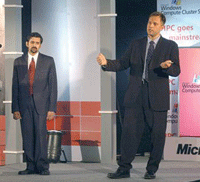
Microsoft Corporation has recently launched Windows Compute Cluster Server 2003 – the product for High-Performance Computing (HPC). The Windows Compute Cluster Server (CCS) has been designed specifically to run applications solving complex computations and is aimed at taking supercomputing to the mainstream by making it more accessible, affordable and easy to use. According to Vaibhav Phadnis, Director–– Server Business Group, Microsoft India,–“The company has identified engineering, oil & gas, academia and public sector as focus verticals, and is working with ISVs to develop applications that can run on or interoperate with Windows Compute Cluster Server 2003. These ISVs include Abaqus Inc., Ansys Inc, ESI Group, Fluent, MSC Software Corp, Schlumberger Information Systems and The Portland Group. Microsoft is also partnering with a range of OEM partners, including AMD, Dell, HP, IBM and Intel.”
“High-performance computing technology holds great potential for expanding the opportunities within engineering, medical research, exploration and other critical human endeavours that until now have been too expensive and too difficult for many people to use effectively,” said Kyril Faenov, General Manager, High Performance Computing, Microsoft Corporation. “Microsoft is making HPC technology more mainstream by bringing the cost advantages, ease-of-use and partner ecosystem of the Windows Server platform to departments and divisions in the commercial industry and the public sector. We want HPC technology to become a pervasive resource – something that is as easy to locate and use as printers are today. Microsoft is excited about the promise this holds for our customers and partners in the months and years ahead,” he further added.
Globally, Microsoft has seen Windows Compute Cluster Server 2003 used by early-adopter customers for oil and gas reservoir simulation and seismic processing, by life sciences customers for simulations of enzyme catalysis and protein folding, and by manufacturing customers for vehicle design and safety improvements. Some of Microsoft’s early adopter customers include: aQuantive, Inc., BAE Systems (UK), CASPUR (Italy), Cornell University’s Computational Biology Service Unit, National Center for Atmospheric Research, Northrop Grumman Corp., Petrobras (Brazil), Queen’s University Belfast (UK), Tokyo Institute of Technology’s Global Scientific Information and Computing Centre, University of Cincinnati’s Genome Research Institute, and Virginia Tech’s Computational Bioinformatics and Bioimaging Laboratory. Over the next few years, Microsoft will work closely with its partners and customers to bring HPC to the mainstream by taking it beyond traditional supercomputing centres, to departments and divisions in commercial organizations as well as the public sector.
“Windows Compute Cluster Server 2003 will deliver a more mainstream platform for engineers, scientists and researchers to solve scaled-out business and scientific computational problems. We are working with key ISVs and industry experts to accelerate the adoption of the Microsoft platform, and are confident of making strong inroads into this market segment that has traditionally been dominated by Unix and Linux,” adds Vaibhav Phadnis.
Windows Compute Cluster Server 2003 provides customers with a simplified deployment and management experience, easy integration with existing Windows infrastructure, and allows customers to leverage their existing development skills using Visual Studio 2005. Windows Compute Cluster Server 2003 will deliver a more mainstream platform for engineers, scientists and researchers to solve scaled-out business and scientific computational problems.
The benefits of deploying the Windows Compute Cluster Server 2003 are:
® Accelerate time-to-insight by applying computational analysis to business processes across the enterprise
® Realize a faster Return on Investment (RoI) by simplifying cluster deployment, job submission and monitoring with familiar software tools
® Use Web services integration to accept input from and deliver financial results to business processes, applications, and other value chain relationships
® Achieve seamless integration with the existing Windows-based infrastructure for identity, group policy and information rights management.