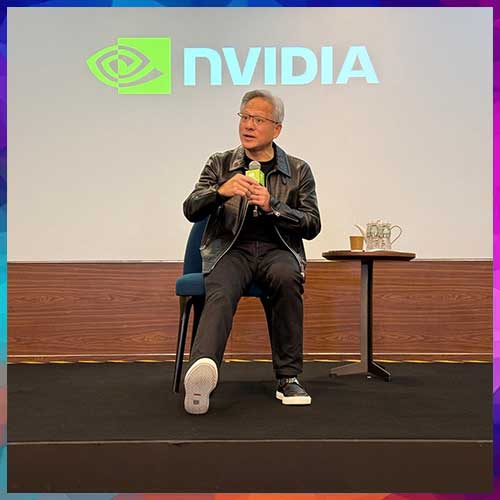
Jensen Huang is expected to outline the next phase of Nvidia’s artificial intelligence strategy at the company’s annual developer conference in San Jose, California, as the chipmaker seeks to maintain its dominance in the rapidly evolving AI market.
Huang is scheduled to deliver a keynote address at the four-day event, commonly known as Nvidia GTC, where he is expected to present the company’s roadmap for AI hardware and software to an audience of more than 18,000 attendees.
Among the announcements expected at the conference is a next-generation AI chip called “Feynman,” named after physicist Richard Feynman. The processor is likely to represent the next step in Nvidia’s AI chip lineup as demand for computing power continues to surge.
The presentation is also expected to highlight advances in AI infrastructure, including data center systems, the company’s widely used programming platform CUDA, and emerging technologies such as AI agents and robotics.
Another potential focus is the role of Groq, a startup specializing in high-performance inference computing technology. Nvidia licensed technology from Groq in a deal valued at about $17 billion in December, according to reports.
The move reflects a broader shift in the AI industry. After investing heavily in chips for training large AI models, companies including OpenAI, Anthropic and Meta Platforms are increasingly focused on inference computing—the process of running trained AI models to serve millions of users in real time.
Competition in the inference chip market is intensifying, with several technology companies developing their own custom processors to reduce dependence on external suppliers.
Despite the growing competition, Nvidia remains central to the global AI ecosystem. The company’s chips power many of the world’s largest AI data centers and national AI initiatives, including projects in countries such as Saudi Arabia.
Nvidia is also one of the few large U.S. technology firms that continues to release open-source AI software, an area increasingly viewed as part of the technological rivalry between the United States and China.
Analysts expect the announcements at the conference to signal how Nvidia intends to defend its leadership as AI adoption expands and competition in AI infrastructure intensifies.
Huang is scheduled to deliver a keynote address at the four-day event, commonly known as Nvidia GTC, where he is expected to present the company’s roadmap for AI hardware and software to an audience of more than 18,000 attendees.
Among the announcements expected at the conference is a next-generation AI chip called “Feynman,” named after physicist Richard Feynman. The processor is likely to represent the next step in Nvidia’s AI chip lineup as demand for computing power continues to surge.
The presentation is also expected to highlight advances in AI infrastructure, including data center systems, the company’s widely used programming platform CUDA, and emerging technologies such as AI agents and robotics.
Another potential focus is the role of Groq, a startup specializing in high-performance inference computing technology. Nvidia licensed technology from Groq in a deal valued at about $17 billion in December, according to reports.
The move reflects a broader shift in the AI industry. After investing heavily in chips for training large AI models, companies including OpenAI, Anthropic and Meta Platforms are increasingly focused on inference computing—the process of running trained AI models to serve millions of users in real time.
Competition in the inference chip market is intensifying, with several technology companies developing their own custom processors to reduce dependence on external suppliers.
Despite the growing competition, Nvidia remains central to the global AI ecosystem. The company’s chips power many of the world’s largest AI data centers and national AI initiatives, including projects in countries such as Saudi Arabia.
Nvidia is also one of the few large U.S. technology firms that continues to release open-source AI software, an area increasingly viewed as part of the technological rivalry between the United States and China.
Analysts expect the announcements at the conference to signal how Nvidia intends to defend its leadership as AI adoption expands and competition in AI infrastructure intensifies.