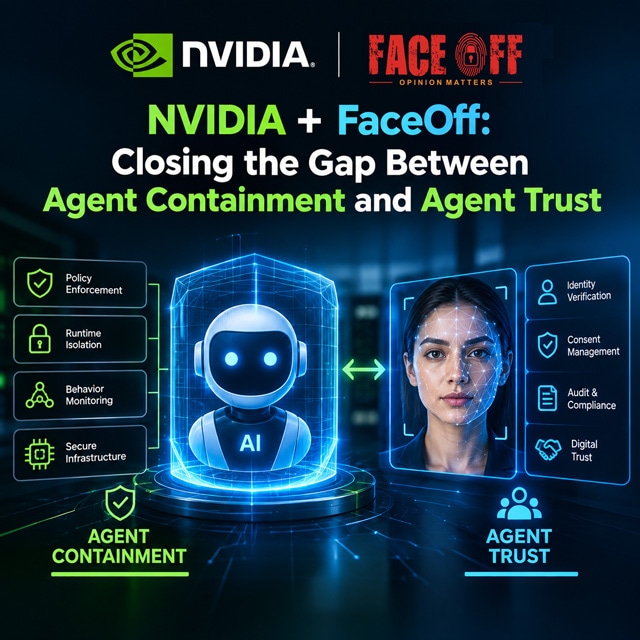
As enterprises race to deploy autonomous AI agents, a hard truth is setting in: agents cannot be trusted to police their own behavior. Nvidia's answer is its new Open Agent Safety Platform, backed by more than 100 technology, research and public-sector organizations, built around a layered approach to agent security. But containment alone doesn't answer every question a security team now has to ask, and that gap is exactly where FaceOff Technologies' identity and behavioral-trust layer becomes relevant.
Why agents break the old security model
AI agents pose a fundamentally different challenge than traditional applications. They reason, execute code, access databases, call APIs, use credentials, and communicate with other systems, sometimes operating independently for extended stretches of time without a human in the loop. That autonomy is precisely what dramatically raises the stakes when an agent is compromised, manipulated, or simply drifts off-task.
Nvidia's containment architecture
Nvidia's platform separates agent intelligence from security enforcement across three layers: application (models, tools, data), runtime (what an agent is permitted to access), and infrastructure (an additional enforcement boundary beneath it all). At the center sits NVIDIA OpenShell, an open-source secure runtime that sandboxes each agent individually, denying access to files, networks, processes, tools and credentials by default and granting only what policy explicitly allows. The second piece, NVIDIA Sentry, runs on BlueField-4 DPUs, observing agent behavior independently of the host so it can enforce policy even when the agent or the host itself can't be fully trusted.
This separation matters because prompt-level instructions and model guardrails only describe what an agent should do. Infrastructure controls determine what it actually can do, applying classic Zero Trust principles, least privilege, isolation, explicit authorization, auditability, to autonomous AI for the first time at this depth.
Where containment alone falls short
Nvidia's platform can correlate agent interactions, policy decisions, tool usage and data access into contextual activity records, which helps flag an agent drifting beyond its intended task. But this is fundamentally a containment and enforcement layer: it governs what an agent can technically do, not who or what is actually behind the interaction, and not whether the data an agent is about to move is sensitive enough to warrant a human check. That's a different problem, and it's the one FaceOff Technologies is built to solve.
How FaceOff complements the stack
FaceOff's approach adds identity and behavioral trust intelligence above Nvidia's runtime and infrastructure containment. Where OpenShell and Sentry answer "is this agent authorized to take this action," FaceOff's direction, AI-DLP plus identity-aware security plus agent governance, is built to answer a different set of questions: Is the human or system triggering this agent genuinely who they claim to be? Does this agent's behavior pattern match its established baseline, or does it look like it's been hijacked or socially engineered mid-session? Is the data this agent is about to read, generate or transmit sensitive enough that a human should approve it first?
Combined, the two layers form a more complete stack: Nvidia provides the sandboxing and enforcement boundary that stops an agent from technically exceeding its permissions, while FaceOff adds the identity verification, behavioral-trust scoring, and sensitive-data controls that catch the cases where an agent stays within its technical permissions but is still being misused, impersonated, or manipulated into acting against its intended purpose.
A new product category is forming
Nvidia's ecosystem already includes Microsoft, Cisco, CrowdStrike, Palo Alto Networks, IBM, SAP, ServiceNow, Deloitte, Accenture, Hugging Face and Scale AI, with SAP integrating OpenShell into Joule Studio and Salesforce pairing it with Slack for human-approval workflows on agent permissions. This signals the emergence of AI Agent Security and Runtime Governance as its own category, one where traditional IAM, DLP, SIEM, SOAR and application security tools will all need to extend beyond human and machine identities to account for what autonomous agents are authorized to read, generate, transmit and execute.
The combined value proposition
The industry message is clear: securing agentic AI cannot rest on making models behave safely alone. As agents gain more autonomy, enterprises need independent security boundaries around them, spanning Identity → Authorization → Isolation → Runtime Monitoring → Data Control → Audit → Containment. Nvidia's platform delivers the isolation, authorization and containment links in that chain. FaceOff's identity-aware, behavioral-trust and data-sensitivity layer is built to cover the identity, monitoring and data-control links that sit above it. Together, they point toward a full-stack answer to agentic AI risk: one where an agent is not just sandboxed from doing technical damage, but continuously verified as trustworthy in the first place.