Four small open-source robots, trained through AI agents, simulation and cloud computing, closed Jensen Huang’s Europe-focused keynote, offering a lighthearted look at how Nvidia wants developers to build machines for physical tasks.
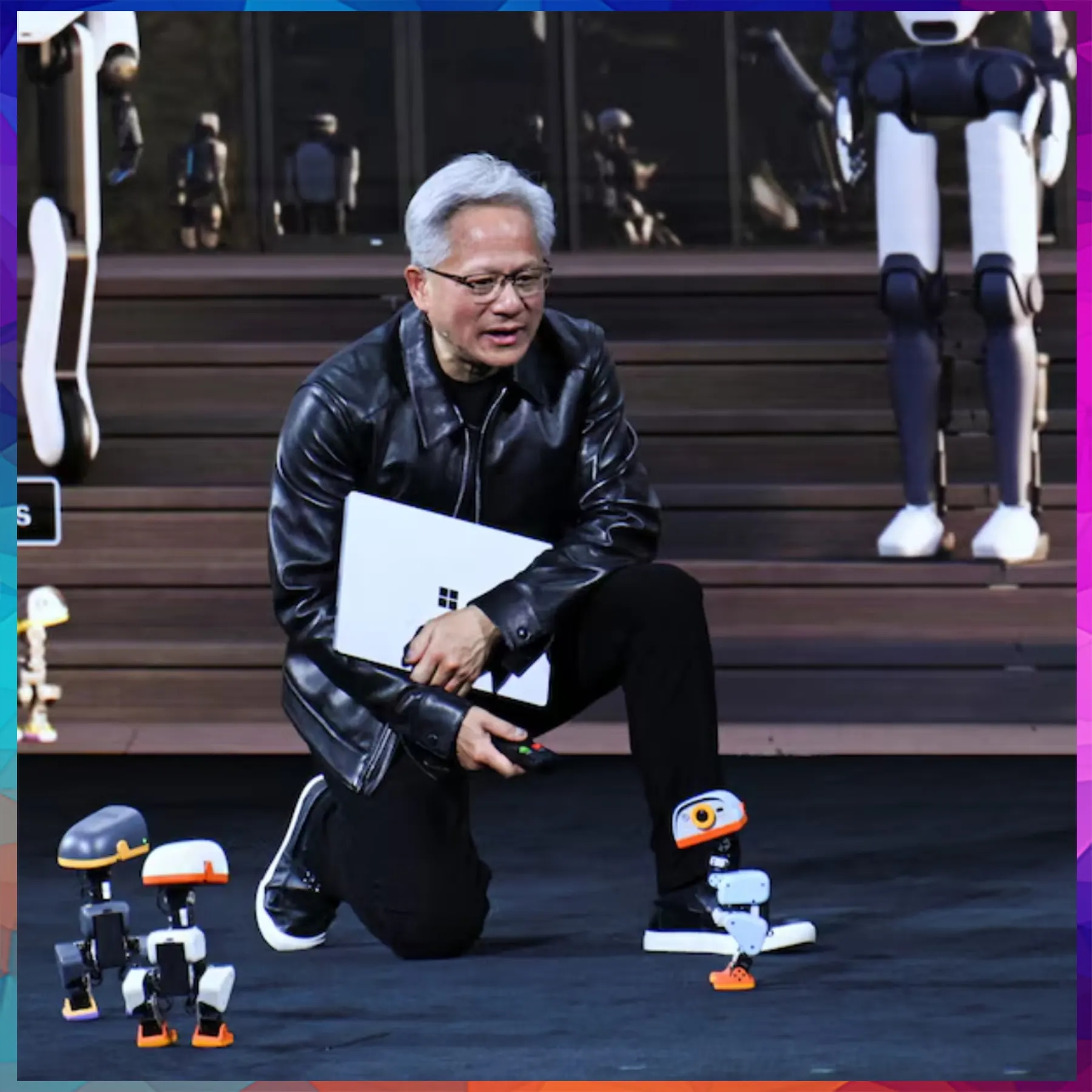
Nvidia chief executive Jensen Huang ended his keynote at the company’s GPU Technology Conference in Berlin on October 21 with a short show-and-tell: four tiny walking robots called Microducks, brought out to illustrate how AI, simulation tools and cloud computing can teach machines physical skills.
The robots gathered on stage near the close of the presentation and responded to Huang’s spoken instructions, though not entirely in unison. When he asked them to sit and then stand, they made the attempt. A later request to take a nap drew laughs: three lay down almost at once, while the fourth kept walking for a moment before joining the others.
What the Microducks are
Microduck is an open-source robotics platform meant for developers and students who want to experiment with robot behaviour, teach machines physical abilities and share their results. The robots were developed by Hugging Face and the French startup Pollen Robotics. Each stands about 10 inches tall and weighs under two pounds.
They were built using Nvidia’s Isaac Lab and Isaac Sim robotics software, along with its Newton physics engine. Such tools let developers train and test movements in virtual environments before transferring them to physical machines, which can reduce how much of the training has to be done on real hardware.
How the training worked
During the keynote, Huang played a video explaining the process. An AI agent designed a training course and tested a virtual copy of the robot in Isaac Sim. The heavy computational work was then carried out on cloud servers. Nvidia said the results were checked on an RTX Spark laptop before being loaded onto the real robots.
The company presented the sequence as an example of AI agents, simulation software and computing hardware working together to build robotic capabilities.
Huang also spoke about the RTX Spark laptops, which went on sale the previous week. He said the machines deliver up to one petaflop of computing performance and carry 128GB of memory. To underline how far hardware has come, he compared the laptop with the DGX-1 system he personally delivered to OpenAI in 2016. That machine, he noted, took two people to carry upstairs, while the RTX Spark can be held in one hand.
The robot demonstration capped a keynote devoted to Nvidia’s plans for Europe, covering AI factories, autonomous agents and physical AI. Huang closed with a message aimed at widening participation in the field, telling the audience that everybody can build agents.