
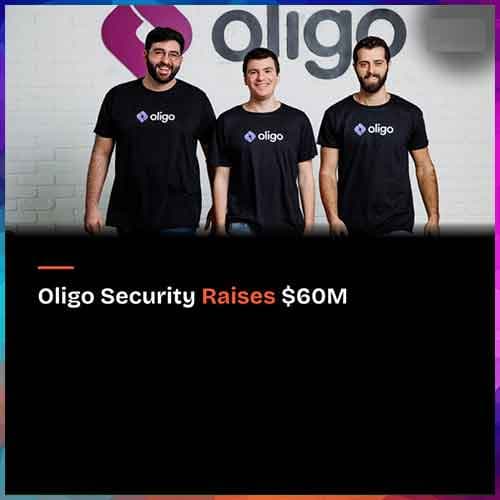
Cybersecurity startup Oligo Security has raised $60 million in fresh funding as enterprises increasingly deploy autonomous AI agents capable of accessing applications, data and critical infrastructure. The investment brings Oligo's total funding to $140 million and follows strong demand for runtime security as AI accelerates both software development and cyberattacks.
Oligo's approach focuses on protecting applications while they are actually running, rather than depending primarily on vulnerability scanning and patching. Its Runtime Exploit Blocking technology is designed to detect and stop exploitation at the application layer in real time, while its broader platform addresses cloud workloads, software supply chains and AI environments.
The expansion into agentic AI security is particularly significant. AI agents can autonomously call tools, access databases, execute code and interact with enterprise systems. Oligo aims to provide visibility across this activity—from prompts and agent tool calls down to application and system-level behavior—helping security teams understand not simply that something happened, but how an AI-driven action translated into runtime activity.
This becomes critical as attackers increasingly use AI to discover and weaponize vulnerabilities faster than traditional patching cycles can respond. Runtime protection changes the security equation by providing organizations with another defensive layer while vulnerabilities are being investigated or patched. Oligo also says virtual patching can provide organizations with larger remediation windows.
The funding could significantly strengthen Oligo's position in the emerging AI runtime-security market. The company plans to accelerate product innovation and expand its global go-to-market operations. Its selection as an AI runtime-security partner for AWS Security Hub Extended and participation in Palantir's FedStart program also point toward opportunities spanning large enterprises, cloud environments and government workloads.
The larger industry implication is clear: AI security is moving from protecting models to protecting autonomous actions. Firewalls, endpoint tools and vulnerability scanners remain essential, but agentic environments require visibility into what an AI agent is doing at runtime and the ability to stop dangerous behavior immediately.
As enterprises give agents greater autonomy, runtime security could therefore emerge as a critical control layer—connecting AI security, application security and cloud security. Oligo's $60 million investment reflects growing investor confidence that securing AI agents at machine speed will become an important part of the next generation of enterprise cybersecurity.